GEU
facilities
Level
Undergraduate
facilities
Duration
3 years after Diploma
facilities
Fee Structure
Click Here
B. Tech. in Civil Engineering for working professionals

Admission Procedure

Merit prepared on basis of the qualifying exam

Provisional Admission

All interested candidates should have passed Class XII from a recognized board of examination with Physics, Mathematics and Chemistry or equivalent or as per AICTE guidelines with not less than 55% marks either in PCM or aggregate. OR Diploma in Civil Engineering for lateral entry students.

About The Program

B.Tech in Civil Engineering with Specialization (Construction Management, GIS and RS) is an undergraduate program that focuses on the fundamentals of Civil Engineering and its various applications. It is a four-year degree program that cover diverse disciplines, including structural engineering, transportation planning, sustainable construction, and smart infrastructure.

We offer specializations in Geoinformatics, blending traditional civil engineering with geospatial technologies for roles in infrastructure, urban planning, and disaster management, and Construction Management, combining core engineering with project management, cost estimation, and resource planning for leadership in large-scale projects.

Eligibility

All interested candidates should have passed Class XII from a recognized board of examination with Physics, Mathematics and Chemistry or equivalent or as per AICTE guidelines with not less than 55% marks either in PCM or aggregate. OR Diploma in Civil Engineering for lateral entry students.

Key Highlights

Key Highlights of the B.Tech Civil Engineering Program

The B.Tech Civil Engineering program is a four-year undergraduate degree divided into eight semesters. Throughout the course, students undertake a balanced mix of core subjects, laboratory work, field training, and elective courses. The curriculum is designed to build strong analytical, technical, and practical skills essential for modern civil engineering practice.

Core Courses Include:

  • Engineering Mechanics : Fundamentals of forces, equilibrium, and structural behavior.
  • Strength of Materials : Stress–strain analysis, material behavior, and design fundamentals.
  • Fluid Mechanics :Flow analysis, hydraulic principles, and water systems design.
  • Soil Mechanics & Geotechnical Engineering : Soil properties, foundations, and geotechnical investigations.
  • Structural Analysis : Analysis of beams, frames, and structural systems.
  • Transportation Engineering : Highway design, traffic analysis, and pavement engineering.
  • Environmental Engineering : Water and wastewater treatment, pollution control, and sustainability.
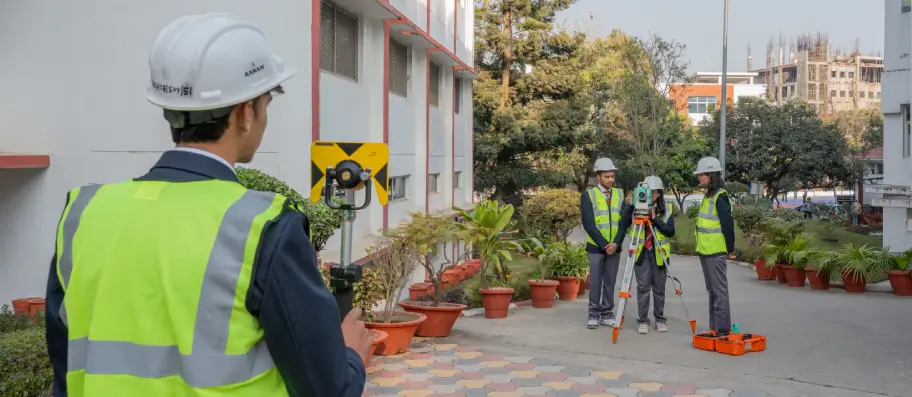
  • Surveying & Geomatics : Total station, GPS, GIS, and mapping for engineering projects.

Elective Courses May Include:

  • Solid waste management Engineering
  • Structural Health Monitoring
  • Prefabricated and modular construction
  • Emerging Technologies in Construction
  • Building Information Modeling (BIM)

Program Educational Objectives (PEOs)

PEO1

To produce graduates having ability to apply principles of Basic Sciences to the analysis, design and evaluation of infrastructural facilities.

PEO2

To inculcate the aptitude for coordinated planning, communicating, executing and managing civil engineering projects and enterprises.

PEO3

To develop an affinity for applying state-of-art methods in multi-disciplinary context for achieving sustainable solutions to contemporary civil engineering problems.

PEO4

To impart social awareness, eco-sensitiveness and ethical practices in personal and professional pursuits.

Specializations

Program Outcomes (POs)

PO1

Engineering Knowledge

Apply the knowledge of mathematics, science, engineering fundamentals, and an engineering specialization to the solution of complex engineering problems.

PO2

Problem Analysis

Identify, formulate, review research literature, and analyze complex engineering problems reaching substantiated conclusions using first principles of mathematics, natural sciences, and engineering sciences.

PO3

Design / Development of Solutions

Design solutions for complex engineering problems and design system components or processes that meet the specified needs with appropriate consideration for public health and safety, and cultural, societal, and environmental considerations.

PO4

Conduct Investigations of Complex Problems

Use research-based knowledge and research methods including design of experiments, analysis and interpretation of data, and synthesis of information to provide valid conclusions for complex problems.

PO5

Modern Tool Usage

Create, select, and apply appropriate techniques, resources, and modern engineering and IT tools including prediction and modeling to complex engineering activities with an understanding of their limitations.

PO6

The Engineer and Society

Apply reasoning informed by contextual knowledge to assess societal, health, safety, legal, and cultural issues and the consequent responsibilities relevant to professional engineering practice.

PO7

Environment and Sustainability

Understand the impact of professional engineering solutions in societal and environmental contexts, and demonstrate the knowledge of and need for sustainable development.

PO8

Ethics

Apply ethical principles and commit to professional ethics, responsibilities, and norms of engineering practice.

PO9

Individual and Team Work

Function effectively as an individual, and as a member or leader in diverse teams and in multidisciplinary settings.

PO10

Communication

Communicate effectively on complex engineering activities with the engineering community and society at large, including writing effective reports and design documentation, making presentations, and giving and receiving clear instructions.

PO11

Project Management and Finance

Demonstrate knowledge and understanding of engineering and management principles and apply these to one’s own work, as a member and leader in a team, to manage projects and work in multidisciplinary environments.

PO12

Life-long Learning

Recognize the need for, and have the preparation and ability to engage in independent and life-long learning in the broadest context of technological change.

Program Specific Outcomes (PSOs)

PSO1

Hill-region engineering: Appreciate the importance of conserving resources in hilly regions and develop sustainable models for development of hilly regions.

PSO2

Earthquake Engineering: Understand and apply the philosophy of seismic design for building safe and serviceable infrastructural facilities.

PSO3

Geographic Information Systems: Apply the principles of GIS for resource planning and management of a geographical region.

Career Prospects

With the rapid pace of infrastructure development and the growing focus on sustainable construction, B.Tech Civil Engineering graduates have extensive career opportunities across multiple sectors. A Civil Engineering graduate can work in structural engineering, geotechnical engineering, transportation engineering, environmental engineering, construction management, water resources engineering, surveying, and many other specialised domains.

B.Tech Civil Engineering graduates find roles in government organizations, public sector undertakings, private infrastructure companies, consulting firms, construction industries, urban development bodies, research institutions, and academia. The demand for skilled civil engineers remains consistently strong due to continuous growth in national infrastructure, smart cities, transportation networks, and environmental projects. The field offers competitive career prospects, professional stability, and opportunities to contribute directly to society’s development.

B.Tech Civil Engineering is a rewarding and dynamic discipline that allows graduates to build the nation’s future with innovation, precision, and engineering excellence.

Graduates of Civil Engineering have a vast range of career opportunities in sectors such as infrastructure development, urban planning, and environmental engineering. Some prominent career roles include:
  • Structural Engineer
  • Construction Project Manager
  • Geotechnical Engineer
  • Transportation Engineer
  • Environmental Consultant
  • GIS & Remote Sensing Specialist
  • Research & Development Professional
  • Government & Public Sector Engineer
Graphic Era (Deemed to be University)

Placements

Graphic Era Deemed to be University has established strong industry linkages across the construction, infrastructure, consultancy, and technology sectors, ensuring excellent placement outcomes for Civil Engineering graduates. The university’s consistent track record of securing internships and full-time positions for students reflects its commitment to industry-oriented education and practical skill development.

Civil Engineering graduates from Graphic Era have gained opportunities in reputable organizations such as Nerolac, Encardio Rite, NewGen, DXC Technologies, Reliance Jio BP, KPMG, CyberTech, Formulaic Engineers, Sterlite, Girnar Insurance Brokers, JSW, Flipkart (Internships), and Simpolo, among others. These industry connections provide students access to real-world engineering exposure, project-based learning, and career pathways across diverse domains such as construction management, geotechnical services, infrastructure development, quality testing, consultancy, and materials engineering.

Graduates from Graphic Era Deemed to be University can confidently enter the workforce equipped with hands-on training, practical insights, and comprehensive field experience gained through internships and placements with these top-tier companies—ensuring they are well-prepared for successful engineering careers.


Notes: Semester 1 and 2 are applicable only for regular entry students. Lateral entry students begin from Semester 3.

Course Curriculum

Semester 3

  • Mathematics III
  • Fluid Mechanics
  • Geomatic Engineering
  • Mechanics of Solids
  • Building Materials and Construction Equipment
  • Fluid Mechanics Laboratory
  • Geomatic Engineering Laboratory
  • Career Skills-I
  • Universal Human Value -II

Specialisation-I : Construction Management (Optional): Extra credits over above regular scheme

  • Emerging Technologies in Construction Practices (only for specialization in construction management)
  • Excel for Civil Engineers Laboratory (only for specialization in construction management)

Specialisation-II GIS and RS (or Minor from Civil Engg.) (Optional): Extra credits over above regular scheme

  • Remote Sensing and Its Techniques (only for specialization in GIS and Remote Sensing and Minor)

Semester 4

  • Hydraulics and Hydraulic Machines
  • Structural Analysis
  • Soil Mechanics
  • Concrete Technology
  • Discipline Electives-I
  • Hydraulics and Hydraulic Machines Laboratory
  • Concrete Laboratory
  • Computer Aided Civil Engineering Drawing
  • Career Skills-II
  • General Proficiency -II
  • Academic Report Writing and IPR
  • Constitution of India

Specialisation-I : Construction Management (Optional): Extra credits over above regular scheme

  • Town/Urban Planning and Management (only for specialization in construction management)

Specialisation-II GIS and RS (or Minor from Civil Engg.) (Optional): Extra credits over above regular scheme

  • Basic Geographical Information Systems (only for specialization in GIS and Remote Sensing and Minor)

Discipline Specific Elective-I

  • Municipal Solid Waste Management
  • Fundamentals of GIS
  • Case Studies in Civil Engineering
  • Swayam (Core) Offered in 4th Semester

Semester 5

  • Advance Structural Analysis
  • Reinforced Cement Concrete Design
  • Geotechnical and Foundation Engineering
  • Hydrology and Irrigation
  • Discipline Electives-II
  • Generic Elective I
  • Geotechnical Engineering Laboratory
  • Structural Analysis Laboratory
  • Mini Project (Software)
  • Career Skills-III
  • Civil Engineering Wonders and Challenges
  • Indian Knowledge System

Specialisation-I : Construction Management (Optional): Extra credits over above regular scheme

  • Building Information Modeling(only for specialization in construction management)
  • Building Information Modeling (BIM) using Autodesk Revit Laboratory (only for specialization in construction management)

Specialisation-II GIS and RS (or Minor from Civil Engg.) (Optional): Extra credits over above regular scheme

  • Advance Geographical Information systems (only for specialization in GIS and Remote Sensing and Minor)

Discipline Specific Elective-II

  • Air and Noise Pollution
  • Design of Masonry Structure
  • Advance Concrete Technology
  • Swayam (Core) Offered in 5th Semester

Semester 6

  • Water and Wastewater Engineering
  • Advance Reinforced Cement Concrete Design
  • Construction Planning and Management
  • Estimation and Costing
  • Discipline Electives-III
  • Discipline Electives-IV
  • University Open Elective* / Generic Elective-II
  • Mini Project (Survey Camp)
  • Career Skills-IV
  • General Proficiency-III
  • Rivers and Civilization

Specialisation-I : Construction Management (Optional): Extra credits over above regular scheme

  • Safety and Health in construction (only for specialization in construction management)
  • Basics of Project Management and Primavera Laboratory (only for specialization in construction management)

Specialisation-II GIS and RS (or Minor from Civil Engg.) (Optional): Extra credits over above regular scheme

  • RS & GIS for Hydrology and Water Resources (only for specialization in GIS and Remote Sensing and Minor)

Discipline Specific Elective-III

  • Finite Element Methods (FEM) in Civil Engineering
  • Geotechnical Earthquake Engineering
  • Design of Hydraulic Structures
  • Swayam (Core) Offered in 6th Semester

Discipline Specific Elective-III

  • Watershed Management
  • Pre-Stressed Concrete
  • Rock Mechanics and Foundation on Rocks
  • Swayam (Core) Offered in 7th Semester
  • Swayam (Core) Offered in 6th Semester

Semester 7

  • Highway and Airfield
  • Discipline Electives-V
  • University Open Elective* / Generic Elective-III
  • Industrial Summer Training
  • Major Project -I
  • Building Planning and Vaastu

Discipline Electives-V

University Open Elective* / Generic Elective-III

Specialisation-I : Construction Management (Optional)

  • Total Quality Management (TQM) in Construction (only for specialization in Construction Management)

Specialisation-II : GIS and RS (or Minor from Civil Engg.) (Optional)

  • Remote Sensing and GIS in Environmental Science (only for specialization in GIS and Remote Sensing and Minor)

Discipline Specific Elective-V S

  • Earthquake Resistant Design of Structures
  • Bridge Engineering
  • Tunnel Engineering
  • Swayam (Core) Offered in 7th Semester

Semester 8

  • Highway and Airfield
  • Discipline Electives-V
  • University Open Elective* / Generic Elective-III
  • Industrial Summer Training
  • Major Project -I

Specialisation-II GIS and RS (or Minor from Civil Engg.) (Optional)

  • Concepts and Applications of Geospatial Technology in Natural Resources Management (only for specialization in GIS and Remote Sensing and Minor)

List of Minor Courses Offered by department of Civil Engineering - (Sp note: Cannot be chosen by Civil Students as Minor)

  • Remote Sensing and Its Techniques
  • Basic Geographical Information Systems
  • Advance Geographical Information Systems
  • RS & GIS for Hydrology and Water Resources
  • Remote Sensing and GIS in Environmental Science
  • Concepts and Applications of Geospatial Technology in Natural Resources Management

Contact Us

GEU
GEU

566/6, Bell Road, Society Area,
Clement Town, Dehradun,
Uttarakhand