GEU
facilities
Level
Undergraduate
facilities
Duration
4 Years
facilities
Fee Structure
Click Here
B.Sc. (Hons.) Microbiology

Admission Procedure

Merit prepared on basis of the qualifying exam

Provisional Admission

Seats to be allocated based on projected scores(12th), calculated basis the candidate’s 10th percentage – only meritorious students

About The Program

The B.Sc. (Honours) Microbiology degree, designed in accordance with the National Education Policy (NEP) 2020, offers a comprehensive foundation in microbiology.

This program emphasizes a student-centric approach, integrating the Choice-Based Credit System (CBCS) and modern technology in its curriculum. The program aims to develop key competencies, including disciplinary knowledge, critical thinking, problem-solving, communication, digital proficiency, ethical awareness, and lifelong learning.

Students engage in core microbiology courses, elective courses from other disciplines, skill development courses, and extracurricular activities to ensure holistic development. This program prepares students for successful professional careers in different areas of microbiology.

Eligibility

A Bachelor’s degree in a relevant science field with a minimum aggregate score

Teaching Pedagogies

The teaching pedagogies for the B.Sc. (Honours) Microbiology program at Graphic Era (Deemed to be University) are designed to foster a student-centric, experiential, and foundational learning environment. Aligned with the National Education Policy (NEP) 2020 and Outcome-Based Education (OBE), these methods emphasize active learning, critical inquiry, and the integration of technology to develop competencies in disciplinary knowledge, problem-solving, and ethical practice. Pedagogies are tailored to the undergraduate level, focusing on skill-building from basic principles to interdisciplinary applications. Key approaches include a mix of traditional and innovative methods, ensuring holistic development through classroom, laboratory, and field-based activities.

This undergraduate program employs interactive and foundational pedagogies to build core microbiological concepts while encouraging curiosity and practical application. The focus is on scaffolding knowledge from basic principles to interdisciplinary problem-solving, with a strong emphasis on hands-on learning to prepare students for real-world challenges.

Lecture–Discussion Method
  • The lecture–discussion method forms the foundation of conceptual learning in B.Sc. Microbiology. Core theoretical topics such as microbial taxonomy, metabolism, genetics, immunology, and industrial microbiology are introduced through structured lectures.
  • Students are encouraged to ask questions during the lecture, enabling immediate clarification of complex concepts such as metabolic pathways, microbial pathogenicity, and host–microbe interactions.
  • This interactive approach enhances student engagement, improves retention of knowledge, and develops analytical skills essential for higher studies and research.
Laboratory-Based Learning
  • Laboratory-based learning is a mandatory and integral component of every core course in the B.Sc. Microbiology curriculum.
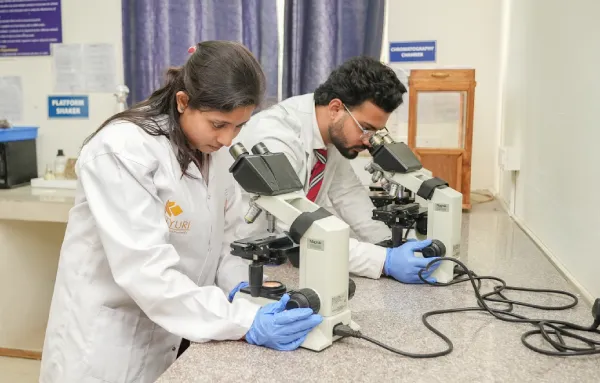
  • Regular wet-lab sessions provide hands-on training in aseptic techniques, preparation of culture media, microbial culturing, staining techniques, microscopy, and biochemical testing. Students learn proper handling, maintenance, and disposal of microbial cultures following biosafety guidelines.
  • These practical sessions help bridge the gap between theory and practice, promote skill acquisition and scientific discipline, and prepare students for careers in research laboratories, diagnostics, and the biotechnology industry.
Flipped Classroom and Blended Learning
  • The flipped classroom approach complements traditional teaching by providing students with pre-recorded video lectures, e-notes, and online modules through platforms such as Moodle or Google Classroom.
  • Students review theoretical content before class, allowing classroom time to be utilized for problem-solving exercises, group discussions, quizzes, and debates on emerging topics like antibiotic resistance, microbial biotechnology, and environmental microbiology.
  • This blended learning approach promotes self-directed learning, improves conceptual clarity, and encourages collaborative learning among students.
Project-Based Learning (PBL)
  • Project-Based Learning is implemented through short-term training programs and mini-projects related to microbiology. Students work individually or in small groups to apply theoretical knowledge to practical problems such as water quality analysis, microbial isolation from environmental samples, fermentation studies, or antimicrobial activity assays.
  • PBL enhances teamwork, research aptitude, data interpretation, and scientific writing skills, while also fostering creativity and problem-solving abilities.
  • These projects help students gain early exposure to research methodology and experimental design.
Field Visits and Experiential Learning
  • Field visits and experiential learning are incorporated to provide real-world exposure to microbial applications.
  • Mandatory excursions to diagnostic laboratories, dairy and food-processing units, wastewater treatment plants, agricultural research stations, and environmental monitoring sites allow students to observe the role of microorganisms in industry, agriculture, and pollution control.
  • These experiences help students connect classroom learning with practical applications, broaden career awareness, and enhance observational and analytical skills.
Digital Tools and Simulations
  • Students are introduced to basic data analysis tools such as Microsoft Excel and introductory bioinformatics software for sequence analysis, database searches, and interpretation of experimental data.
  • This digital exposure equips students with essential computational skills required in modern microbiology and biotechnology.
Assessment Variety
  • Student performance is evaluated through a continuous and comprehensive assessment system. This includes written quizzes, viva voce examinations, laboratory records, practical exams, project reports, presentations, and peer assessments.
  • Such varied assessment methods help evaluate not only theoretical knowledge but also practical competence, communication skills, and critical thinking.
  • Peer reviews and self-assessment encourage reflective learning and improve confidence, preparing students for academic and professional challenges
E-Learning, NPTEL/SWAYAM and MOOCs Integration
  • The B.Sc. Microbiology program integrates e-learning resources, including NPTEL and SWAYAM online courses, to promote flexible, self-paced, and outcome-oriented learning. Students are encouraged to enroll in relevant certified courses offered by premier institutions such as IITs, IISc, and central universities.
  • These courses supplement classroom teaching and laboratory training, helping students strengthen conceptual understanding and gain exposure to nationally recognized academic content.

Specializations

  • Environmental Microbiology

Program Educational Objectives (PEOs)

PEO1:

To produce students employable towards building a successful career based on sound understanding of theoretical and applied aspects as well as methodology to solve multidisciplinary real-life problems.

PEO2:

To produce professional graduates ready to work with a sense of responsibility, ethics and efficiency, both individually and also as a team.

PEO3:

To impart competency in students so that they are able to pursue higher studies and research in areas of life sciences and other professionally related fields.

Program Outcomes (POs)

PO1

Problem-solving: Students will acquire basic knowledge of principles and processes underlying Microbiology and will apply the learning to real life situations as well solve different problems in the field.

PO2

Critical thinking and creativity: Students will develop essential analytical skills and apply reasoning/thought to innovate and conduct independent work in Microbiology areas.

PO3

Research-related skills: Student will be able to appropriately use statistical and other analytical tools and techniques, to develop methodology which enable the student to problematize, synthesize, and articulate issues and design research proposals.

PO4

Team work and leadership qualities: Student will function effectively as an individual, and as a member or leader in diverse teams, and in multidisciplinary settings.

PO5

Skill development: Student will acquire knowledge and skills necessary for working independently, acquire organizational skills, and time management to set self-defined goals and targets with timeline. Student will acquire skills necessary for pursuing learning activities throughout life aimed at personal development, meeting social, economic, and cultural objectives, and adapting to changing demands of the workplace.

PO6

Modern tool usage: Student will be able to demonstrate the capability to create, select, and apply appropriate techniques, resources, and modern IT tools and software for data analysis in a variety of learning and work situations.

PO7

Multicultural competence and inclusive spirit: Student will be able to demonstrate knowledge of multiple cultural values and beliefs with perspective to respect, honour cultural diversity, gender sensitivity, adopt gender neutral approach, as well as empathy for the less advantage/ differently-abled or learning disabilities.

PO8

Value inculcation: The students will be able to demonstrate the acquisition of knowledge and attitude that are required to embrace and practice constitutional humanities, ethics, human and moral values and perform responsible global citizenship. Also, the student will acquire knowledge to understand regulatory norms, and will adopt ethical practices in the pursuit of science.

PO9

Autonomy, responsibility and accountability: The student will be able to apply knowledge, understanding or skills independently and exercise responsibility as well as accountability in applying knowledge and or skills in work.

PO10

Society, Environment and sustainability: Students will be able to demonstrate the acquisition of and ability to apply the knowledge, skills, attitude and values for mitigating the problems related to society, health, environment, food security, sustainable development.

PO11

Communication: Students will acquire oral and communication skills and will be able to ccommunicate effectively with the community and with society at large, such as, being able to comprehend and write effective reports and design documentation, make effective presentations, and give and receive clear instructions.

PO12

Community engagement and service: The student will be able to demonstrate the capability to engage in community-services/activities for promoting the wellbeing of society.
Program Specific Outcomes (PSOs)

PSO1

Students will possess basic knowledge of principles and processes involved in classification, evolution and growth of various microorganisms and acquire essential skills in handling and processing microbial cultures and strains.

PSO2

Students will be aware of both problems and benefits associated with microbes in relation to society, health, environment, agriculture and food, and possess problem solving ability.

PSO3

Students will acquire scientific temper, communication and writing skills and follow ethical and biosafety guidelines in the pursuit of science.

Career Prospects

The B.Sc. (Honours) Microbiology program includes a wide range of courses to cover the diversity of microbiology specializations. Graduates in microbiology have a wide range of career opportunities in:

Pharmaceutical Companies

Healthcare Institutions

Research Institutes

Food and Beverage Industries

Pollution Control Boards (at state and central levels)

Environmental consulting firms

NGOs working in environmental health and sanitation

Diagnostic Laboratories

Course Curriculum

Semester 1

  • Bacteriology & Mycology
  • Concepts in Microbiology
  • Multidisciplinary Course / Open Elective
  • Basics of Computer Application
  • Probiotics and Human Health
  • Disaster Management
  • Professional Communication

Semester 2

  • Inorganic & Physical Chemistry
  • Microbial Ecology
  • Multidisciplinary Course / Open Elective
  • Cell Culture Techniques
  • Environmental Science
  • Universal Human Values (UHV-II)
  • Career Skills

Semester 3

  • Organic & Analytical Chemistry
  • Cell Biology
  • Extremophiles & Adaptations
  • Multidisciplinary Course / Open Elective
  • Quality Control in Microbiology
  • Leadership and Public Speaking / Literature in Translation / Modern English Language

Semester 4

  • Biochemistry
  • Molecular Biology
  • Microbial Genetics
  • Agro-Environment Microbiology
  • Academic Writing

Semester 5

  • Microbial Physiology
  • Virology
  • Immunology
  • Bioanalytical Techniques
  • Microbes in Green Energy & Sustainable Development

Semester 6

  • Recombinant DNA Technology
  • IPR, Biosafety & Bioethics
  • Bioinformatics
  • Biostatistics and Biomathematics
  • Biocomposting & Bioremediation

Semester 7

  • Environmental Microbiology
  • Medical Microbiology
  • Research Methodology
  • Waste Water Treatment
  • From University Pool
  • Industrial Waste Management

Semester 8

Without Research

  • Food & Dairy Microbiology
  • Industrial Microbiology
  • Microbial Genomics
  • Microbiological Analysis of Air & Water
  • Aquatic Environment Microbiology

With Research

  • Food & Dairy Microbiology
  • Industrial Microbiology
  • Dissertation / Research Project

Frequently Asked Questions

Graphic Era stands out with its NAAC A+ accreditation and NIRF 2025 ranking of 48 in the University category, offering state-of-the-art labs, industry collaborations, and a research-driven curriculum aligned with NEP 2020. The department's experienced faculty and focus on hands-on training ensure high employability in pharmaceuticals, healthcare, and environmental sectors, backed by strong placement records and global exposure opportunities.

The program is 3 years (6 semesters) with 120 credits or 4 years (8 semesters) with 160 credits under NEP 2020. It includes core microbiology courses, electives, skill enhancement, and options for minors from other departments.

Applicants need to have passed Class 10+2 with Physics, Chemistry, and Biology (PCB) or equivalent, securing at least 50% aggregate marks from a recognized board. Relaxation may apply for reserved categories.

Admission is primarily merit-based on Class 12 marks, supplemented by university entrance tests like CUET-UG or GEU's own exam. Applications are submitted online via the university portal.

Check https://geu.ac.in/admissions/fee-structure/ for exact details, scholarships, and category-wise variations.

Graduates can pursue roles in pharmaceutical companies, diagnostic labs, food industries, or environmental agencies. It also prepares for higher studies like M.Sc. or competitive exams in life sciences.

Contact Us

GEU
GEU

566/6, Bell Road, Society Area,
Clement Town, Dehradun,
Uttarakhand