





GEU
facilities
Level
Postgraduate
facilities
Duration
1 Year
facilities
Fee Structure
Click Here
M.Sc Biotechnology

Admission Procedure

Merit prepared on basis of the qualifying exam

Provisional Admission

Bachelor’s degree in science with specialisation in any biological sciences. A minimum of 55% marks in aggregate must have been obtained at the undergraduate level.

About The Program

The M.Sc. Biotechnology program is a One-year postgraduate degree designed to integrate life sciences, computer science, mathematics, and statistics for the analysis and interpretation of complex biological data.

The program follows the Outcome-Based Education (OBE) framework and Choice-Based Credit System (CBCS), preparing graduates for data-driven research, industry roles, and doctoral studies in bioinformatics and computational biology.

The curriculum provides strong foundations in molecular biology, biochemistry, genomics, transcriptomics, proteomics, systems biology, and structural bioinformatics, combined with intensive training in computer programming (C, Python, R), database development, chemoinformatics, artificial intelligence, machine learning, and data visualization. Advanced courses in drug design, immunoinformatics, biodiversity informatics, genome editing, next-generation sequencing, and IoT applications ensure exposure to emerging and industry-relevant technologies. Each semester includes hands-on laboratory components that emphasize pipeline development, algorithm implementation, data analysis, and problem-solving using real biological datasets.

The program adopts student-centric, blended, and experiential learning pedagogies, including mini-projects from early semesters, internships, and continuous internal evaluation. The final semester is dedicated entirely to a 20-credit major project/dissertation, enabling students to undertake original, application-oriented research under faculty mentorship. Graduates of the program are well-prepared for careers in pharmaceuticals, healthcare, genomics, biotech start-ups, data science, academic research, and Ph.D. programs, contributing effectively to innovation, precision medicine, and sustainable development in the life-science ecosystem.
Eligibility Criteria for Admission in the Program

Bachelor’s degree in science with specialisation in any biological sciences. A minimum of 55% marks in aggregate must have been obtained at the undergraduate level.

Teaching Pedagogies

Student-Centric and Outcome-Based Learning

  • Introducing the flexible curriculum for the students, the curriculum is structured around clearly stated learning outcomes-what students are expected to be able to do upon completion of a program or course.
  • Effective teaching methods, such as learning tasks and assessment materials, to best assist students in attaining those results.
  • Emphasis on Real-world Skills aimed at training skills and competencies that can be implemented in real-life situations by students. The students learn to apply knowledge to solve problems, think critically, communicate, and work in groups.
  • Adopt constructive learning, where students build knowledge through active tasks.
  • Align teaching with Bloom’s Taxonomy (Understand → Remember → Apply Analyze → Evaluate → Create).

Blended Learning (Hybrid Mode)

  • LMS-based learning modules that enable students to learn anytime and anywhere, removing barriers of time and location, but with the possible support of in-person engagement. (Any speed, any mode, any language).
  • Blended learning provides a platform to promote greater interaction between students, as well as between students and teachers. It combines face-to-face classroom teaching with digital learning platforms like SWAYAM, NPTEL, and Virtual Labs.

Experiential and Practical-Based Learning

  • Enhancing skill: providing hands on training, workshops and industrial visits, a personalized learning and adaptable educational experience that helps in building social skills of the students
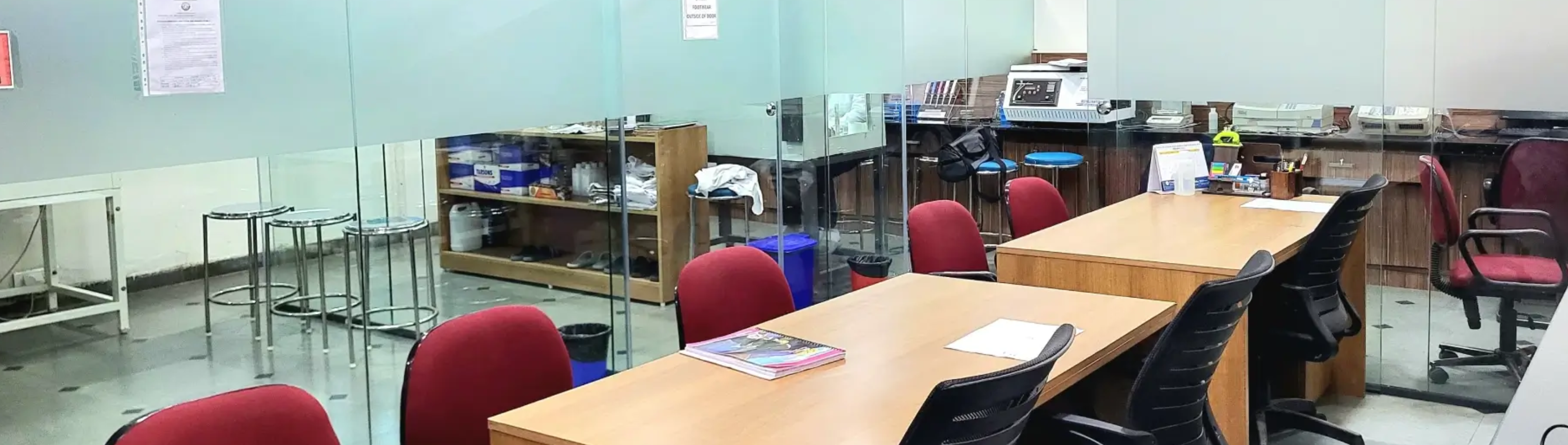
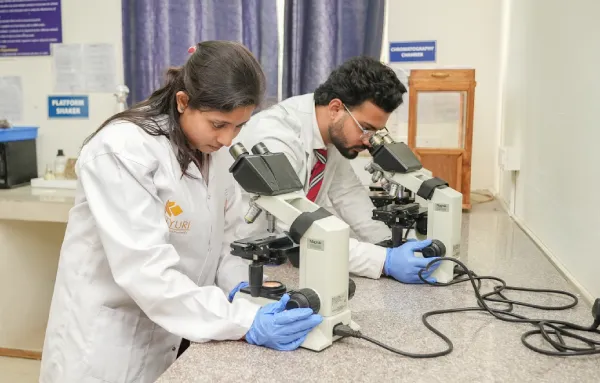
  • Encourage hands-on laboratory sessions aligned with practical casework, upgrading the experimental knowledge of students, which is a practical aspect for making knowledge more efficient.

Research-Integrated Teaching

  • The programs focus more on innovative and interdisciplinary training, capacity building, skill enhancement, and consultancy, with the main goal of contributing meaningfully to the development and economic upliftment of the local population in general and the region in particular by exposing them to various job and self-employment opportunities.
  • Introduce students to mini research projects from Semester I for upgrading the skill and interest of the students towards innovation and research.
  • Each student completes a six months’ dissertation based on original research in national level research institutes/ industry.

Continuous and Comprehensive Evaluation (CCE)

  • Continuous Internal Evaluation, Includes viva-voce, seminars, and regular lab performance to assess conceptual understanding, practical skills, and scientific communication
  • Problem-solving assignments, case analysis reports, and fieldwork presentations to evaluate analytical ability, real-world application, and professional competence
  • Peer assessments and group activities to promote teamwork, critical thinking, and participatory learning in line with holistic education approach.

Skill-Based and Vocational Training

  • Initiating SWAYAM MOOCs and skill-based courses in the curriculum to Enhance Employability and Practical Competence, Promote Application-Oriented Learning, and Build Lifelong Learning and Industry-Relevant Skills.
  • Promoting internships in government organizations and Industries as a part of vocational training, to develop job-ready Practical Skills, bridge the Gap between Education and Employment and support career Growth and Lifelong Skill development

Program Educational Objectives (PEOs)

PEO1

Understand and apply the concepts of biotechnology, microbiology and food technology, including related aspects of science and technology for pursuing higher studies, successful careers in industry and as successful entrepreneur.

PEO2

Apply the acquired practical skills and broad biotechnological training in product, process and techniques development to meet the societal demands

PEO3

Participate in individual and team based multidisciplinary project, demonstrate professional and ethical attitude with awareness on health, environment and sustainable development.

PEO4

Emerge as pioneers in research and innovations, contributing to solutions for global issues.

Program Outcomes (POs)

PO1

Students will acquire advanced knowledge of principles and processes underlying Biotechnology.

PO2

Students will develop high skills and research intelligence to conduct independent research in Life Sciences area such as Biochemistry, Microbiology and Biotechnology.

PO3

Students will understand and develop ability to solve problems related to society, health, environment, food security and sustainable development

PO4

Students will be able to understand regulatory norms, and will adopt ethical practices in the pursuit of science.

PO5

Students will be able to participate in scientific conferences, seminars and research paper writings.

Program Specific Outcomes (PSOs)

PSO1

To provide basic knowledge of principles and processes involved in growth, evolution and classification of various microorganisms, plants and animals.

PSO2

To develop the postgraduates with essential skills  in handling and processing living cells (microbes, plants and animals)

PSO3

To inculcate ability to solve problems related to society, health, environment, agriculture and food.

PSO4

To develop scientific temper, communication skill and ethical practices and biosafety guidelines in the pursuit of sciences

Career Prospects

Industry (Biotech & Pharma)
  • Pharmaceuticals
  • Agri‑Biotech
  • Biotech Start‑ups
Healthcare & Clinical Informatics
  • Clinical Bioinformatics Analyst
  • Medical Writer/Scientific Consultant
  • Health‑Tech Product Manager
Data‑Science & IT
  • Bioinformatics Engineer
  • Machine‑Learning Specialist
  • Data Scientist (Life‑Sciences)
Academic & Research
  • Junior Research Fellow / Research Assistant
  • Ph.D. Candidate
Entrepreneurship & Consulting
  • Founder/Co‑Founder
  • Scientific Consultant
Further Education & Certifications
  • MBA (Biotech Management)
  • Certified Bioinformatics Professional
  • Short Courses

Notes: Semester 1 and 2 are applicable only for regular entry students. Lateral entry students begin from Semester 3.

Contact Us

GEU
GEU

566/6, Bell Road, Society Area,
Clement Town, Dehradun,
Uttarakhand