


GEU
facilities
Level
Ph.D.
facilities
Duration
As per UGC Guidelines
Ph.D. in Chemistry

Admission Procedure

Merit prepared on basis of the qualifying exam

Provisional Admission

Candidates must hold a Master's degree (MSc) in Chemistry or allied fields from a recognized university.

About The Program

The PhD Chemistry program at Graphic Era Deemed to be University aims to train scholars for high-level international research, adhering to rigorous scientific practices and ethics. Candidates develop creative solutions to complex chemical challenges, generating societal and economic impacts in energy, health, and sustainability.

This doctoral initiative equips researchers with advanced expertise for academia, industry, and policy roles through collaborations with national and global institutions.

Spanning natural product synthesis, polymers, organic synthesis, nanomaterials, biofuels, and analytical techniques, the program aligns with UN Sustainable Development Goals, fostering interdisciplinary breakthroughs in catalysis, sensors, and green materials. Research spans basic curiosity-driven inquiries and applied innovations in energy conversion, nanotechnology, drug discovery, and environmental remediation. World-class faculty lead projects with extensive international networks, preparing graduates for leadership in CSIR labs, pharma R&D, higher education, and governmental research. The Department advances both fundamental and translational chemistry, addressing real-world needs through state-of-the-art methods in spectroscopy, computational modeling, and synthesis, ensuring versatile career readiness.


Eligibility

Candidates must hold a Master's degree (MSc) in Chemistry or allied fields from a recognized university, with a minimum 55% marks or equivalent CGPA (relaxation for reserved categories per UGC norms).

Duration

The PhD Chemistry program spans 3-5 years (minimum 3 years), structured in phases as per UGC regulations, including coursework, comprehensive exams, and thesis submission.

Teaching Pedagogies

Teaching and Research Approach

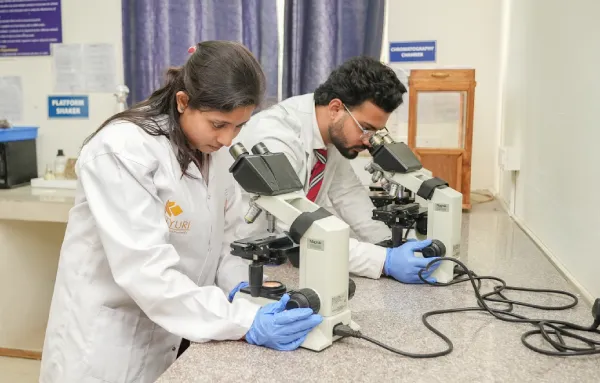
The PhD Chemistry program employs a research-centric pedagogy, integrating advanced seminars, journal clubs, and collaborative projects with rigorous mentorship. Doctoral candidates receive hands-on training in state-of-the-art facilities, with a focus on experimental design, data interpretation, and scientific communication. Computational modeling, grant writing, and ethical research practices prepare scholars for independent careers.

Specializations

  • Biofuels
  • Cellulose Chemistry
  • Environmental chemistry and sustainability
  • Organic synthesis and natural products
  • Organometallic chemistry and catalysis
  • Nanomaterials and hybrid materials
  • Nano-biomaterials and interdisciplinary applications

Program Educational Objectives (PEOs)

PEO1

To recognize intricate challenges across modern chemical domains-such as theoretical chemistry, analytical methods, organic/inorganic synthesis, bioinorganic systems, physical/biophysical processes, nanomaterials, and medicinal/natural products—and deliver innovative solutions driving economic progress, sustainable practices, and enhanced human well-being alongside ecosystem health.

PEO2

To execute pioneering, translational research under ongoing research committee oversight, adhering strictly to safety protocols and exemplary laboratory standards.

PEO3

To cultivate a scientific mindset that sharpens skills in inquiry, experimentation, hypothesis formulation, critical evaluation of research issues, and achievement of targeted outcomes.

PEO4

To refine communication, scholarly writing, ethical conduct, and active engagement in high-caliber research endeavors.

Career Opportunities

A Ph.D. in Chemistry opens diverse and rewarding career opportunities across academia, research, industry, and allied sectors. Graduates can pursue academic careers as Assistant Professors, Associate Professors, or Professors in universities and colleges, contributing to teaching, research, and curriculum development. Postdoctoral research positions in premier national and international laboratories further enhance research expertise and global exposure. In the industrial sector, Ph.D. holders are highly sought after as Research Scientists, R&D Chemists, Product Development Scientists, and Quality Control Analysts in pharmaceutical, chemical, agrochemical, polymer, petrochemical, and materials industries. Opportunities also exist in process development, regulatory affairs, intellectual property rights (IPR), and technology transfer. Overall, a Ph.D. in Chemistry equips graduates with advanced analytical, problem-solving, and research skills, enabling them to contribute significantly to scientific advancement, industrial innovation, and societal development.

Program Outcomes

Advanced Expertise

Attain in-depth and specialized knowledge in a chosen area of chemistry.

Independent Research

Design and conduct original research contributing to new scientific knowledge.

Problem Solving

Address complex chemical problems using advanced theoretical and experimental approaches.

Instrumentation Mastery

Demonstrate expertise in sophisticated analytical and research instruments.

Innovation & Critical Thinking

Develop novel methodologies, materials, or processes through critical analysis.

Scientific Communication

Publish research in peer-reviewed journals and present findings at conferences.

Ethics & Integrity

Adhere to research ethics, intellectual property rights, and professional standards.

Interdisciplinary Skills

Integrate chemistry with allied fields such as nanotechnology, biotechnology, and materials science.

Leadership & Collaboration

Lead research projects, mentor students, and work effectively in teams.

Career Excellence

Prepare for advanced careers in academia, R&D, industry, and scientific leadership roles.

Course Curriculum

  • Research & publication ethics
  • Seminar on RM presentation
  • Spectroscopic Techniques
  • Synthesis and Applications of Nanomaterials

Frequently Asked Questions

The minimum duration is 3 years, and the maximum duration is generally 6 years, as per UGC regulations.

Candidates must have a Master’s degree in Chemistry or allied subjects with the required minimum marks and or qualify for UGC-NET/CSIR-NET/GATE or equivalent examinations, as per institutional norms.

Specializations include Organic, Inorganic, Physical, Analytical, Materials, and Interdisciplinary Chemistry.

Yes, coursework is mandatory during the initial phase of the programme, followed by a comprehensive examination.

Assessment includes coursework evaluation, research progress reviews, thesis submission, and viva-voce examination.

Yes, eligible candidates may receive fellowships such as UGC-JRF, CSIR-JRF, INSPIRE, or institutional fellowships, subject to availability.

Graduates can pursue careers in academia, research organizations, R&D industries, government laboratories, and scientific consultancy.

Yes, scholars are encouraged to publish their research in peer-reviewed national and international journals.

Yes, the programme is conducted in accordance with the latest UGC guidelines.

Yes, subject to institutional policies and UGC norms, working professionals may apply under permitted categories.

Contact Us

GEU
GEU

566/6, Bell Road, Society Area,
Clement Town, Dehradun,
Uttarakhand