







GEU
facilities
Level
Undergraduate
facilities
Duration
4 Years
facilities
Fee Structure
Click Here
B. Tech in Electronics Engineering (VLSI Design and Technology)

Admission Procedure

Merit prepared on basis of the qualifying exam

Provisional Admission

Seats to be allocated based on projected scores(12th), calculated basis the candidate’s 10th percentage – only meritorious students

About The Program

The Department of Electronics and Communication Engineering (ECE) at Graphic Era (Deemed to be University), Dehradun offers a specialized undergraduate program in B.Tech Electronics Engineering (VLSI Design and Technology), designed to meet the growing demand for skilled professionals in the semiconductor and chip design industry. The program is closely aligned with national initiatives such as the India Semiconductor Mission, contributing to India’s vision of becoming a global hub for semiconductor manufacturing and design.

The curriculum provides a strong foundation in core electronics engineering, including electronic devices and circuits, signals and systems, digital electronics, and communication systems, while offering in-depth specialization in VLSI design and semiconductor technology. Key areas of focus include digital and analog VLSI design, CMOS technology, semiconductor device physics, fabrication processes, system-on-chip (SoC) design, and hardware–software co-design. Students also gain exposure to emerging fields such as AI-enabled chip design, embedded systems, and nanoelectronics.

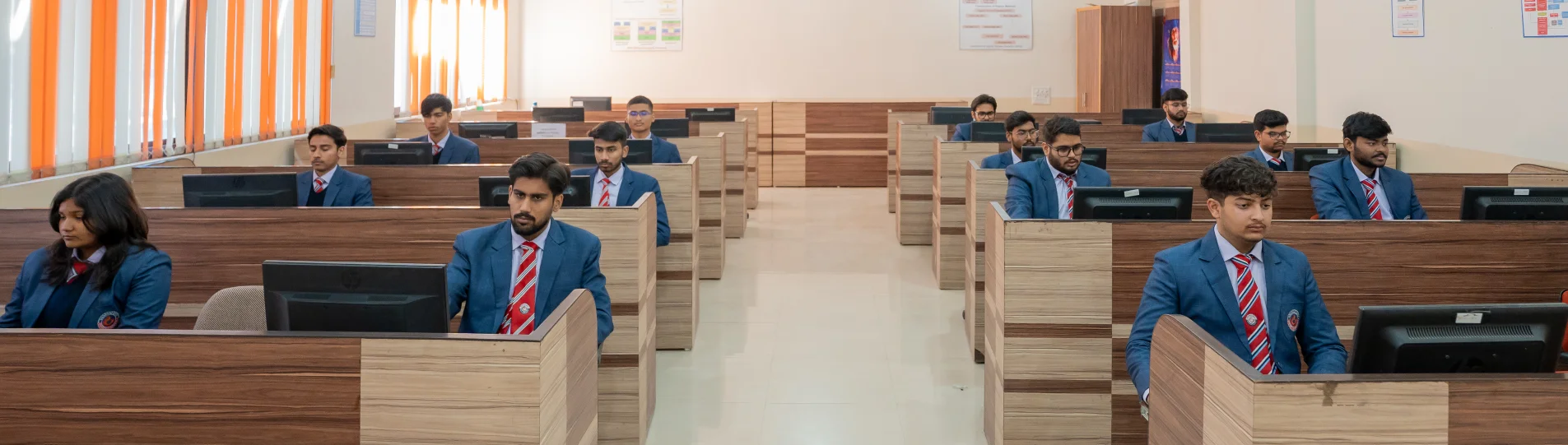
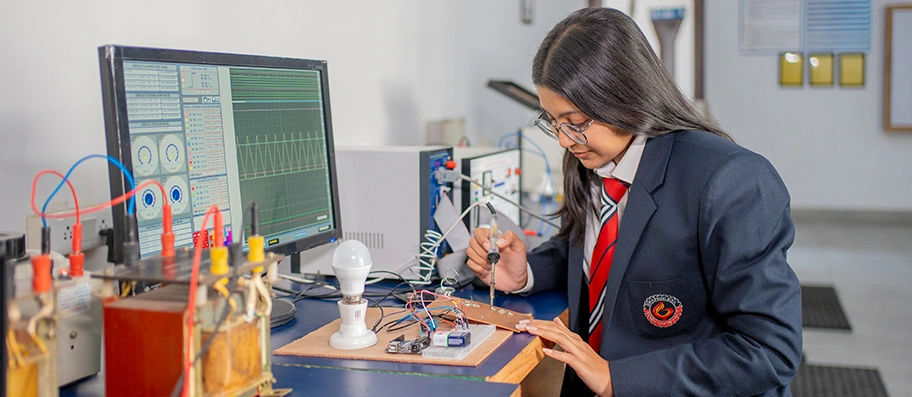
A significant emphasis is placed on hands-on learning and practical design skills. Students are trained using industry-standard EDA tools such as Cadence, Xilinx, MATLAB, and OrCAD, enabling them to design, simulate, and validate integrated circuits and systems. The program incorporates project-based learning, design challenges, and internships to ensure industry readiness.

The program is delivered by experienced and research-oriented faculty, including members recognized among the World’s Top 2% Scientists, with expertise in VLSI, nanoelectronics, semiconductor devices, embedded systems, and communication technologies. Students benefit from advanced laboratories, industry collaborations, funded research projects, and innovation-driven learning environments.

Graduates of the program are well prepared for careers in semiconductor design companies, chip fabrication industries, electronics manufacturing, embedded systems development, and high-tech sectors. They are also well equipped to pursue higher studies and research in VLSI, microelectronics, and related domains at leading institutions in India and abroad.

Eligibility

Passed 10+2 examination with Physics/Mathematics/ Chemistry/ Computer Science/ Electronics/ Information Technology/ Biology/ Informatics Practices/Biotechnology/ Technical Vocational subject / Agriculture/ Engineering Graphics/ Business Studies / Entrepreneurship. Obtained at least 45% marks (40% marks in case of candidates belonging to reserved category) in the above subjects taken together.

Provisional admission (Yes/ No)

Yes, Provisional admission may be granted to candidates who are awaiting the results of their qualifying exam, if they submit their final grade reports prior to the start of the academic year. This guarantees that worthy candidates will not be denied the chance because of delayed results.

Key Highlights

  • Specialized VLSI-Centric Curriculum
    Designed to provide in-depth knowledge of semiconductor devices, digital and analog IC design, CMOS technology, VLSI architecture, and advanced chip design workflows aligned with global semiconductor industry requirements.
  • Strong Focus on Semiconductor and Chip Design Technologies
    Including RTL design, ASIC & SoC design, physical design, verification, low-power VLSI, FPGA-based system design, and advanced semiconductor fabrication technologies.
  • State-of-the-Art VLSI and Semiconductor Laboratories
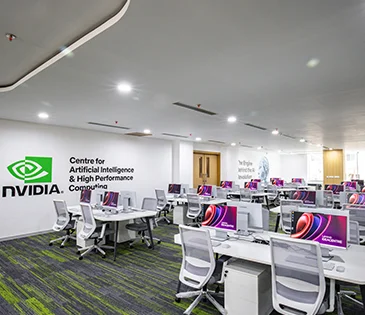
    With dedicated Cadence Virtuoso & Digital Design Labs, FPGA & HDL Labs, Device Modelling Labs, and EDA Tool Suites, providing hands-on experience with industry-standard software and hardware platforms.
  • Industry-Oriented Learning and Design Methodology
    Through design-based courses, live industry problems, case studies, internships, and collaborative projects with semiconductor and electronics companies.
  • Research-Driven Program Structure
    Encouraging innovation in chip design, device modelling, low-power electronics, and emerging nanoelectronics technologies, with opportunities for research publications, patent filing, and prototype IC development.
  • Integration of Emerging Technologies with VLSI
    Including AI/ML for hardware acceleration, neuromorphic computing, IoT hardware platforms, and advanced embedded system design.
  • Experienced Faculty and Industry Mentors
    With strong expertise in VLSI design, semiconductor devices, nanoelectronics, and electronic system design, actively involved in funded research, consultancy, and industry collaborations.
  • Hands-on Exposure to Complete Chip Design Flow
    Covering specification, RTL coding, simulation, synthesis, floorplanning, placement, routing, timing analysis, verification, and tape-out-oriented design methodology.
  • Entrepreneurship and Innovation Support in Semiconductor Domain
    Through innovation cells, startup incubation facilities, IP awareness programs, and mentorship for chip startups, fabless design ventures, and product development.
  • Interdisciplinary and Skill-Based Learning Environment
    Integrating electronics, computer architecture, materials science, and applied physics to address challenges in advanced semiconductor and VLSI technologies.
  • Active Student Participation in Technical and Professional Activities
    Through IEEE, VLSI forums, chip design competitions, hackathons, workshops, and national/international conferences.
  • Strong Career and Higher Education Pathways
    Preparing graduates for roles in VLSI design, ASIC/SoC engineering, FPGA design, semiconductor manufacturing, R&D, higher studies (M.Tech/MS/Ph.D.), and entrepreneurship in the global semiconductor ecosystem.

Teaching Pedagogies

  • Outcome-Based Education (OBE)

    A structured teaching–learning framework with clearly defined Course Outcomes (COs) aligned with Program Outcomes (POs), Program Specific Outcomes (PSOs), graduate attributes, and current industry requirements in VLSI design, semiconductor technology, and chip development.

  • Project-Based Learning (PBL)

    Integration of hands-on mini-projects and comprehensive capstone projects focusing on digital and analog VLSI design, RTL coding, ASIC/SoC design flow, FPGA-based implementations, and physical design to strengthen design thinking, innovation, and real-world problem-solving skills.

  • Laboratory-Centric Instruction

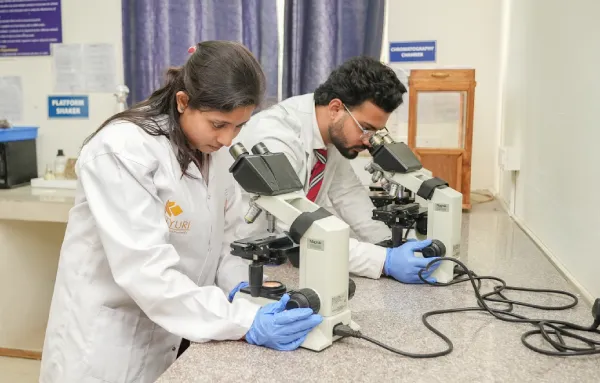
    Extensive practical exposure through advanced laboratories in VLSI Design, Digital IC Design, Analog and Mixed-Signal Circuits, FPGA and ASIC Design, CMOS Technology, Semiconductor Devices, and EDA Tools, enabling experiential and skill-oriented learning.

  • ICT-Enabled Learning

    Effective use of modern digital teaching tools and industry-standard EDA platforms such as Cadence, Synopsys, Xilinx/Vivado, ModelSim, MATLAB, Multisim, Learning Management Systems (LMS), NPTEL/SWAYAM resources, and virtual VLSI labs for design, simulation, and verification.

  • Industry Engagement

    Regular guest lectures by semiconductor industry experts, industrial visits, workshops, certification programs, internships, and collaborative training initiatives to provide exposure to contemporary VLSI technologies, fabrication processes, and industry-standard design practices.

  • Research and Innovation Culture

    Active encouragement for student participation in IEEE/ISTE student chapters, VLSI design contests, hackathons, innovation challenges, IPR awareness programs, and funded research projects to foster research aptitude, innovation, and entrepreneurial thinking.

  • Collaborative and Active Learning

    Promotion of teamwork and peer learning through group design projects, technical seminars, paper presentations, design reviews, discussions, and collaborative problem-solving sessions to enhance communication skills, professional ethics, and teamwork abilities.

Program Educational Objectives (PEOs)

PEO1

Engineering Graduates will excel in Microelectronics and VLSI Design & Technology field both in the industry and academics by analyzing and applying their knowledge in a professional manner to create, develop, and execute creative solutions to real world challenges.

PEO2

Engineering Graduates will be able to demonstrate design and skills to analyze, interpret and create solutions to the real-life VLSI chip and testing problems to showcase their leadership, collaboration, and design abilities to thrive in fields in semiconductor chips.

PEO3

Graduates will embrace capability to expand horizons beyond engineering for creativity, innovation and entrepreneurship in multidisciplinary fields by engaging in lifelong learning and professional growth.

PEO4

Imbibe competence and ethics for social and environmental sustainability with a focus on the welfare of humankind and will exhibit a sense of social responsibility through their work that advances technology and society

Program Outcomes (POs)

PO1

Engineering knowledge

Acquire in-depth knowledge in the field of VLSI Design with an ability to evaluate and analyse the existing knowledge for enhancement.

PO2

Problem analysis

Analyse critical complex engineering problems and provide solutions through research.

PO3

Design/development of solutions

Design solutions for complex engineering problems and design system components or processes that meet the specified needs with appropriate consideration for the public health and safety, and the cultural, societal, and environmental considerations.

PO4

Conduct Investigations of Complex Problems

Use research-based knowledge and research methods including design of experiments, analysis and interpretation of data, and synthesis of the information to provide valid conclusions for complex problems.

PO5

Modern Tool Usage

Create, select, and apply appropriate techniques, resources, and modern engineering and IT tools including prediction and modeling to complex engineering activities with an understanding of the limitations.

PO6

The engineer and society

Apply reasoning informed by the contextual knowledge to assess societal, health, safety, legal and cultural issues and the consequent responsibilities relevant to the professional engineering practice.

PO7

Environment and Sustainability

Understand the impact of the professional engineering solutions in societal and environmental contexts, and demonstrate the knowledge of, and need for sustainable development.

PO8

Ethics

Apply ethical principles and commit to professional ethics and responsibilities and norms of the engineering practice.

PO9

Individual and Team Work

Function effectively as an individual, and as a member or leader in diverse teams, and in multidisciplinary settings.

PO10

Communication

Communicate effectively on complex engineering activities with the engineering community and with society at large, such as, being able to comprehend and write effective reports and design documentation, make effective presentations, and give and receive clear instructions.

PO11

Project management and finance

Demonstrate knowledge and understanding of the engineering and management principles and apply these to one’s own work, as a member and leader in a team, to manage projects and in multidisciplinary environments.

PO12

Life-long learning

Recognize the need for and have the preparation and ability to engage in independent and life-long learning in the broadest context of technological change.

Program Specific Outcomes(PSOs)

PSO1

Abilty to design, simulate, optimize and analyse to develop solutions of problems in the area of microelectronics chip fabrications and VLSI Technologies.

PSO2

Capable to gain knowledge of semiconductor fabrication processes and applying testing and verification methodologies to ensure reliability of VLSI chips.

PSO3

Ability to make use of integrated VLSI systems into embedded platforms and apply them to real-world problems for successful career, contribution to research and entrepreneurship

Career Prospects

The field of Very-Large-Scale Integration (VLSI) is at the heart of semiconductor and chip design, making it a critical area for the tech industry. With increasing demand for compact, efficient, and high-performance electronic devices, the VLSI domain offers lucrative opportunities in microchip design, FPGA programming, and ASIC development. As industries transition to advanced nanotechnology and 3D IC design, professionals specializing in VLSI will play pivotal roles in creating the next generation of processors and memory solutions. Companies like Intel, AMD, Qualcomm, and Texas Instruments are actively seeking talent in this field. Moreover, the global push towards self-reliance in semiconductor manufacturing, fuelled by geopolitical shifts, further boosts career prospects in VLSI design and technology.

Graphic Era (Deemed to be University)

Placements

Graphic Era Deemed to be University has a strong connection to various industries, and its track record for successfully placing students in reputable positions is outstanding, with graduates being placed in internships and permanent roles. The university has formed valuable relationships with globally recognized companies such as Amazon, Microsoft, Google, Walmart, Adobe, and many more, providing students with ample opportunities to kick-start their careers.

Graduates from Graphic Era Deemed to be University can be confident in their ability to succeed in the workforce due to the exceptional training and real-world experience they gain from their internships and placements with these top-tier companies.

Notes: Semester 1 and 2 are applicable only for regular entry students. Lateral entry students begin from Semester 3.

Course Curriculum

Semester 1

  • Professional Communication
  • Engineering Physics
  • Engineering Mathematics-I
  • Basic Electrical Engineering
  • Fundamental of Computer & Introduction to Programming
  • Design Thinking
  • Electrical Engineering Lab
  • Physics Lab
  • Workshop And Manufacturing Practices
  • Computer Lab-I
  • Healthy Living & Fitness

Semester 2

  • Advanced Professional Communication
  • Engineering Chemistry
  • Engineering Mathematics- II
  • Programming for problem solving
  • Basic Electronics Engineering
  • Chemistry Lab
  • Engineering Graphics and Design Lab
  • Computer Lab - II
  • Basic Electronics Engineering Lab
  • Basic Civil Engg Lab
  • Environmental Science

Semester 3

  • Electronic Devices and Circuits
  • Digital Electronics
  • Networks Analysis and Synthesis
  • Signals Processing
  • Universal Human Value - II
  • Probability and Random Processes
  • Career Skills
  • Electronics Circuit Lab
  • Digital Electronics Lab
  • Signal Processing Lab

Discipline Specific Elective-I

  • Electronics Engineering Materials
  • Electronic Instrumentation
  • The Joy of Computing using Python (Through Swayam)
  • Introduction to Internet of Things (Through Swayam)

Semester 4

  • Introduction to Microfabrication
  • Analog Integrated Circuits
  • Microprocessor and its Applications
  • Computer and Processor Architecture
  • Data Structures with C
  • Career Skills
  • Analog Integrated Circuits Lab
  • Microprocessor Lab
  • Data Structures Lab
  • Constitution of India

Discipline Specific Elective-II

  • Physics of Solid State Devices
  • Basics of Nanotechnology
  • Fundamentals of semiconductor devices (Through Swayam)
  • Introduction to Artificial Intelligence

Semester 5

  • Electronic Systems Design
  • VLSI Design
  • Microcontroller and Embedded Systems
  • Analog and Digital Communication
  • Career Skills
  • Electronic Systems Design Lab
  • CAD of VLSI Design Lab
  • Microcontroller & Embedded Lab
  • Indian knowledge System

DisciplineSpecific Elective-III

  • Silicon On Chip Design (SOC)
  • PCB and System Design
  • Electronics system Packaging
  • Control Systems (Through Swayam)
  • Deep Learning (Through Swayam)

Semester 6

  • Design of Analog CMOS Circuit
  • Memory Design and Testing
  • VLSI Testing
  • Object Oriented Programming with C++
  • Career Skills
  • VLSI Testing Lab
  • Mini Project
  • OOPs with C++ Lab

Discipline Specific Elective-IV

  • VLSI Digital Signal Processing
  • Digital VLSI Circuit Design
  • RF Microelectronics Devices
  • Computer Integrated Manufacturing (Through Swayam)
  • Fuzzy Sets, Logic and Systems & Applications (Through Swayam)

Semester 7

  • Analog and Mixed IC Design
  • University OpenElective /Generic Elective I
  • Seminar on Industrial Training
  • Project Phase I

Discipline Specific Elective-V

  • Semiconductor Materials Synthesis and Characterization
  • Microsensors and Nanosensors (Through Swayam)
  • Heterojunction Device Physics
  • C-Based VLSI Design (Through Swayam)
  • Semiconductor Device Modelling
  • ASIC and FPGA Design
  • Low power VLSI
  • Organic Electronics
  • VLSI Design Flow: RTL to GDS (Through Swayam)
  • Phase-Locked Loops (Through Swayam)
  • Computer Vision (Through Swayam)

Semester 8

  • Disaster Management
  • University Open Elective /Generic Elective II
  • Project Phase-II

Discipline Specific Elective-VI

  • Semiconductor Optoelectronics
  • Testing and Testability
  • Design and Analysis of VLSI Subsystems (Through Swayam)
  • Semiconductor Equipment Design and Technology
  • VLSI Verification and Testing

Discipline Specific Elective-VII

  • Digital IC Design (Through Swayam)
  • CAD for IC Design
  • VLSI Physical Design (Through Swayam)
  • Optimization Methods in Machine Learning
  • Sensors and Actuators (Through Swayam)

Contact Us

GEU
GEU

566/6, Bell Road, Society Area,
Clement Town, Dehradun,
Uttarakhand