







GEU
facilities
Level
Undergraduate
facilities
Duration
4 Years
facilities
Fee Structure
Click Here
B.Tech Computer Science and Engineering (Hons.) with specialization in - Artificial Intelligence and Data Science/ Artificial Intelligence and Machine Learning/ Cybersecurity

Admission Procedure

Merit prepared on basis of the qualifying exam

Provisional Admission

Seats to be allocated based on projected scores(12th), calculated basis the candidate’s 10th percentage – only meritorious students

About The Program

B.Tech Computer Science and Engineering (Honors) with specialization in - Artificial Intelligence and Data Science/ Artificial Intelligence and Machine Learning/ Cybersecurity is a four-year undergraduate program designed to equip students with strong foundations in computing, engineering principles, and emerging digital technologies.

The curriculum covers core areas such as programming, data structures, algorithms, operating systems, database management systems, computer networks, and software engineering, along with advanced domains including artificial intelligence, machine learning, data science, cybersecurity, cloud computing, the Internet of Things, big data analytics, blockchain, and generative AI.

Flexible specialization options enable students to tailor their learning in line with industry trends and career aspirations.

The program emphasizes experiential and outcome-based learning through project-based learning, hands-on laboratories, industry-oriented electives, internships, and capstone projects.

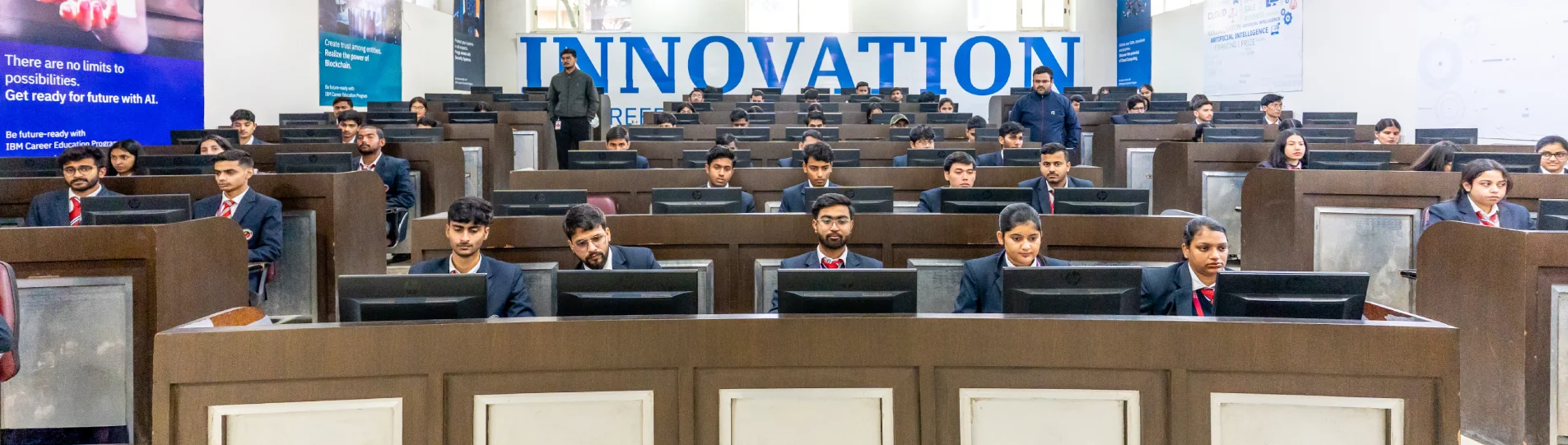
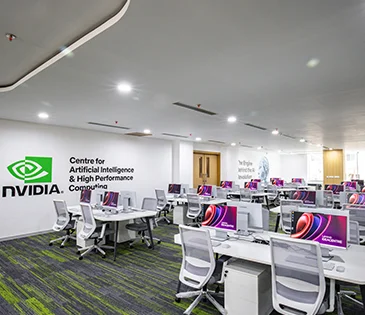
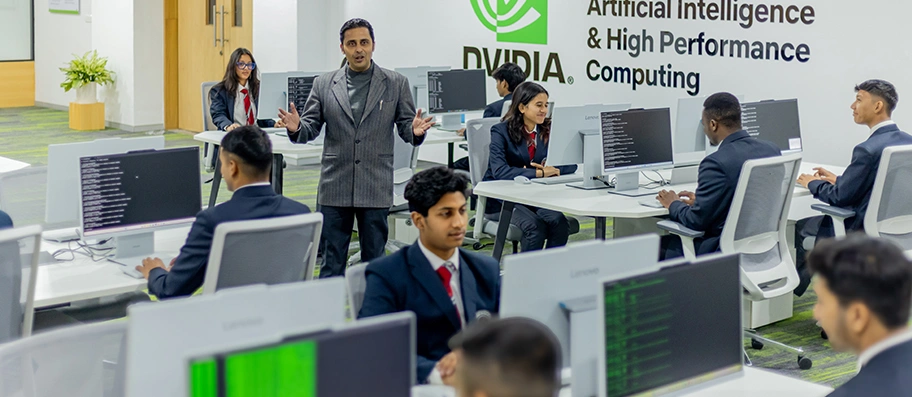
Students gain practical exposure through state-of-the-art Centres of Excellence, including the AWS Skill Builder University Campus and the nation’s first Future Ready GenAI Campus for advanced learning in cloud computing and generative AI; the Centre for Artificial Intelligence & High-Performance Computing, established in collaboration with NVIDIA, supporting innovation in AI, deep learning, and high-performance computing; and the iOS Development Center, powered by Apple and Infosys, enabling application development for the Apple ecosystem. Students are encouraged to participate in coding competitions, hackathons, research activities, and professional skill development initiatives to enhance problem-solving, analytical thinking, and innovation.

Graduates of the program are well prepared for diverse career opportunities, entrepreneurship, and higher studies in rapidly evolving technological domains.
Eligibility

10+2 with Physics, Mathematics, and Chemistry/Computer Science as core subjects with regional criteria or quotas as applicable. Minimum qualifying percentage in board exams (typically 60-75%). Valid scores in national/state-level entrance exams like JEE Main (or equivalent).

Teaching Pedagogies

The department adopts innovative, student-centric teaching pedagogies designed to enhance conceptual understanding, practical proficiency, and industry readiness. Our approach integrates modern educational practices with advanced technological tools to create an engaging and outcome-driven learning environment. Key pedagogical practices include:

  • Outcome-Based Education (OBE)

    All courses are structured around clearly defined learning outcomes to ensure measurable academic and professional growth.

  • Experiential & Hands-On Learning

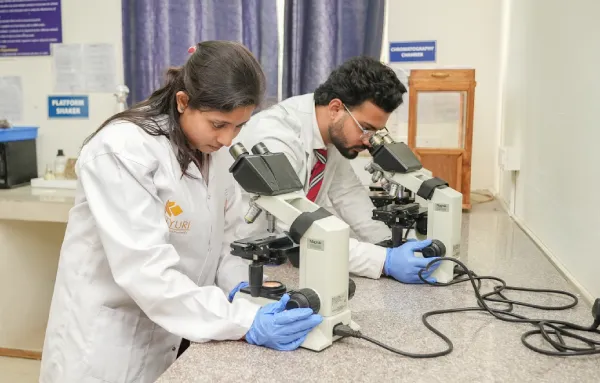
    Emphasis on laboratory work, real-time projects, coding sessions, and technical workshops to strengthen practical understanding.

  • Project-Based & Problem-Based Learning

    Students work on industry-relevant problems, case studies, mini-projects, and capstone projects to develop analytical and solution-oriented skills.

  • Flipped Classroom & Blended Learning

    Classroom time is optimized through pre-class digital content, interactive discussions, and collaborative problem-solving activities.

  • Industry-Academia Engagement

    Regular expert lectures, masterclasses, internships, and certifications through collaborations with leading MNCs enhance industry exposure.

  • Use of Modern ICT Tools

    Smart classrooms, LMS platforms, virtual labs, simulation tools, and coding environments support interactive and technology-driven learning.

  • Continuous Assessment & Feedback

    Frequent quizzes, assignments, reviews, presentations, and peer evaluations help monitor progress and encourage continuous improvement.

  • Skill Development & Holistic Learning

    Focus on communication skills, teamwork, professional ethics, and lifelong learning to prepare students for global professional environments.

Program Educational Objectives (PEOs)

PEO1

To produce students employable towards building a successful career based on sound understanding of theoretical and applied aspects as well as methodology to solve multidisciplinary real-life problems.

PEO2

To produce professional graduates ready to work with a sense of responsibility, ethics and enabling them to work efficiently individually and also as a team.

PEO3

To impart the competency in students so that they are able to pursue higher studies and research in areas of engineering and other professionally related fields.

PEO4

To inculcate ability to adapt to the changing technology through continuous learning.

Program Outcomes (POs)

PO1

Engineering Knowledge

Apply knowledge of mathematics, natural science, computing, engineering fundamentals and an engineering specialization to develop to the solution of complex engineering problems.

PO2

Problem Analysis

Identify, formulate, review research literature and analyze complex engineering problems reaching substantiated conclusions with consideration for sustainable development.

PO3

Design/Development of Solutions

Design creative solutions for complex engineering problems and design/develop systems/components/processes to meet identified needs with consideration for the public health and safety, whole-life cost, net zero carbon, culture, society and environment as required.

PO4

Conduct Investigations of Complex Problems

Conduct investigations of complex engineering problems using research-based knowledge including design of experiments, modelling, analysis & interpretation of data to provide valid conclusions.

PO5

Engineering Tool Usage

Create, select and apply appropriate techniques, resources and modern engineering & IT tools, including prediction and modelling recognizing their limitations to solve complex engineering problems.

PO6

The Engineer and the World

Analyze and evaluate societal and environmental aspects while solving complex engineering problems for its impact on sustainability with reference to economy, health, safety, legal framework, culture and environment.

PO7

Ethics

Apply ethical principles and commit to professional ethics, human values, diversity and inclusion; adhere to national & international laws.

PO8

Individual and Collaborative Team Work

Function effectively as an individual, and as a member or leader in diverse/multi-disciplinary teams.

PO9

Communication

Communicate effectively and inclusively within the engineering community and society at large, such as being able to comprehend and write effective reports and design documentation, make effective presentations considering cultural, language, and learning differences.

PO10

Project Management and Finance

Apply knowledge and understanding of engineering management principles and economic decision-making and apply these to one’s own work, as a member and leader in a team, and to manage projects and in multidisciplinary environments.

PO11

Life-long Learning

Recognize the need for, and have the preparation and ability for

  • Independent and life-long learning
  • Adaptability to new and emerging technologies and
  • Critical thinking in the broadest context of technological change.

Program Specific Outcomes(PSOs)

PSO1

Ability to analyze, design, implement, and test software systems based on requirement specifications and development methodologies of software systems.

PSO2

Apply computer science theory blended with engineering mathematics to solve computational tasks and model real world problems using appropriate programming language, data structure, and algorithms.

PSO3

Ability to explore technological advancements in various domains, evaluate its merits and identify research gaps to provide solution to new ideas and innovations.

Career Prospects

With the rapid growth of technology and the digital world, B.Tech CSE graduates have a wide range of career opportunities in various sectors. As a B.Tech CSE graduate, one can work in software development, web development, mobile application development, data analytics, cybersecurity, artificial intelligence, machine learning, and many other domains.

B.Tech CSE graduates can work in government organizations, private companies, start-ups, research labs, and academia. The demand for B.Tech CSE graduates is consistently high, and the industry offers competitive salaries and excellent growth prospects. B.Tech CSE is an exciting and dynamic field with endless possibilities for those who have a passion for technology and innovation.

They have various career opportunities as:

Software Engineers

System Analysts

Software Developers

System Scientists

System Engineers

Database Administrator

Network Engineer

Cybersecurity Analyst

Data Scientist

Cloud Engineer / Cloud Architect

AI / Machine Learning Engineer

DevOps Engineer

Blockchain Developer

Big Data Engineer

Graphic Era (Deemed to be University)

Placements

Graphic Era Deemed to be University has a strong connection to various industries, and its track record for successfully placing students in reputable positions is outstanding, with graduates being placed in internships and permanent roles. The university has formed valuable relationships with globally recognized companies such as Amazon, Microsoft, Google, Walmart, Adobe, and many more, providing students with ample opportunities to kick-start their careers.

Graduates from Graphic Era Deemed to be University can be confident in their ability to succeed in the workforce due to the exceptional training and real-world experience they gain from their internships and placements with these top-tier companies.

Notes: Semester 1 and 2 are applicable only for regular entry students. Lateral entry students begin from Semester 3.

Contact Us

GEU
GEU

566/6, Bell Road, Society Area,
Clement Town, Dehradun,
Uttarakhand