Merit prepared on basis of the qualifying exam
Undergraduate degree from a recognized university
The Department of Environmental Science at Graphic Era (Deemed to be University) offers postgraduate program with a strong focus on environmental research, sustainability, and interdisciplinary learning.
The department emphasizes academic excellence, hands-on research opportunities, and real-world applications to address today’s complex environmental challenges. Students are trained through a dynamic curriculum supported by experienced faculty and modern laboratory infrastructure.
Undergraduate degree from a recognized university with minimum 55% marks in B.Sc.
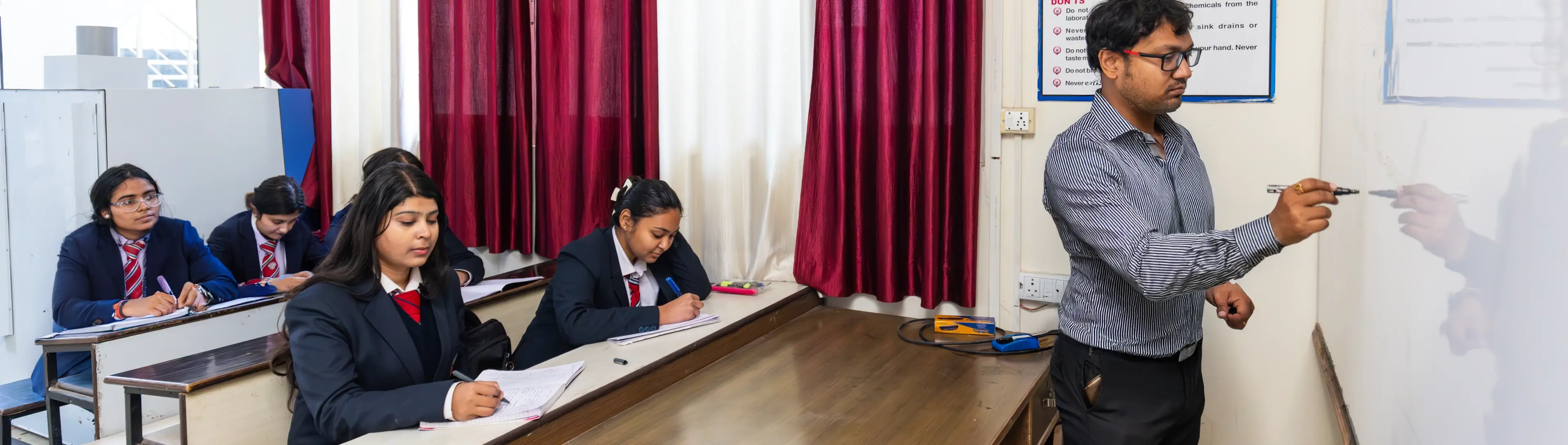
The Department of Environmental Science adopts a holistic teaching–learning approach that integrates theory, practical skills, field exposure, and research to prepare students for real-world environmental challenges.The department follows a combination of:
Apply core concepts and methods from ecological and natural sciences to identify and solve environmental problems.
Examine complex environmental issues using a problem-oriented and interdisciplinary approach.
Analyze the ethical, cross-cultural, and historical contexts of environmental issues and their links between human and natural systems and evaluate solutions across local, regional, and global scales.
Design and apply systems concepts and methodologies to analyze interactions between socio-economic and environmental processes.
Build proficiency in quantitative methods, qualitative analysis, critical thinking, and effective written and oral communication for high-level interdisciplinary academic and professional work
Demonstrate ethical leadership, communication, and teamwork, pursuing lifelong learning to advance in careers in industry, government, or research.
To apply fundamental knowledge of Environmental Science to the solution of complex environmental problems.
To evaluate the ethical, cross-cultural and historical context of environmental issues and the links between human society and environment.
To build knowledge about various natural resources and their management for sustainable development.
To classify and understand various types of pollution and devising methods of solid waste management.
To adapt the concept of remote sensing, GIS, environmental biotechnology and environmental microbiology for analysis and reclamation of the degraded environment.
To examine core concepts and methods from economic, political, social and cultural aspects as they pertain to the design and evaluation of environmental policies and institutions.
To relate various laws and assessment processes to protect the natural environment.
To discuss critically about the roles and identity as stakeholders and environmental actors in a complex, interconnected world.
Apply scientific knowledge to identify, analyse, and solve environmental problems related to water, air, soil, and waste management.
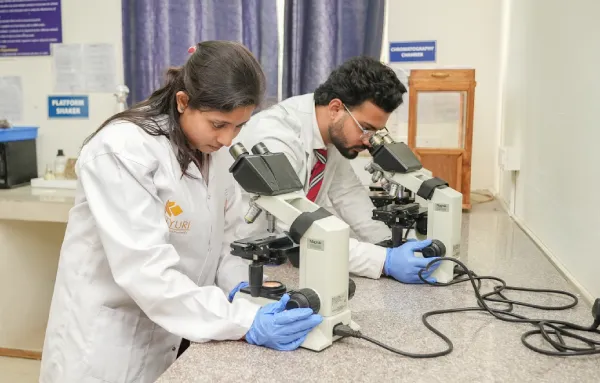
Perform laboratory and field-based environmental monitoring, including water and soil quality analysis, pollution assessment, and ecological surveys.
Design and evaluate sustainable solutions using modern approaches such as bioremediation, wastewater treatment, bioenergy production, and nature-based technologies.
Conduct independent research, analyse environmental data, and prepare scientific reports, project dissertations, and research publications.
Demonstrate understanding of environmental policies, laws, and impact assessment procedures for effective environmental planning and management.
Develop professional, ethical, and communication skills required for careers in research, industry, government services, and higher education.
Post Graduates and Ph.D. of the Environmental Science program can pursue careers in :
Notes: Semester 1 and 2 are applicable only for regular entry students. Lateral entry students begin from Semester 3.
Graduates of the Environmental Science program can pursue careers in:
Students also receive placement support through the university’s active placement cell and gain exposure through internships, site visits, and live projects. Some students have also secured international doctoral admissions and qualified UGC NET/JRF.
M.Sc. students participate in:
Students also get opportunities to present research in national and international conferences and some progress to Ph.D. programs in India and abroad.
Students can expect to develop strong analytical and problem-solving skills related to environmental issues. They gain practical skills in environmental monitoring, data collection, laboratory analysis, fieldwork techniques, research methodology, report writing, and scientific communication. The program also helps students build skills in teamwork, critical thinking, sustainability planning, and the application of environmental laws and policies for real-world problem-solving.
Yes, M.Sc. Environmental Science graduates are eligible to apply for various government jobs. These include positions in Environmental Departments, Pollution Control Boards, Forest and Wildlife Departments, Water Resources Departments, Urban Development Bodies, and Research Organizations. Graduates can also appear for competitive examinations such as UPSC, State Public Service Commissions, and other government recruitment exams related to Environment, Forestry, and Sustainability.