Admission Procedure
Merit prepared on basis of the qualifying exam
Provisional Admission
A relevant undergraduate degree such as B. Tech. / B.E. in Biotechnology/ Bioinformatics/ Medical Biotechnology/ Bioengineering/ Chemical Engineering, or related fields., OR an M. Sc. in Life Sciences, Microbiology, Biochemistry etc., OR 4-year B. Sc. (Honours/ Research) degree, with a minimum of 55% marks (or equivalent in CGPA in relevant discipline), with English as the medium of instruction.
About The Program
The M.Tech. in Biotechnology is a two-year, research-oriented postgraduate programme integrating biological sciences and engineering to address challenges in healthcare, industry, and the environment.
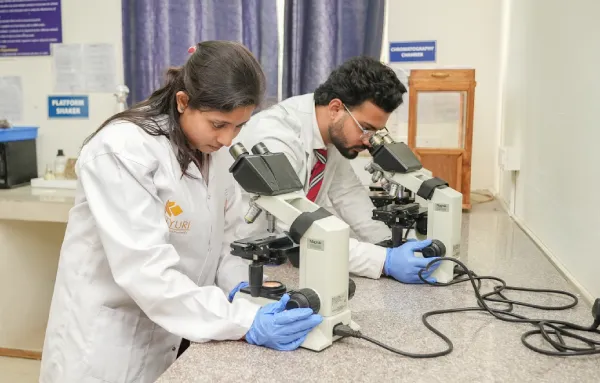
It covers areas such as molecular biology, genetic engineering, and bioprocess technology, with strong emphasis on laboratory training, internships, and industry exposure. The programme develops skills in research design, data analysis, and innovation, enabling students to create biotechnological solutions and prepare for careers in industry, research, or higher studies
Eligibility Criteria for Admission in the Program
A relevant undergraduate degree such as B. Tech. / B.E. in Biotechnology/ Bioinformatics/ Medical Biotechnology/ Bioengineering/ Chemical Engineering, or related fields., OR an M. Sc. in Life Sciences, Microbiology, Biochemistry etc., OR 4-year B. Sc. (Honours/ Research) degree, with a minimum of 55% marks (or equivalent in CGPA in relevant discipline), with English as the medium of instruction.
Teaching Pedagogies
Smart Classrooms, Flipped Classroom Learning, Project Based Learning, Assignments, Educational Visits, Field Based Learning, Group Discussions, Collaborative Thinking, Industry Based Internships and Projects.
Program Educational Objectives (PEOs)
PEO1
To develop strong theoretical and practical knowledge in biotechnology for solving complex biological problems.
PEO2
To prepare for careers in industry, research, and academia with skills in experimentation, data analysis, and modern tools.
PEO3
To instill professional ethics, biosafety awareness, teamwork, leadership, and effective communication.
PEO4
To foster lifelong learning, innovation, entrepreneurship, and pursuit of higher studies in biotechnology.
Program Outcomes (POs)
PO1
Apply advanced knowledge of biotechnology, biological sciences, and engineering principles to analyze and solve complex biotechnological problems.
PO2
Identify, formulate, and evaluate complex problems using research-based approaches and contemporary scientific methodologies.
PO3
Design and develop biotechnological processes, products, or systems considering safety, sustainability, environmental impact, and ethical standards.
PO4
Conduct investigations using appropriate experimental, analytical, and statistical techniques, and interpret data with scientific accuracy.
PO5
Utilize modern laboratory instruments, computational tools, and bioinformatics resources effectively for biotechnological applications.
PO6
Apply professional ethics, biosafety practices, and regulatory guidelines in research and industrial practices.
PO7
Communicate effectively through technical writing, presentations, and interdisciplinary collaboration.
PO8
Demonstrate leadership, teamwork, and project management skills in multidisciplinary environments.
PO9
Engage in independent learning and adapt to emerging technologies, innovation, and global trends in biotechnology.
Program Specific Outcomes (PSOs)
PSO1
Apply advanced molecular, cellular, and computational approaches to address challenges in healthcare, agriculture, and environmental biotechnology.
PSO2
Design and optimize bioprocesses, bioproducts, and biotechnological systems using interdisciplinary knowledge and modern technological tools.
PSO3
Conduct independent and collaborative research with adherence to ethics, biosafety, and regulatory standards, contributing to innovation and sustainable development in biotechnology.
Career Pathways
Graduates of M.Tech Biotechnology are equipped with advanced technical, analytical, and research skills, enabling them to contribute to innovation-driven sectors in alignment with the multidisciplinary and skill-oriented vision of NEP 2020. The programme prepares students for roles across research, industry, entrepreneurship, and academia, with a strong focus on problem-solving, sustainability, and lifelong learning.
M. Tech graduates can pursue careers in biopharmaceuticals, healthcare, diagnostics, agriculture, food technology, environmental management, and industrial biotechnology. They are trained for higher-level responsibilities in research and development, process optimization, product design, quality assurance, regulatory affairs, and data-driven biotechnology applications.
Key Career Pathways include
- Biotech Research Scientist
- Bioprocess Engineer
- Bioinformatics Analyst
- Biomedical Engineer
- Pharmacovigilance Specialist
- Regulatory Affairs Specialist
- Quality Control and Quality Assurance Analyst
- Medical Science Liaison
- Food and Agricultural Biotechnologist
- Entrepreneur in Biotechnology Startups
In line with NEP 2020, graduates are also encouraged to pursue interdisciplinary research, higher studies (Ph.D.), and innovation-driven entrepreneurship, contributing to national development and the global biotechnology ecosystem.
Frequently Asked Questions
M.Tech Biotechnology is a two-year postgraduate programme that integrates advanced biological sciences with engineering and technology to develop solutions in healthcare, industry, and the environment.
The programme duration is two years, divided into four semesters, including coursework, laboratory training, and research/dissertation.
The programme includes advanced core subjects, electives, and research-based courses in areas such as molecular biology, genetic engineering, bioprocess technology, and bioinformatics.
The syllabus emphasizes advanced concepts, research methodologies, computational tools, and practical laboratory skills for interdisciplinary learning.
Candidates must have a Bachelor’s degree in Biotechnology, Bioengineering, Life Sciences, or related fields with minimum qualifying marks as per university norms.
Admission may be based on national-level exams like GATE/ NET or university-level entrance tests, depending on institutional policies.
Required documents include graduation mark sheets, degree certificate, transfer/migration certificate, ID proof, and photographs.
Applicants must meet eligibility criteria, complete the application process, and may need to appear for entrance tests or interviews.
Yes, students from allied disciplines such as Life Sciences, Microbiology, Biochemistry, or Chemical Engineering may apply, subject to eligibility criteria.
Graduates can work in research, biopharmaceuticals, healthcare, agriculture, bioinformatics, regulatory affairs, and academia.
Yes, scholarships may be offered based on merit, entrance exam scores, or institutional criteria.
Yes, it offers strong career prospects in research, industry, and emerging biotechnology sectors.
Salary depends on job role, skills, and organization, with higher potential in research, industry, and specialized domains.
Yes, graduates can pursue Ph.D. programmes or advanced research in specialized areas of biotechnology.















 Download Brochure




 Scheme of Teaching and
Evaluation
Scheme of Teaching and
Evaluation