Merit prepared on basis of the qualifying exam
Master’s Degree holder: 1-year after a 4-year UG or 2- year after a 3- year UG, with 55% marks or equivalent.
Ph.D. in Biotechnology program at Graphic Era (Deemed to be University), is a cutting-edge doctoral program designed for innovators and researchers aiming to contribute to the advancement of life sciences.
This program integrates molecular biology, genetic engineering, drug discovery, immunology, bioinformatics, and bioprocessing to solve real-world problems in healthcare, agriculture, and the environment. As one of the premier destinations for advanced research in biotechnology in India, the university offers a vibrant research environment, access to high-end laboratories, and collaborative opportunities with industry and international research bodies. The program empowers scholars to produce impactful, interdisciplinary research that shapes the future of Biotechnology.
4 -year/8- semester Bachelor’s degree with 75% marks.
5% relaxation for Reserved categories (SC/ST/OBC (NCL)/ PwD/ EWS)
Note: All eligibility conditions as per AICTE/UGC regulations in force.
Emphasis is placed on problem-driven research, critical thinking, and innovation rather than rote learning. Doctoral scholars actively engage in literature synthesis, proposal development, and research dissemination from the initial stages of the Programme.
Teaching is delivered through a combination of Interactive lectures, seminars, tutorials and guided discussions, webinars and seminars
Laboratory experimentation, Field-based investigations, Instrument-based training and Data analysis workshops
Field Based Studies, Interdisciplinary & Transdisciplinary Learning, Hands on Instrumentation and Research Labs Exposure
Interdisciplinary and team-based research through group discussions, joint publications, and collaborative projects.
Use of online research tools, MOOCs, virtual labs, digital libraries, research databases, and advanced software platforms
Learning through preparation of journal papers, conference publications, patents, and technical reports.
To train researchers to identify, analyze, and generate innovative, sustainable solutions for complex environmental issues.
To foster a deep, integrated understanding of biophysical, social, and economic aspects of environmental challenges.
To equip students with mastery of advanced research methodologies, data analysis (statistical software, sophisticated instruments), and modern environmental modeling.
To develop leaders who apply ethical principles, professional integrity, and critical thinking to their research and management roles in public and private sectors.
To cultivate strong scientific communication skills for publishing findings, presenting research, and engaging diverse stakeholders (policy makers, public).
To instill a commitment to continuous professional development and to produce graduates capable of making significant, evidence-based contributions to environmental science and policy.
Formulate problems, design experiments, and conduct significant research at international standards.
Apply scientific temper, critically evaluate literature, and analyze complex issues without bias.
Use advanced tools, instruments, and statistical methods relevant to their specific environmental focus.
Skillfully interpret complex environmental data to form evidence-based conclusions.
Understand environmental regulations, public health impacts, and sustainability principles.
Clearly articulate research findings, ideas, and critiques orally and in writing (publications, presentations).
Demonstrate integrity, responsibility, and high ethical standards in research.
Prepare for leadership roles in academia, research institutions, industry, and policymaking.
Develop deep, comprehensive theoretical and applied understanding in core environmental science areas (pollution, ecology, climate) and related disciplines (biology, chemistry, geology).
Design, conduct, and interpret advanced research; create innovative, viable solutions for complex environmental challenges
Utilize advanced statistical, modelling, and experimental techniques for monitoring, assessment, and impact analysis.
Integrate knowledge from natural and social sciences to understand socio-ecological systems and human-environment interactions.
Effectively Communicate complex findings to diverse (academic, policy, public) and uphold strong responsibilities in research and practice.
Work independently as a leading researcher, contributing new theories and methodologies to the field.
A Ph.D. in Biotechnology equips scholars with advanced scientific expertise, analytical thinking, problem-solving ability, and innovation skills. The Scholars are prepared for diverse and high-impact careers across academia, research, industry, healthcare, agriculture, environment, policy, and entrepreneurship. With rapid advancements in life sciences, biotechnology Ph. D. holders play a critical role in addressing global challenges related to health, food security, sustainability, and bio-innovation.

Graphic Era Deemed to be University has a strong connection to various industries, and its track record for successfully placing students in reputable positions is outstanding, with graduates being placed in internships and permanent roles. The university has formed valuable relationships with globally recognized companies such as Amazon, Microsoft, Google, Walmart, Adobe, and many more, providing students with ample opportunities to kick-start their careers.
Graduates from Graphic Era Deemed to be University can be confident in their ability to succeed in the workforce due to the exceptional training and real-world experience they gain from their internships and placements with these top-tier companies.
Major research domains include genetic engineering, microbial biotechnology, molecular diagnostics, environmental biotechnology, plant biotechnology, bioinformatics, enzyme technology, and agricultural biotechnology.
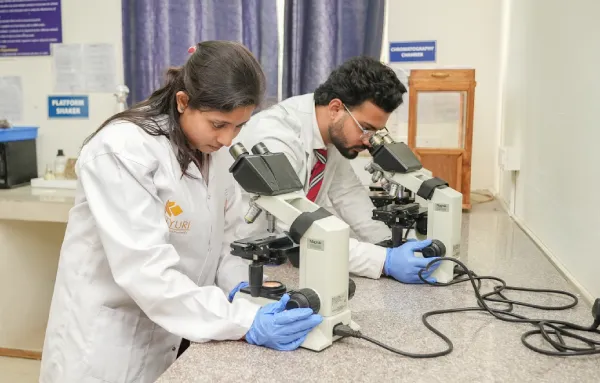
The university provides access to sophisticated labs with high end instruments for research and development.
Yes, the university encourages and financially supports publishing in high-impact journals and participating in both national and international academic events.
Graduates can pursue careers in academia, pharmaceutical and biotech R&D, regulatory agencies, scientific publishing, and biotech entrepreneurship.