






GEU
facilities
Level
Postgraduate
facilities
Duration
2 Years
facilities
Fee Structure
Click Here
M.Tech in Structural Engineering

Admission Procedure

Merit prepared on basis of the qualifying exam

Provisional Admission

Seats to be allocated based on projected scores(12th), calculated basis the candidate’s 10th percentage – only meritorious students

About The Program

The M.Tech in Structural Engineering program is a specialized postgraduate degree designed to provide advanced knowledge, analytical skills, and research capabilities in the field of structural engineering.

This program focuses on the analysis, design, evaluation, and retrofitting of structural systems, enabling students to master both theoretical concepts and practical applications essential to modern infrastructure development.

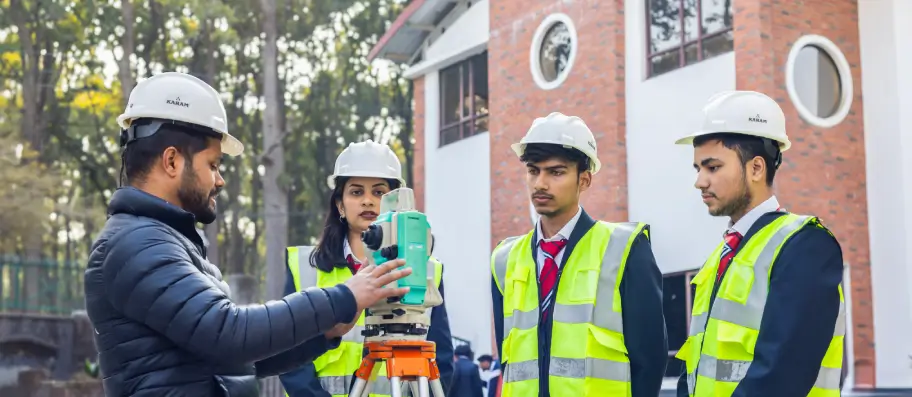
Throughout the curriculum, students gain expertise in subjects such as advanced structural analysis, finite element methods, design of reinforced concrete and steel structures, earthquake engineering, bridge engineering, and structural dynamics. The program integrates cutting-edge software tools, laboratory experimentation, and real-world case studies to prepare graduates for the complexities of structural behavior under various loading conditions.

Students also undertake a research dissertation or major project, allowing them to contribute to emerging areas such as sustainable materials, seismic-resistant design, performance-based engineering, and structural health monitoring.

Graduates of the program are well-prepared for careers in consultancy firms, construction companies, research organizations, infrastructure development agencies, government bodies, and academia. The M.Tech in Structural Engineering equips professionals with the advanced engineering judgment and technical proficiency required to design safe, sustainable, and resilient structures for the future.
Eligibility

B.Tech (CE), B.E with minimum 55% marks or equivalent in CGPA in relevant discipline followed by Personal Interview. M.Tech in Structural Engineering (for Working Professionals) B.Tech (CE), B.E with minimum 55% marks or equivalent in CGPA in relevant discipline and should fulfill all the criteria as being laid down by AICTE for working professional.

PEOs

PEO1

Imparttraining to the graduate in methods to analyze idealized structural components and advanced systems occurring in various infrastructure facilities.

PO2

Guide the graduates to design structural components and systems and to evaluate their performance with respect to the codal recommendations.

PO3

Introduce the graduates to the emerging areas of research into multidisciplinary aspects of solutions required for sustainable and ethical growth.

PO4

Nurture the attitude required for self-employment and entrepreneurial pursuits for infrastructure development of the nation.

Program Outcomes (POs)

Engineering Postgraduates will be able to:

PO1

The graduate will be able to understand the behavior of advanced structural systems and the underlying principles of their mathematical modeling.

PO2

The graduate will be able to independently carry out research/investigation and development work to solve practical structural engineering problems.

PO3

The graduate will be able to write and present a substantial technical report/document of the procedures adopted, the underling limitations, and will be able to communicate through appropriate means to the stakeholders.

PO4

The graduate will be able to select and use appropriate analysis tools, design software, IT techniques, published literature & data, collaborative discussion, etc. to arrive at feasible and optimal solution to structural engineering problems.

PO5

The graduate will be able create self-employment through consultancy service to the public, and also be able to provide economic, eco-friendly and ethical solutions to society.

PO6

The graduate will be able to collaborate in multi-disciplinary projects using the ever-learning aptitude.

Career Prospects

A Master’s in Structural Engineering opens diverse and rewarding career options in both industry and academia. Graduates gain advanced expertise in structural analysis, design, materials, and research, enabling them to contribute to high-end infrastructure development and scientific advancement.

Key Career Roles
  • Assistant Professor
  • Ph.D. Research Scholar
  • Research Associate in Government Institutions
  • Structural Design Engineer
  • Bridge / Highway Structures Engineer
  • Structural Consultant
  • BIM Structural Engineer
  • Research & Development Engineer

Industries and Organizations to Explore

Graduates with an M.Tech in Structural Engineering can explore professional opportunities in prestigious institutions and industries such as:

  • CSIR (Council of Scientific and Industrial Research)

    Structural modelling, material research, infrastructure safety investigations, and advanced computational mechanics.

  • IITs (Indian Institutes of Technology)

    Research fellowships, project associate roles, doctoral programs, and advanced structural analysis projects.

  • NITs (National Institutes of Technology)

    Academic positions, sponsored research, and consultancy-based structural engineering projects.

  • DRDO (Defence Research and Development Organisation)

    Structural testing, blast-resistant design, protective structures, and high-performance material research.

  • ISRO (Indian Space Research Organisation)

    Structural design of launch pads, test facilities, and dynamic analysis for aerospace support structures.

  • BIM-Based Companies

    Opportunities in global engineering firms specializing in BIM modelling, structural detailing, digital twin systems, and infrastructure visualization.

Graphic Era (Deemed to be University)

Placements

Graduates of the Master’s and Bachelor’s programs in Civil and Structural Engineering have consistently secured prestigious positions in leading design firms, government organizations, and top-tier academic institutions. The strong technical foundation, research exposure, and industry-oriented training provided by the department have enabled students to excel in highly competitive environments.

Successful Alumni Placements

  • Placed as Structural Design Engineers at THDC

    Our graduates have joined Tehri Hydro Development Corporation (THDC), contributing to the design and analysis of large-scale hydropower and infrastructure projects. Their expertise in advanced structural modelling and seismic analysis has made them valuable contributors to national infrastructure development.

  • Recruited by SKELETON Consultants

    Several students have been placed at SKELETON, a renowned structural design consultancy known for its innovative engineering solutions. Alumni working here are involved in high-rise building design, retrofitting projects, structural detailing, and BIM-integrated workflows.

  • Placed in Private and Multidisciplinary Designing Firms

    Students have secured roles in reputable design and consultancy firms where they work on commercial buildings, industrial structures, bridges, and international engineering projects. Their proficiency in software tools such as STAAD Pro, ETABS, SAP2000, and Tekla has been highly valued by recruiters.

Higher Education & Research Achievements

  • Pursuing Ph.D. at IITs

    Many alumni have been selected for doctoral research programs at premier institutes such as IIT Roorkee, IIT Delhi, IIT Kanpur, IIT Guwahati, and IIT Bhubaneswar. Their research spans earthquake engineering, structural health monitoring, sustainable materials, and finite element modelling.

  • Pursuing Ph.D. at NITs

    Our students are also pursuing advanced research degrees at leading NITs, including NIT Suratkal, NIT Allahabad, NIT Rourkela, and NIT Jaipur. Their work contributes to cutting-edge structural engineering advancements and industry-focused research.

  • Research positions in CSIR laboratories

    Select graduates have joined CSIR labs as project associates, working on structural behaviour studies, seismic modelling, and material characterization.

Notes: Semester 1 and 2 are applicable only for regular entry students. Lateral entry students begin from Semester 3.

Course Curriculum

Semester 1

  • Theory of Elasticity and Plasticity
  • Advance Design of Steel Structures
  • Advance Concrete Technology
  • Matrix Methods of Structure Analysis
  • Mathematical Modelling of Structures
  • Elective – I
  • Computer Aided Analysis Lab
  • Advanced Material Testing Lab
  • Audit Course 1

Semester 2

  • Structural Dynamics and Seismic Resistant Design
  • Advance Concrete Design
  • FEM in Structural Engineering
  • Wind Engineering
  • Emerging Technologies in Civil Engineering
  • Seismic Hazard Assessment
  • Finite Element Analysis Lab
  • Computer Aided Design Lab
  • Audit Course 2

Semester 3

  • Soil-Structure Interaction
  • Design of Bridges
  • Elective – II
  • Elective – III
  • Dissertation Phase – I
  • Mini Project

Semester 4

  • Dissertation Phase – II

Frequently Asked Questions

The program typically spans 2 years, divided into 4 semesters, including coursework, laboratory work, and a dissertation/project.

Candidates must have a B.Tech/B.E. degree in Civil Engineering or an equivalent discipline from a recognized institution with the minimum required percentage or CGPA as per university norms.

A valid GATE score is preferred, but non-GATE candidates can also apply as per university admission policies.

The curriculum includes advanced topics such as:

  • Advanced Structural Analysis
  • Theory of Elasticity & Plasticity
  • Finite Element Method
  • Design of Reinforced Concrete & Steel Structures
  • Earthquake Resistant Design
  • Structural Dynamics
  • Advanced Construction Material

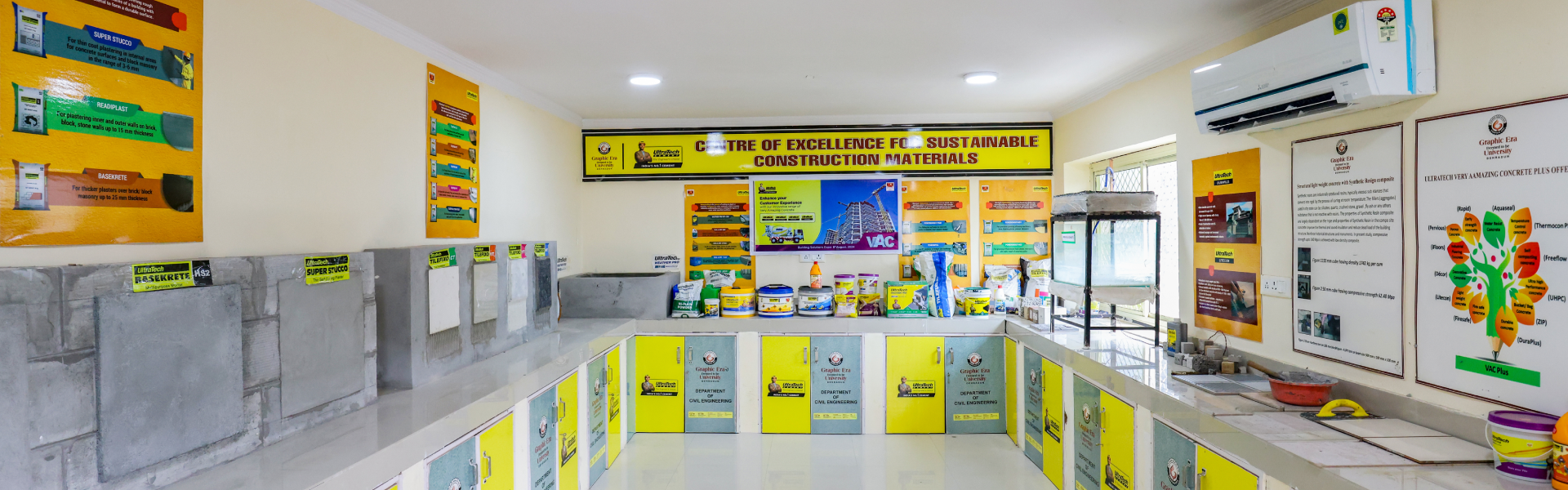
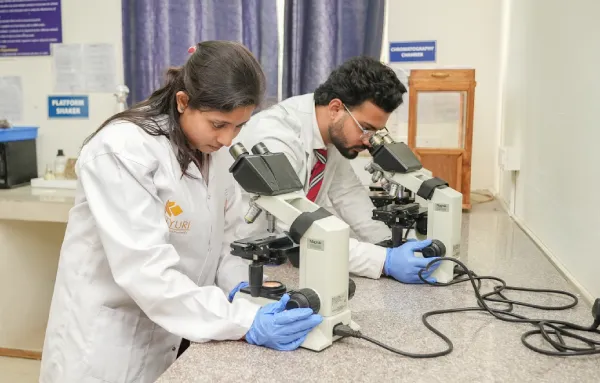
Students have access to state-of-the-art labs including:

  • Structural Engineering Lab
  • Material Testing Lab
  • Concrete Technology Lab
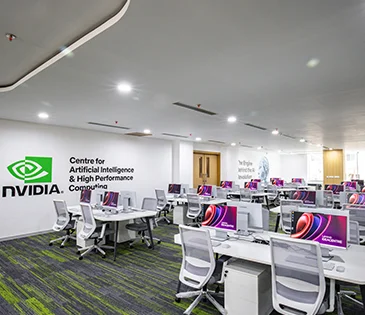
  • CAD and FEM Simulation Lab

Yes, students learn industry-relevant tools such as: STAAD Pro, ETABS, SAP2000, ANSYS, SAFE, AutoCAD, Midas, and other FEM and modelling software.

  • Structural Engineer
  • Design Engineer
  • Construction Manager
  • Bridge and Infrastructure Analyst
  • Research Scientist
  • Academician
  • Consultant in design firms, government agencies, R&D organisations, and construction companies.

Yes, Graphic Era (Deemed to be University) has an active Training & Placement Cell that supports internships, industry connections, and placements with reputed companies.

While not compulsory for all, students are encouraged and supported to take industry internships or consultancy projects to enhance practical exposure.

Yes, students may engage in research collaborations with industry partners, government-funded projects, and can pursue Ph.D. programs in structural engineering or allied fields.

Yes, working professionals with the required academic background can apply, subject to university norms regarding attendance and course load.

  • Experienced faculty with industry and research background
  • Well-equipped laboratories and software facilities
  • Strong placement support
  • Opportunities for live projects and consultancy work
  • Emphasis on innovation, sustainability, and advanced structural concepts

Candidates can apply through the official Graphic Era (Deemed to be University) website during the admission cycle. The process typically includes registration, form submission, and document verification.

Students can pursue research in:

  • Earthquake Engineering
  • High-Performance Concrete
  • Structural Health Monitoring
  • Sustainable and Smart Materials
  • FEM and Computational Mechanics
  • Bridge and Tall Building Analysis
  • Retrofitting & Rehabilitation of Structures

Contact Us

GEU
GEU

566/6, Bell Road, Society Area,
Clement Town, Dehradun,
Uttarakhand