






GEU
facilities
Level
Undergraduate
facilities
Duration
4 Years
facilities
Fee Structure
Click Here
B.Sc (Hons.) in Geology

Admission Procedure

Merit prepared on basis of the qualifying exam

Provisional Admission

Candidates who have passed 10+2 level with PCM/PCB or equivalent with a minimum of 50% marks from a recognized board of examination.

About The Program

B.Sc. Hons Geology is a four year divided into eight semesters, undergraduate science program in geology as per NEP 2020, aims to develop a vibrant and inclusive geosciences community of scholars.

The program focuses on the study of core areas of Earth sciences, like its materials, structure, processes, history, resources, and a range of electives courses like artificial intelligence, machine learning, Indian Knowledge System etc.

Its application span mineral and petroleum exploration, infrastructure development, climate change, disaster management, planetary sciences, strategic and critical mineral industry and IT industry working in the earth science domain.

This program is an exciting choice for students fascinated about exploring natural landscapes, uncovering the stories behind rocks, minerals, fossils, understanding the powerful processes that shape our ever-changing planet, exploration of strategic and critical minerals, groundwater, petroleum, geothermal reservoirs, CBM, gas hydrates, global climate system, carbon capture and storage, regional tectonics and deformation, geological investigation for infrastructure development like dam, tunnel, bridges, disaster management and the evolution of the solar system.

Even in the age of Artificial Intelligence (AI), geology remains an exciting and demanding field, blending hands-on exploration, scientific analysis, and applications of modern technology to uncover the Earth’s secrets. This program offers students a unique opportunity to engage with the natural world, develop geoscience knowledge and skills, and prepare for a rewarding career in research, environmental management, resource exploration, petroleum, geology and beyond.

The geology offers the great job opportunity in both government and private sector. The top recruiters in the government sectors are, Geological Survey of India (GSI), Central Ground Water Board (CGWB), Oil & Natural Gas Commission (ONGC), Coal India, Indian Bureau of Mines, Indian Space Research Organization (ISRO), Minerals & Metal Trading Corporation (MMTC), Bharat Petroleum Corporation Limited, Hindustan Zinc Limited, National Hydroelectric Power Corporation (NHPC) etc. The top recruiters in the private sectors are, Accenture, Shell, Reliance Industries, Emerson, Schlumberger, Cairn Energy India Private Limited, Paras Defence & Space Technologies Limited, C.E Testing Company Private Limited, Baker Huges etc.

One of the unique strengths of pursuing B.Sc. Hons Geology in Dehradun is its location in one of India’s most important hubs for Earth science education, research, and professional practice. Dehradun is home to several nationally and internationally renowned institutions such as the Oil and Natural Gas Corporation (ONGC), Wadia Institute of Himalayan Geology (WIHG), Indian Institute of Remote Sensing (IIRS–ISRO), Indian Institute of Disaster Management and Training (IDT), Survey of India (SOI), and the Uttarakhand State Disaster Management Authority (USDMA). The city’s proximity to the Himalayan orogenic belt, Siwalik ranges, river systems, and active geomorphic landscapes offers unparalleled opportunities for field-based learning, geological mapping, and exposure to tectonics, geohazards, groundwater studies, and environmental assessment. Interaction with scientists, researchers, and professionals through guest lectures, workshops, internships, and field visits enhances students’ awareness of real-world applications and emerging career pathways.

Graduates of the program are well prepared to pursue higher studies and research in geology, applied geology, environmental sciences, and allied disciplines, or to seek entry-level roles in geological surveys, mining and mineral industries, environmental consultancies, infrastructure and construction sectors, disaster management agencies, and government and private organizations. With its strong emphasis on field exposure, skill development, ethical scientific practice, and the advantage of studying in a nationally significant geoscience ecosystem, the B.Sc. Hons Geology program in Dehradun equips students with the knowledge, experience, and perspective required to build successful and meaningful careers in Earth sciences.

Eligibility

Candidates who have passed 10+2 level with PCM/PCB or equivalent with a minimum of 50% marks from a recognized board of examination.

Teaching Pedagogies

The B.Sc. Hons Geology programme with a specialization in Geoinformatics adopts a student-centric and skill-oriented pedagogical framework that integrates foundational geological knowledge with modern geospatial technologies. The teaching–learning process is designed to provide a dynamic and engaging educational experience, enhance conceptual understanding, build practical competencies, and encourage interdisciplinary thinking, aligning with the transformative vision of the National Education Policy (NEP) 2020. The key pedagogical approaches include:

  • Student-Centric Approach
    The program places students at the center of the teaching–learning process by adopting a student-centric approach that addresses their individual needs and interests. Faculty members foster a supportive and inclusive learning environment that promotes active participation, critical thinking, and intellectual curiosity. Tutorial classes further strengthen student–teacher interaction by providing personalized guidance and individual attention to each learner.
  • Lecture–Discussion Method
    Core concepts in geology and geoinformatics are delivered through interactive lectures and discussions. Student participation is encouraged to clarify complex geological processes, spatial analysis, and geospatial data interpretation, strengthening conceptual understanding and analytical skills.
  • Laboratory-Based Learning
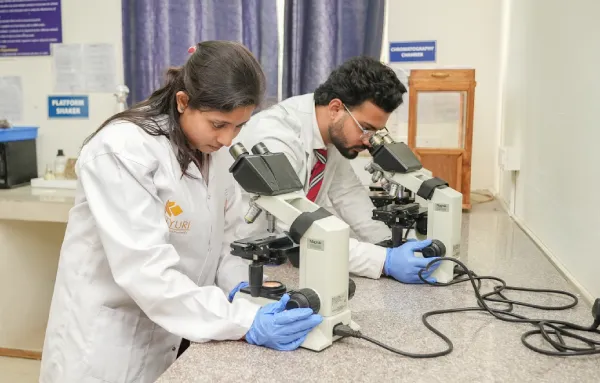
    Laboratory sessions provide hands-on training in mineral, rock and fossil identification, geological mapping, GIS, remote sensing, and spatial data analysis. Practical work bridges theory and application while developing technical and analytical skills.
  • Flipped Classroom and Blended Learning
    Digital resources such as recorded lectures and e-learning materials are provided in advance. Classroom time is used for problem-solving, case studies, and discussions. Blended learning integrates traditional face-to-face instruction with online learning tools, offering flexibility and enhancing student engagement. Together, these approaches promote active learning, critical thinking, and greater student–teacher interaction.
  • Project-Based Learning (PBL)
    Mini-projects and assignments enable students to apply geological and geospatial concepts to real-world problems such as mapping, resource analysis, and environmental studies, enhancing research aptitude and teamwork.
  • Field Visits and Experiential Learning
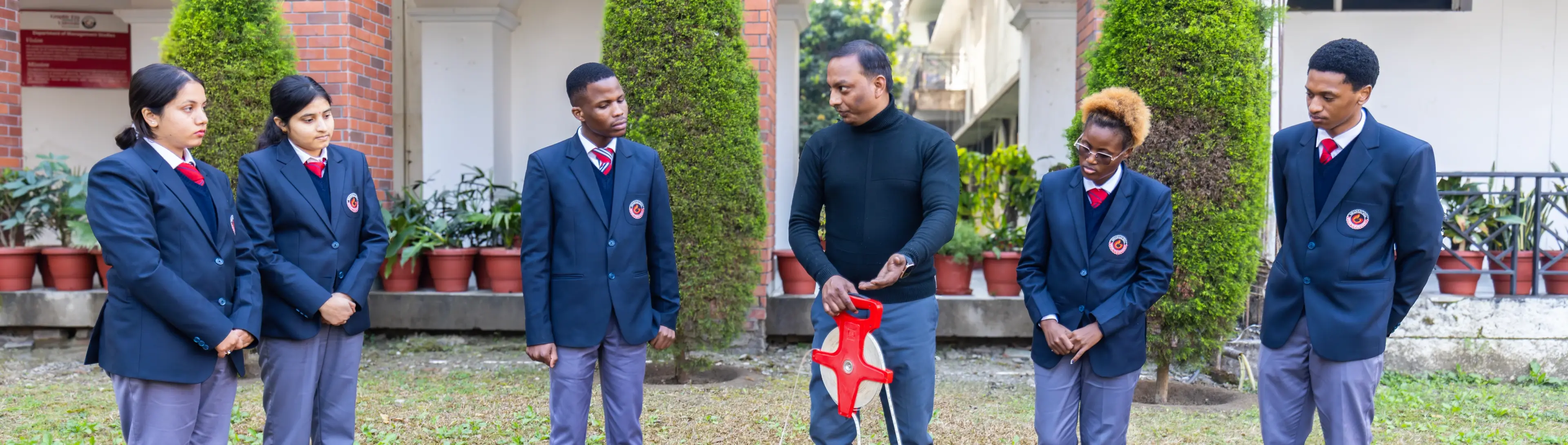
    Field excursions and mapping exercises expose students to geological formations and data collection methods, strengthening observational skills and linking theory with practical applications.
  • Industry-Based Internships and Projects
    Industry-based internships and projects are adopted as experiential pedagogies to provide practical exposure, enhance professional skills, and link academic learning with industry practices.
  • Collaborative / Team Learning
    Collaborative or team learning is an instructional approach where students work together in structured groups to achieve learning goals. It emphasizes active participation, interaction, and shared responsibility.
  • Digital Tools and ICT Enabled Learning
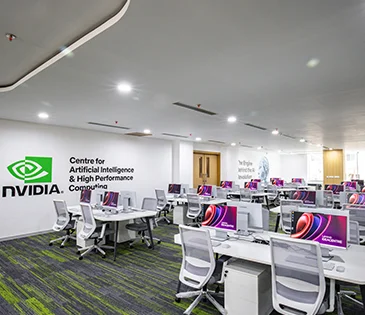
    Students are trained in GIS software, remote sensing tools, and basic data analysis techniques to develop essential geospatial and computational skills.

Program Educational Objectives (PEOs)

PEO1

Provide graduates with a strong foundation in geological principles enabling students to analyze Earth processes and systems comprehensively.

PEO2

Develop competence in geological field work, geological mapping, sampling, petrography, and interpretation of geological and geospatial data to address multidisciplinary earth science challenges.

PEO3

Prepare graduates for higher education, research, and professional practice in geology, earth system sciences, and allied disciplines, while fostering ethical and environmentally responsible conduct.

PEO4

Prepare students for careers in geosciences, environmental management, exploration, oil and gas and academia, emphasizing effective communication, teamwork, lifelong learning and ethical practices, in multidisciplinary environments.

Program Outcomes (POs)

PO1

Geological Knowledge

Apply the knowledge of science, geology fundamentals, and geology specialization to the solution of complex geological problems.

PO2

Problem Analysis

Identify, formulate, review research literature, and analyze complex geological problems reaching substantiated conclusions.

PO3

Design/Development of Solutions

Design solutions for geological problems that meet specified needs with appropriate consideration for public health and safety, and cultural, societal, and environmental considerations.

PO4

Conduct Investigations of Geological Problems

Use research-based knowledge and research methods including design of experiments, analysis and interpretation of geological data, and synthesis of information to provide valid conclusions for geological problems.

PO5

Modern Tool Usage

Create, select, and apply appropriate modern tools, techniques, resources, and IT tools to understand, analyze, predict, and model complex geological activities with an understanding of their limitations.

PO6

The Geologist and Society

Apply reasoning informed by contextual knowledge to assess societal, health, safety, legal, and cultural issues and the consequent responsibilities relevant to professional geological practice.

PO7

Environment and Sustainability

Understand the impact of professional geological solutions in societal and environmental contexts, and demonstrate knowledge of, and the need for, sustainable development.

PO8

Ethics

Apply ethical principles and commit to professional ethics, responsibilities, and norms in applying geological knowledge to problem solving.

PO9

Individual and Team Work

Function effectively as an individual and as a member or leader in diverse teams and multidisciplinary settings in geological projects and field studies.

PO10

Communication

Communicate effectively on complex geological activities with the different audience and in different situations and with society at large, such as, being able to comprehend and write effective reports and design documentation, make effective presentations, and give and receive clear instructions.

PO11

Project Management

Demonstrate knowledge and understanding of geological principles and apply these to one’s own work, as a member or leader in a team, to manage projects in multidisciplinary environments.

PO12

Life-long Learning

Recognize the need for, and have the preparation and ability to engage in independent and life-long learning in the broad context of evolving geoscience disciplines and related technologies.

Program Specific Outcomes (PSOs)

PSO1

Apply fundamental geological concepts and field techniques to identify, analyze, and interpret rocks, minerals, fossils, and geological processes and structures.

PSO2

Perform basic laboratory and field-based geological investigations, including mineral identification, petrographic analysis, geological mapping, and data interpretation.

PSO3

Assess geological problems related to natural resources, environmental issues, and geohazards using systematic observation, analytical reasoning, AI & ML and ethical scientific practices.

Career Prospects sdss

The B.Sc. (Hons.) Geology program equips graduates with strong theoretical knowledge, practical field skills, and analytical expertise, enabling them to explore diverse career opportunities in government, research, and industry. Graduates can pursue roles across exploration, environmental management, resource evaluation, and advanced studies. Key career pathways include:

Exploration Geologist

mineral, petroleum, and hydrocarbon exploration.

Hydrogeologist

groundwater assessment, aquifer management, and water-resource planning.

Environmental Geologist

environmental impact assessment, remediation, and consultancy.

Mining Geologist / Resource Analyst

orebody evaluation, reserve estimation, and mine planning.

Geophysicist / Geochemist

subsurface investigation, geochemical analysis, and geophysical surveys.

Palaeontologist / Sedimentologist

fossil analysis, stratigraphy, and basin studies.

Government Sector Roles

Geological Survey of India (GSI), Central Ground Water Board, Ministry of Mines, public sector units in energy, mining, and environment.

Research and Academic Careers

M.Sc., Ph.D., postdoctoral research, and teaching positions in universities and research institutes.

Industry Opportunities

consultancy firms, mining and petroleum companies, environmental agencies, geospatial and data analysis services.

Technical & Analytical Roles

GIS analyst, remote sensing specialist, petrophysicist, and hydrogeological consultant.

This structured career roadmap ensures graduates are prepared to make meaningful contributions in scientific, industrial, and societal domains.

Notes: Semester 1 and 2 are applicable only for regular entry students. Lateral entry students begin from Semester 3.

Course Curriculum

Semester 1

  • Earth System Science
  • Introduction to Remote Sensing
  • Multi-Disciplinary Course (University Pool of Courses)
  • Career Skills-I / Community Outreach Program
  • Disaster Management
  • Healthy Living and Fitness
  • English Communication / Functional and Formal Hindi
  • Earth System Science Lab and Field Visit
  • Environmental Science (Mandatory Non-Graded Course)

Semester 2

  • Crystallography & Mineralogy
  • Aerial Photography and Photogrammetry
  • Multi-Disciplinary Course (University Pool of Courses)
  • Career Skills-II / Introduction to Programming in Python
  • Introduction to Artificial Intelligence / Foundations of Machine Learning
  • Effective Waste Management / Yoga Education
  • Leadership and Public Speaking / PDP
  • Crystallography & Mineralogy Lab
  • Aerial Photography and Photogrammetry Lab
  • Constitution of India (Mandatory Non-Graded Course)

Semester 3

  • Igneous & Metamorphic Petrology
  • Sedimentology and Principles of Stratigraphy
  • Basic Surveying
  • Multi-Disciplinary Course (University Pool of Courses)
  • Soft Skills / Entrepreneurship Development / Geological Field Methods
  • Literature in Translation / Modern Indian Language
  • Universal Human Values and Professional Ethics
  • Igneous & Metamorphic Petrology Lab
  • Sedimentology Lab and Field Visit
  • Basic Surveying Lab
  • Indian Knowledge System (Mandatory Non-Graded Course)

Semester 4

  • Geochemistry
  • Structural Geology
  • Geomorphology & Remote Sensing
  • Fundamentals of Geographic Information System
  • Summer Internship
  • Academic Writing / Business Communication
  • Structural Geology Lab
  • Indian Culture (Mandatory Non-Graded Course)

Semester 5

  • Palaeontology
  • Stratigraphy
  • Petroleum Geology
  • Engineering Geology
  • Digital Image Processing
  • Palaeontology Lab
  • Engineering Geology Lab and Field Visit

Semester 6

  • Coal Geology
  • Petrophysics
  • Economic & Mining Geology
  • Hydrogeology
  • Cartography and Global Navigation Satellite System
  • Petrophysics Lab
  • Economic Geology Lab

Semester 7

  • Research Methodology
  • Unconventional Hydrocarbon Resources
  • Climate Change
  • Geospatial Analysis and Modelling
  • Geoinformatics Technology and Application
  • Geospatial Analysis and Modelling Lab

Semester 8

With Research

  • River Rejuvenation and Water Resources Management
  • Micropaleontology & Palaeoceanography
  • Dissertation

Without Research

  • River Rejuvenation and Water Resources Management
  • Micropaleontology & Palaeoceanography

Select Any Three DSC

  • Geoinformatics for Earth Science Applications
  • Geophysical Exploration Methods
  • Himalayan Geology
  • Sequence Stratigraphy and Basin Analysis

Frequently Asked Questions

Students gain analytical skills, geological field and laboratory techniques, data interpretation, scientific communication, and problem solving relevant to Earth science applications.

Yes. Students can engage in independent and faculty led research projects, present findings at academic forums, and contribute to publications, enhancing academic and professional readiness.

Absolutely. The program covers critical topics such as hydrology, geochemistry, and environmental geology that underpin environmental and sustainability careers.

Candidates must have completed Class 12 with Physics, Chemistry, and Mathematics or Biology and meet the minimum percentage requirement as defined by the university.

Yes. Extensive field mapping, geological surveys, and field-based projects are an integral part of the curriculum to provide hands-on experience.

Yes. Students can choose specializations such as Remote Sensing & GIS, Mineralogy, Mining Geology, Palaeontology, Geostatistics, Petroleum Geology, or Environmental Geology.

Yes. Students learn to use GIS, Remote Sensing software, geostatistical tools, and other analytical applications for geological investigation.

Graduates pursue careers in core engineering industries, R&D, higher education, startups, and public sector organizations

Yes. Graduates are well-prepared for M.Sc., M.Tech., or Ph.D. programs in Geology, Applied Geosciences, Environmental Sciences, and related research fields.

Through a combination of practical laboratory work, field projects, software training, and exposure to industry-oriented topics, students develop skills directly applicable to professional geoscience roles.

Contact Us

GEU
GEU

566/6, Bell Road, Society Area,
Clement Town, Dehradun,
Uttarakhand