




GEU
facilities
Level
Undergraduate
facilities
Duration
3 Years
facilities
Fee Structure
Click Here
B.Sc Biotechnology

Admission Procedure

Merit prepared on basis of the qualifying exam

Provisional Admission

Candidates who have passed 12th with PCB/PCM from a recognized board of examination.

About The Program

The Three-Year B.Sc Biotechnology Program is a comprehensive and multidisciplinary undergraduate degree designed in alignment with the National Education Policy (NEP) 2020, incorporating Outcome-Based Education (OBE) and a Choice-Based Credit System (CBCS).

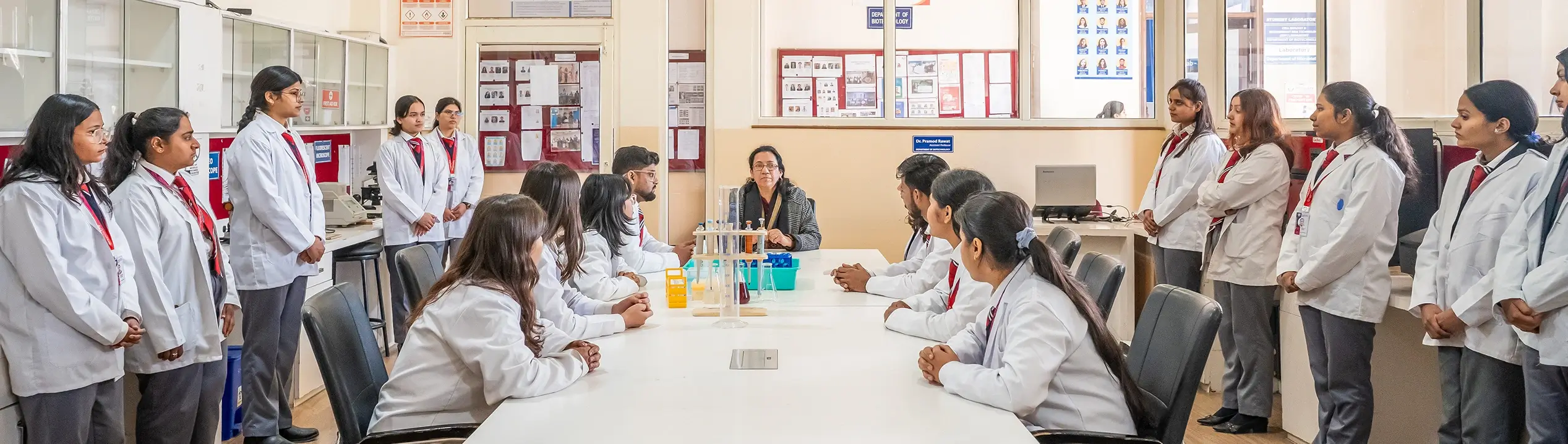
This program offers an in-depth exploration of biological systems and technological innovations, integrating foundational sciences with modern biotechnology tools to prepare students for diverse professional, industrial, and research pathways. Over the first three years, students are progressively introduced to essential concepts in chemistry, microbiology, cell biology, biochemistry, molecular biology, genetics, and bioprocess technologies, complemented by extensive laboratory training.

The curriculum strategically blends theoretical knowledge with practical exposure through hands-on laboratory sessions, skill enhancement courses, value-added modules, and internships. Students also study multidisciplinary and minor courses, enabling them to broaden their academic perspectives across computational biology, sustainability science, food science, and microbiology. The program emphasizes critical thinking, problem-solving, research aptitude, communication skills, ethical responsibilities, and societal awareness, as articulated through its Program Outcomes (POs) and Program Specific Outcomes (PSOs) documented in the evaluation scheme. Students are also encouraged to engage in community outreach, leadership development, and holistic value education through mandated non-graded courses under NEP 2020.

In the fourth year, students have the flexibility to choose between a B.Sc. (Hons.) Biotechnology degree and a B.Sc. (Hons.) Biotechnology with Research track. Students opting for the research pathway undertake a substantial 12-credit research dissertation, gaining direct experience in experimental design, data analysis, and scientific communication, often leading to publications or conference presentations. The program’s design ensures that graduates acquire competencies relevant to rapidly growing sectors such as pharmaceuticals, healthcare, diagnostics, agriculture, food technology, bioinformatics, and environmental biotechnology. With India increasingly becoming a major hub for biotechnology innovation and industrial growth, students completing this degree are well-prepared for career opportunities in industry, government sectors, R&D laboratories, as well as higher education opportunities in premier national and international institutions. By combining conceptual rigor, hands-on training, multidisciplinary exposure, and research opportunities, this four-year degree cultivates skilled biotech professionals capable of contributing meaningfully to scientific research, technological innovation, and sustainable societal development.
Eligibility Criteria for the admission in the Program

Candidates who have passed 12th with PCB/PCM from a recognized board of examination.

Teaching pedagogies

Student-Centric and Outcome-Based Learning

  • Introducing the flexible curriculum for the students, the curriculum is structured around clearly stated learning outcomes-what students are expected to be able to do upon completion of a program or course.
  • Effective teaching methods have been initiated, such as learning tasks and assessment materials, that will best assist students in attaining those results.
  • Emphasis on Real-world Skills aimed at training skills and competencies that can be implemented in real-life situations by students. The students learn to apply knowledge to solve problems, think critically, communicate, and work in groups.
  • Adopt constructive learning, where students build knowledge through active tasks.
  • Align teaching with Bloom’s Taxonomy (Understand → Remember → Apply Analyze → Evaluate → Create).

Blended Learning (Hybrid Mode)

  • LMS-based learning modules that enable students to learn anytime and anywhere, removing barriers of time and location, but with the possible support of in-person engagement. (Any speed, any mode, any language).
  • Blended learning provides a platform to promote greater interaction between students, as well as between students and teachers. It combines face-to-face classroom teaching with digital learning platforms like SWAYAM, NPTEL, and Virtual Labs.
  • Online study portal i-learn, making learning resources and experiences repeatable, reliable and reproducible.

Experiential and Practical-Based Learning

  • Enhancing skill: providing hands on training, workshops and industrial visits, a personalized learning and adaptable educational experience that helps in building social skills of the students.
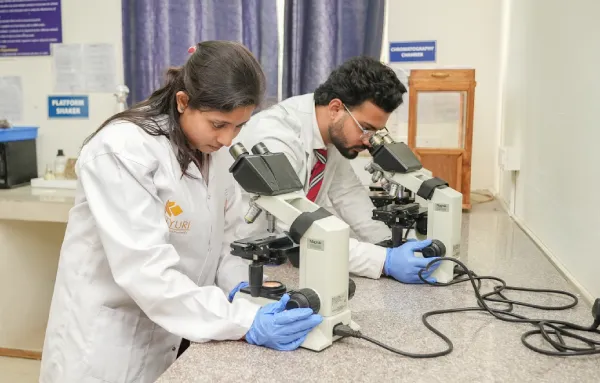
  • Encourage hands-on laboratory sessions aligned with practical casework, upgrading the experimental knowledge of students, which is a practical aspect for making knowledge more efficient.
  • Internship / Apprenticeship mandatory as per NEP: 8–10 weeks.

Research-Integrated Teaching

  • The programs focus more on innovative and interdisciplinary training, capacity building, skill enhancement, and consultancy, with the main goal of contributing meaningfully to the development and economic upliftment of the local population in general and the region in particular by exposing them to various job and self-employment opportunities.
  • Introduce students to mini research projects from Semester I for upgrading the skill and interest of the students towards innovation and research.
  • Each student completes a dissertation based on original research.

Continuous and Comprehensive Evaluation (CCE)

  • Continuous Internal Evaluation (30–40%), Includes viva-voce, seminars, and regular lab performance to assess conceptual understanding, practical skills, and scientific communication.
  • Problem-solving assignments, case analysis reports, and fieldwork presentations to evaluate analytical ability, real-world application, and professional competence.
  • Peer assessments and group activities to promote teamwork, critical thinking, and participatory learning in line with NEP’s holistic education approach.

Skill-Based and Vocational Training

  • Initiating SWAYAM MOOCs and skill-based courses in the curriculum to Enhance Employability and Practical Competence, Promote Application-Oriented Learning, and Build Lifelong Learning and Industry-Relevant Skills.
  • Promoting internships in government organisations and Industries as a part of vocational training, to develop job-ready Practical Skills, bridge the Gap between Education and Employment and support career Growth and Lifelong Skill Development.

Specializations

Computational Biology

  • Principles of Biotechnology
  • Introductory Bioinformatics
  • Structural Biology
  • Programming for Computational Biology
  • Fundamentals of AI/ Machine learning
  • Next-generation sequencing-based metagenomics

Sustainability Science

  • Principles of Biotechnology
  • Introduction to Sustainable Biology
  • Sustainable Agriculture and Organic Farming for Food Security
  • Bio resource Technology for Sustainable Development
  • Circular Economy and Sustainability
  • Biotechnology for One Health

Program Educational Objectives (PEOs)

PEO1

To impart state-of-the-art technology and practical training to solve problems with novelty and updated knowledge.

PEO2

To impart knowledge through updated curriculum as per need to prepare students for higher studies and successful careers in industry, national/international competitive examinations, and as successful entrepreneur.

PEO3

To apply the acquired practical skills and broad biotechnological training in product, process and techniques development to meet the societal demands.

PEO4

To participate in individual and team based multidisciplinary project, demonstrate a professional and ethical attitude with awareness on health, environment and sustainable development.

Program Outcomes (POs)

PO1

Problem-solving: Students will acquire basic knowledge of principles and processes underlying Biotechnology and will be apply the learning to real life situations as well solve different problems in the field.

PO2

Critical thinking and creativity: Students will develop essential analytical skills and apply reasoning/thought to innovate and conduct independent work in Biotechnology areas.

PO3

Research-related skills: Student will be able to appropriately use statistical and other analytical tools and techniques, to develop methodology which enable the student to problematize, synthesize, and articulate issues and design research proposals.

PO4

Team works and leadership qualities: Student will function effectively as an individual, and as a member or leader in diverse teams, and in multidisciplinary settings.

PO5

Skill development: Student will acquire knowledge and skills necessary for working independently, acquire organizational skills, and time management to set self-defined goals and targets with timeline. Student will acquire skills necessary for pursuing learning activities throughout life aimed at personal development, meeting social, economic, and cultural objectives, and adapting to changing demands of the workplace.

PO6

Modern tool usage: Student will be able to demonstrate the capability to create, select, and apply appropriate techniques, resources, and modern IT tools and software for data analysis in a variety of learning and work situations.

PO7

Multicultural competence and inclusive spirit: Student will be able to demonstrate knowledge of multiple cultural values and beliefs with perspective to respect, honour cultural diversity, gender sensitivity, adopt gender neutral approach, as well as empathy for the less advantage/ differently-abled or learning disabilities.

PO8

Value inculcation: The students will be able to demonstrate the acquisition of knowledge and attitude that are required to embrace and practice constitutional humanities, ethics, human and moral values and perform responsible global citizenship. Also, the student will acquire knowledge to understand regulatory norms, and will adopt ethical practices in the pursuit of science.

PO9

Autonomy, responsibility and accountability: The student will be able to apply knowledge, understanding or skills independently and exercise responsibility as well as accountability in applying knowledge and or skills in work.

PO10

Society, Environment and sustainability: Students will be able to demonstrate the acquisition of and ability to apply the knowledge, skills, attitude and values for mitigating Curriculum for B.Sc. (H) Biotechnology (B. Sc.) the problems related to society, health, environment, food security, sustainable development.

PO11

Communication: Students will acquire oral and communication skills and will be able to communicate effectively with the community and with society at large, such as, being able to comprehend and write effective reports and design documentation, make effective presentations, and give and receive clear instructions.

PO12

Community engagement and service: The student will be able to demonstrate the capability to engage in community-services/activities for promoting the wellbeing of society.

Program Specific Outcomes (PSOs)

PSO1

The student will be able to apply the knowledge of biotechnology and allied disciplines in industry, research and higher studies.

PSO2

The student will be able to apply technological solutions in the area of modern biotechnological applications.

PSO3

The students will be able to apply knowledge of biotechnology and allied disciplines to become an entrepreneur.

Career Pathways

After successfully completing the course, programme graduates have significant potential in report and analysis in IT-related domains including Forex earnings and patent registration. Applicants receive training in biotechnology so they can conduct experiments and innovate. A B.Sc. (Hons.) in biotechnology provides up a wide range of career opportunities in the industries of medicine, agriculture, marine science, pharmaceuticals, business, and the environment.

  • Executive in Business Development
  • Senior Research Assistant
  • Biotechnology Specialist
  • Lab Assistant

Notes: Semester 1 and 2 are applicable only for regular entry students. Lateral entry students begin from Semester 3.

Course Curriculum

Semester 1

  • Inorganic and Physical Chemistry
  • Inorganic and Physical Chemistry Lab
  • Disaster Management
  • Principles of Biotechnology
  • Principles of Biotechnology Lab
  • Career Skills- I/ PDP
  • Healthy Living and Fitness
  • English Communication/Functional and Formal Hindi

Semester 2

  • Organic Chemistry
  • Organic Chemistry Lab
  • Introductory Bioinformatics/Introduction to Sustainable Biology
  • Career Skills- II/Creative Writing
  • Science of Happiness and Well-being/ I think Biology
  • Effective Waste Management
  • Community Outreach Program/ Modern Indian language
  • General Proficiency

Semester 3

  • Introductory Microbiology
  • Introductory Microbiology Lab
  • Cell Biology
  • Cell Biology Lab
  • Structural Biology/Sustainable Agriculture and Organic Farming for Food Security
  • Soft Skills/ Entrepreneurship Development
  • Leadership and Public Speaking
  • UHV-II

Semester 4

  • Biochemistry
  • Biochemistry Lab
  • Molecular Biology
  • Molecular Biology Lab
  • Animal Biology
  • Animal Biology Lab
  • Programming for Computational Biology/Bio resource Technology for Sustainable Development
  • Food Biotechnology
  • Internship
  • Academic Writing/ Business Communication
  • Open Elective
  • General Proficiency

Semester 5

  • Principle of Genetics
  • Principle of Genetics Lab
  • Recombinant DNA Technology
  • Recombinant DNA Technology Lab
  • Plant Biology
  • Plant Biology Lab
  • Immunology
  • Immunology Lab
  • Fundamental of AI and Machine learning/ Circular Economy and sustainability
  • Pharmaceutical Biotechnology
  • Open Elective

Semester 6

  • Bioprocess Technology
  • Bioprocess Technology Lab
  • Genomics and Proteomics
  • Genomics and Proteomics Lab
  • Plant Biotechnology
  • Plant Biotechnology Lab
  • Next-generation sequencing-based metagenomics/ Biotechnology for One Health
  • Open Elective
  • General Proficiency

Contact Us

GEU
GEU

566/6, Bell Road, Society Area,
Clement Town, Dehradun,
Uttarakhand