


GEU
facilities
Level
Ph.D.
facilities
Duration
As per UGC Guidelines
Ph.D. in Physics

Admission Procedure

Merit prepared on basis of the qualifying exam

Provisional Admission

M.Sc. (Physics) pass from any Indian University/ Equivalent Foreign University with 55%.

About The Program

The Department of Physics offers a Ph.D. program, supported by advanced research infrastructure and a strong academic environment.

Experienced faculty members guide research across diverse areas, including quantum physics, computational physics, materials science, nuclear theory, and emerging interdisciplinary domains.

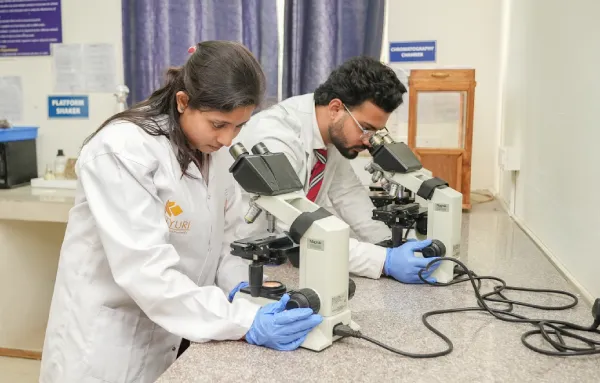
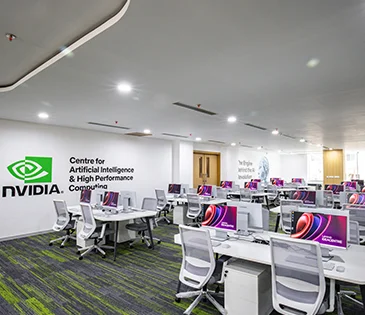
The Department is equipped with a state-of-the-art research laboratory for materials synthesis, advanced simulation facilities, and robust computing resources that support high-quality experimental and theoretical research. Research scholars benefit from access to national and international journals, conferences, and collaborative research platforms, fostering global academic engagement. In addition, the Department offers opportunities for teaching assistantships and a fully funded Ph.D. program in Physics, subject to merit and funding availability. Strong institutional support is provided for conducting research, publishing in high-impact journals, and presenting scholarly outcomes at national and international forums.


Eligibility Criteria for Admission to the Ph.D. Program

M.Sc. (Physics) pass from any Indian University/ Equivalent Foreign University with 55%.

Teaching Pedagogies

The Ph.D. Program in Physics adopts a research-driven and learner-centric pedagogical framework aimed at developing independent researchers with strong theoretical insight, experimental competence, and computational proficiency. Teaching-learning activities are structured to strengthen foundational knowledge while fostering advanced research skills, critical thinking, and scientific rigour.

  • Coursework
    Coursework for Ph.D. scholars is designed to provide in-depth exposure to advanced topics in physics, research methodologies, and emerging interdisciplinary areas. Instruction is delivered through interactive lectures, focused seminars, journal club discussions, and problem-based learning, enabling scholars to critically analyze contemporary research literature and identify open research challenges.
  • Research-oriented pedagogy
    Research-oriented pedagogy forms the core of doctoral training. Scholars actively engage in experimental design, advanced laboratory techniques, numerical modeling, and data-driven analysis using modern scientific software and high-performance computing resources. Regular research seminars, progress presentations, and peer-review sessions promote scholarly discourse, constructive feedback, and continuous improvement of research quality.
  • Blended and digital learning approaches
    Blended and digital learning approaches are integrated through access to online databases, simulation platforms, virtual laboratories, and international research webinars. Ph.D. scholars are encouraged to utilise advanced computational tools and open-access resources to complement formal instruction and broaden their research perspectives.
  • Continuous assessment
    Continuous assessment is conducted through coursework evaluations, research progress reviews, publications, conference presentations, and thesis milestones. Faculty mentoring, doctoral advisory committees, and periodic research evaluations ensure academic rigour, ethical research practices, and timely completion of doctoral work. Through these pedagogical practices, the Department aims to cultivate globally competent researchers who can contribute meaningfully to academia, research institutions, and technology-driven industries.

Specializations

  • Ph. D. (Full/Part-Time)
  • 3/4 Years

Course Curriculum

Semester 1

  • Research and Publication
  • Seminar

Elective course (any two course combination)

  • Atmospheric Physics
  • Characterization of Materials
  • Material Science
  • Fundamentals of Plasmonics
  • Synthesis and Application of Nanomaterials
  • Advances in Nuclear Physics
  • Semiconductor Devices and Thin Film Technology
  • Advances in Plasmonics- Applications
  • General Theory of Relativity-I
  • Quantum Field Theory-I

Contact Us

GEU
GEU

566/6, Bell Road, Society Area,
Clement Town, Dehradun,
Uttarakhand