


GEU
facilities
Level
Ph.D.
facilities
Duration
As per UGC Guidelines
Ph.D. in Biosciences

Admission Procedure

Merit prepared on basis of the qualifying exam

Provisional Admission

The candidate must have a Master’s degree in biosciences or an allied science

About The Program

The Department of Biosciences offers comprehensive academic programs in Biotechnology, Forensic Science, and Bioinformatics, designed to equip students with cutting-edge knowledge, research acumen, and practical expertise.

The field has evolved from traditional areas like fingerprint examination, DNA analysis, ballistics, and toxicology, and now integrates a wider range of advanced techniques for more efficient, streamlined, and dependable investigative methods, leading to accurate and reliable results.

The program is designed to meet the growing demand for highly skilled professionals capable of addressing complex biological questions using computational, statistical, and artificial intelligence–based approaches. The department is actively engaged in ensuring that students acquire cutting-edge expertise in the respective field. The Ph.D. program strictly adheres to the guidelines prescribed by the University Grants Commission (UGC).The primary mission of the PhD. The program is to provide rigorous academic training and research opportunities that prepare scholars to become independent researchers, educators, and innovators capable of contributing original knowledge to the global scientific community.


Eligibility Criteria

The candidate must have a Master’s degree in Biotechnology or Biochemistry or Microbiology or Industrial Microbiology or Genetics or Molecular Biology or Bioinformatics or Botany or Zoology or Toxicology or Forensic Science or other relevant branches of Life Sciences or equivalent with a minimum of 55% marks or equivalent. 5% relaxation for SC/ST/OBC (NCL)/PwD/EWS.

Teaching Pedagogies

The PhD programme in the Department of Biosciences adopts an advanced, research-centric pedagogical framework aimed at developing independent, ethically responsible, and innovative life-science researchers. The pedagogy emphasizes hypothesis-driven biological research, experimental rigor, interdisciplinary integration, and scholarly dissemination. Learning is facilitated through intensive research supervision, laboratory-based training, seminars, collaborative research, field and clinical exposure (where applicable), and the use of advanced digital and bioinformatics platforms.

  • Research-Oriented Pedagogy
    The programme emphasises learning through original biological research involving problem identification. Scholars are trained in hypothesis formulation, experimental design, sample handling, data acquisition, validation, and interpretation using contemporary biological techniques and analytical tools.
  • Inquiry-Based Learning
    Doctoral scholars are encouraged to critically analyse scientific literature, evaluate experimental evidence, question existing biological models, and identify knowledge gaps. This approach fosters scientific reasoning, innovation, and the ability to design novel experiments addressing complex biological questions.
  • Mentor–Mentee Pedagogy
    A strong mentor–mentee model underpins doctoral training in biosciences. Regular interactions with research supervisors and doctoral advisory committees provide personalised guidance in experimental planning, ethical compliance, biosafety practices, data interpretation, and timely research progression.
  • Seminar-Based Learning
    Scholars actively participate in research seminars, journal clubs, synopsis presentations, progress reviews, and pre-submission defences. These platforms strengthen scientific communication, critical evaluation of data, peer feedback, and presentation of experimental findings.
  • Experiential Learning
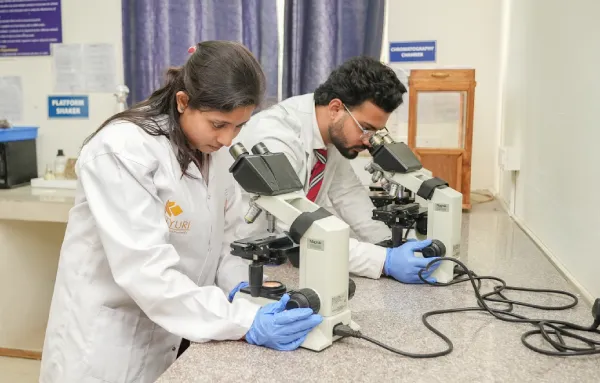
    Learning by doing is emphasised through wet-lab experiments, field sampling, clinical or environmental studies (where applicable), instrumentation handling, microscopy, omics-based analyses, and real-world biological problem solving.
  • Collaborative Learning
    The programme promotes interdisciplinary collaboration across domains such as biotechnology, bioinformatics, forensic biology, environmental sciences, and biomedical sciences. Scholars engage in team-based research, joint publications, and collaborative projects with national and international research laboratories.
  • Blended and Digital Learning
    Digital tools and platforms support bioscience research through access to online databases, genomic and proteomic repositories, bioinformatics software, virtual laboratories, MOOCs, digital libraries, and advanced statistical and visualisation tools.
  • Publication-Oriented Learning
    Scholars are trained in scientific writing and research dissemination through preparation of manuscripts for peer-reviewed journals, conference presentations, patents, datasets, and technical reports, ensuring adherence to ethical research practices and global publication standards.

Specialisations

  • Biotechnology
  • Bioinformatics
  • Forensic Science

Career Pathways

Ph.D. programme in Biosciences is equipped for advanced research, leadership, and professional roles across academia, industry, government, healthcare, and forensic systems. The programme fosters interdisciplinary expertise, ethical practice, and innovation-driven research, enabling diverse and impactful career trajectories.

  • Academic and Research Careers
  • Biotechnology and Life Sciences Industry
  • Bioinformatics and Computational Biology
  • Forensic Sciences and Criminal Justice organizations
  • Government, Policy, and Regulatory Agencies
  • Healthcare, Diagnostics, and Biomedical Research
  • Intellectual Property, Entrepreneurship, and Consultancy
  • Science Communication and Outreach

Notes: Semester 1 and 2 are applicable only for regular entry students. Lateral entry students begin from Semester 3.

Course Curriculum

  • Research & publication ethics
  • Seminar on RM
  • Any two electives to be opted in the respective category

List of Electives for PhD in Biotechnology

  • Bioinformatics and Computational Biology
  • Agricultural Biotechnology
  • Advanced Molecular Biology
  • Microbial Technologies

List of Electives for PhD in Bioinformatics

  • Computer application in biology
  • Programming for computational biology
  • Sequence and structural bioinformatics
  • AI in bioinformatics

List of Electives for PhD in Forensic Science

  • Advanced cyber forensics & digital evidence research
  • Advanced forensic chemistry and toxicological research
  • Advanced document analysis and forensic examination
  • Advanced biometric identification and dermatoglyphic research
  • Advanced forensic biology and molecular profiling

Frequently Asked Questions

Candidates with a valid UGC-NET (Category 1, 2 or 3) or GATE score are exempted from the written test. However, they must attend the interview.

  • Mode : Online
  • Type : MCQ
  • Sections : 50% Research Methodology + 50% Subject-Specific (as per GATE/UGC-NET syllabus)
  • Qualifying marks : 50%
  • Interview: Same day, where candidates discuss their research interests.

Yes. Final-semester candidates can apply, but admission will be provisional until submission of final results.

Yes. Part-Time applicants must submit a No Objection Certificate (NOC) from their employer.

Yes. Fee structure varies for Full-Time and Part-Time candidates.

All information—exam link, schedule, and interview details—will be sent to the registered mobile number and email.

Contact Us

GEU
GEU

566/6, Bell Road, Society Area,
Clement Town, Dehradun,
Uttarakhand