


GEU
facilities
Level
Ph.D.
facilities
Duration
As per UGC Guidelines
Ph.D. in Environmental Science

Admission Procedure

Merit prepared on basis of the qualifying exam

Provisional Admission

National Eligibility Test/ Graphic Era (Deemed to be University) Ph.D. Entrance Exam

About The Program

The Department of Environmental Science at Graphic Era (deemed to be University) offers doctoral program exploring complex issues like climate change, pollution, biodiversity, sustainable energy, ecology, for sustainable solutions through fieldwork and lab research.

Program build advanced skills in core areas (ecology, chemistry, biology, environment science, eco-restoration, renewable energy technology), preparing graduates for careers in academia, government, NGOs, and industry as scientists, consultants, or managers.

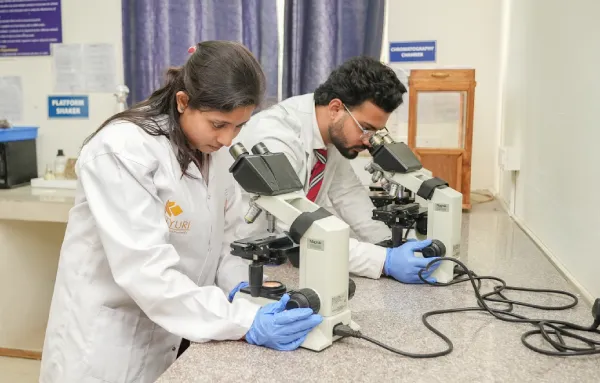
The department emphasizes academic excellence, hands-on research opportunities, and real-world applications to address today’s complex environmental challenges. Scholars are trained through a dynamic curriculum supported by experienced faculty and modern laboratory infrastructure.


Eligibility

National Eligibility Test/ Graphic Era (Deemed to be University) Ph.D. Entrance Exam

Master’s degree in Science from a recognized university/Institute with Minimum 55% marks or CGPA of 5.5/10, for SC/ST candidates or 4-year Bachelor's with high CGPA.

Teaching Pedagogies

  • Problem-Based Learning (PBL)
  • Interdisciplinary & Transdisciplinary Learning
  • Research-Intensive Seminars
  • Hands-on & Field-Based Learning

Specializations

  • Wastewater Treatment and Wastewater Purification
  • Heavy Metals in Industrial Wastewater and Remediation
  • Nature-based Technologies for Environmental Management
  • Bioremediation and Microbial Fuel Cell Technology
  • Environmental Impact Assessment (EIA)
  • Constructed Wetland Technology
  • Bioenergy and Biofuel Production
  • Algae-based Sustainable Development
  • Ecology and Green Chemistry
  • Forest Ecology and Forest Fire Impact Studies
  • Avian Biology, Wetland Ecology and Wildlife Conservation
  • Biodiversity and Traditional Ecological Knowledge
  • Weed Management, Organic Farming and Biocontrol
  • Phytochemistry and Environmental Biotechnology
  • Microbial Water Quality and Sanitation
  • Environmental Monitoring and Environmental Analysis

Program Educational Objectives (PEOs)

PEO1

To train researchers to identify, analyze, and generate innovative, sustainable solutions for complex environmental issues

PEO2

To foster a deep, integrated understanding of biophysical, social, and economic aspects of environmental challenges

PEO3

To equip students with mastery of advanced research methodologies, data analysis (statistical software, sophisticated instruments), and modern environmental modeling

PEO4

To develop leaders who apply ethical principles, professional integrity, and critical thinking to their research and management roles in public and private sectors.

PEO5

To cultivate strong scientific communication skills for publishing findings, presenting research, and engaging diverse stakeholders (policy makers, public).

PEO5

To instill a commitment to continuous professional development and to produce graduates capable of making significant, evidence-based contributions to environmental science and policy. 

Program Outcomes (POs)

PO1

Formulate problems, design experiments, and conduct significant research at international standards.

PO2

Apply scientific temper, critically evaluate literature, and analyze complex issues without bias.

PO3

Use advanced tools, instruments, and statistical methods relevant to their specific environmental focus.

PO4

Skillfully interpret complex environmental data to form evidence-based conclusions. 

PO5

Understand environmental regulations, public health impacts, and sustainability principles. 

PO6

Clearly articulate research findings, ideas, and critiques orally and in writing (publications, presentations).

PO7

Demonstrate integrity, responsibility, and high ethical standards in research. 

PO8

Prepare for leadership roles in academia, research institutions, industry, and policymaking. 

Program Specific Outcomes (PSO)

PSO1

Develop deep, comprehensive theoretical and applied understanding in core environmental science areas (pollution, ecology, climate) and related disciplines (biology, chemistry, geology).

PSO2

Design, conduct, and interpret advanced research; create innovative, viable solutions for complex environmental challenges.

PSO3

Utilize advanced statistical, modeling, and experimental techniques for monitoring, assessment, and impact analysis.

PSO4

Integrate knowledge from natural and social sciences to understand socio-ecological systems and human-environment interactions.

PSO5

Effectively communicate complex findings to diverse audiences (academic, policy, public) and uphold strong ethical responsibilities in research and practice.

PSO6

Work independently as a leading researcher, contributing new theories and methodologies to the field. 

Career Pathways

Post Graduates and Ph.D. of the Environmental Science program can pursue careers in:

  • Environmental consulting
  • Government agencies
  • Research organizations
  • Academic institutions
  • NGOs and sustainability sectors

Course Curriculum

Semester 1

  • Research and Publication Ethics

Semester 2

  • Advanced Environmental Science
  • (a) Instrumentation Principles and Applications
  • (b) Ecorestoration
  • (c) Environmental Biology
  • (d) Renewable Energy Technology
  • Seminar on RM Presentation

Frequently Asked Questions

  • Identify personal interests and areas of expertise.
  • Conduct research on current trends and potential career paths.
  • Select a broad topic and narrow down research focus.
  • Establish clear aims and objectives, and determine scope and methodology.

Work in governmental or non-governmental organizations to develop and evaluate environmental policies, regulations, and legislation as an environmental policy analyst. Or, pursue a career in academia, teaching and mentoring future environmental scientists.

Yes, University offers part-time Ph.D.

General expectations would be completion in 4 or 5 years.

Contact Us

GEU
GEU

566/6, Bell Road, Society Area,
Clement Town, Dehradun,
Uttarakhand