
Merit prepared on basis of the qualifying exam
Candidates who had passed 12th in any stream from a recognized board of examination
The Doctor of Philosophy (Ph.D.) in Civil Engineering is a research-intensive programme designed to foster advanced knowledge, innovation, and independent research capabilities in core and emerging areas of civil engineering.
The programme aims to develop high-quality researchers, academicians, and industry experts capable of addressing complex engineering challenges and contributing to sustainable infrastructure development. Ph.D. scholars engage in original research, advanced experimentation, numerical modelling, field investigations, and interdisciplinary studies under the guidance of experienced faculty members. The programme encourages publication in reputed journals, participation in national and international conferences, and collaboration with leading research institutions and industries.
Geotechnical Engineering
Advanced research in soil mechanics, foundation engineering, ground improvement techniques, slope stability, soil–structure interaction, geosynthetics, and geo-environmental engineering.
Structural Engineering
Research focused on advanced structural analysis, earthquake engineering, structural dynamics, finite element methods, retrofitting and rehabilitation, performance-based design, and structural health monitoring.
Water Resources Engineering
Covers hydrology, groundwater modelling, irrigation engineering, hydraulic structures, flood management, climate change impact assessment, and sustainable water resource planning.
Environmental Engineering
Research in water and wastewater treatment, solid waste management, air and noise pollution control, environmental impact assessment, and sustainable environmental systems.
Material Science Engineering
Focuses on advanced construction materials, sustainable and recycled materials, concrete technology, durability studies, material characterization, and performance enhancement of engineering materials.
Remote Sensing & GIS
Advanced applications of geospatial technologies in infrastructure planning, land use and land cover analysis, disaster management, urban development, environmental monitoring, and spatial data analytics.
Graduates of the Ph.D. programme pursue high-impact careers in academia, research, industry, and government organizations:

Ph.D. scholars from the Civil Engineering department have achieved notable success through:
Graduates pursue careers as faculty members, research scientists, senior consultants, policy advisors, and R&D professionals in academia, industry, and government organizations.
The Ph.D. programme is offered in Geotechnical Engineering, Structural Engineering, Water Resources Engineering, Environmental Engineering, Material Science Engineering, and Remote Sensing & GIS.
Candidates must hold a Master’s degree (M.Tech/M.E. or equivalent) in Civil Engineering or a relevant specialisation with the minimum qualifying marks as prescribed by the university.
GATE/NET qualification is not mandatory; however, candidates with valid GATE/NET scores may receive preference or relaxation as per institutional policy.
Admission is generally based on a Ph.D. entrance test followed by a personal interview/presentation to assess the candidate’s research aptitude and subject knowledge.
Yes. Working professionals can apply for the Ph.D. programme, subject to meeting eligibility criteria and institutional guidelines.
Yes. The programme is offered in both full-time and part-time modes, as per university norms.
Yes. Eligible candidates may receive university fellowships, government scholarships, or funding through sponsored research projects, subject to availability and performance.
Selection is based on academic credentials, performance in the entrance test, research proposal, and interview conducted by the doctoral committee.
Yes. The programme actively encourages interdisciplinary research involving multiple domains of civil engineering and allied fields.
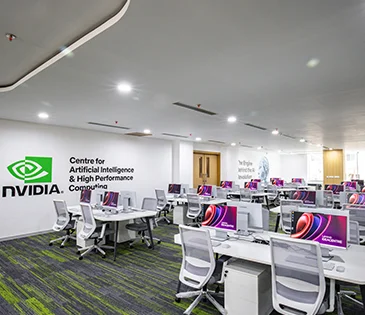
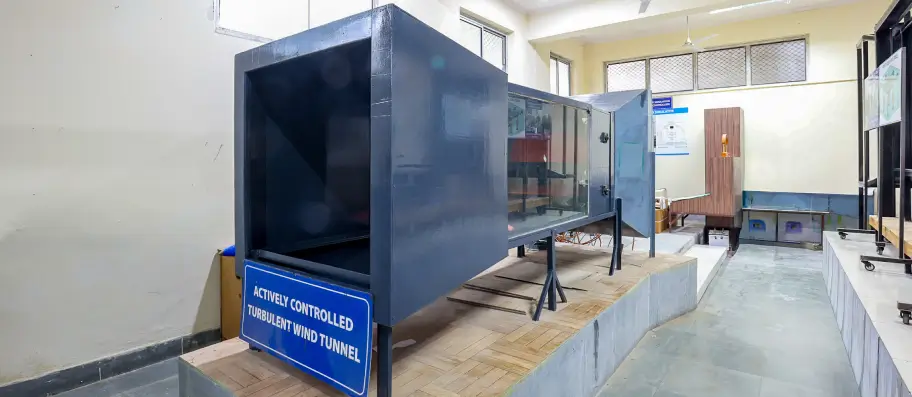
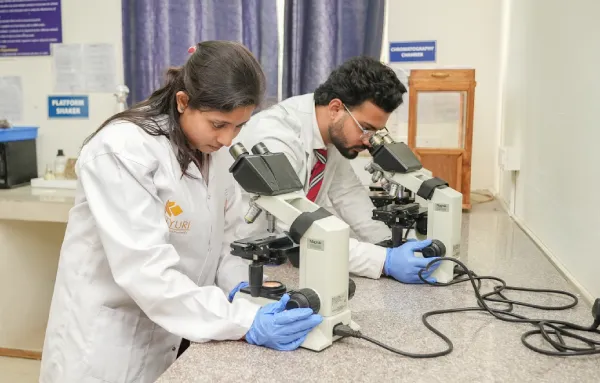
Scholars have access to advanced laboratories, computational tools, research software, digital libraries, and high-performance computing facilities.
Yes. Ph.D. scholars are required to publish research papers in reputed peer-reviewed journals as per university and regulatory requirements.
Yes. Scholars are encouraged to participate in government- and industry-funded research projects, gaining valuable research and professional exposure.
The department promotes international collaborations, joint research, and conference participation, subject to availability and research relevance.
The minimum duration of the Ph.D (Full Time) programme is three years, Ph.D (Part Time) programme is four years and the maximum duration is six years, as per university and regulatory norms.