Merit prepared on basis of the qualifying exam
Bachelor’s degree in Life Sciences, Bio-Sciences, or Allied Health Sciences (Microbiology, Biotech, Biochemistry, Botany, Zoology, Genetics, Food Technology, Pharmacy).
The M.Sc. Microbiology degree is a two-year program designed to develop competent microbiologists. The program aims to provide students with a strong foundation in microbiology and hands-on experience through a blend of theoretical knowledge and practical laboratory exercises.
Key areas of study include Bacteriology, Virology, Microbial Genetics, Immunology, Bioinformatics, and Biostatistics. Students also engage in disciplinary-specific electives and research projects to enhance their practical skills. The program aims to prepare students for diverse career opportunities in fields such as research, industry, teaching and medical sciences.
Bachelor’s degree in Life Sciences, Bio-Sciences, or Allied Health Sciences (Microbiology, Biotech, Biochemistry, Botany, Zoology, Genetics, Food Technology, Pharmacy).
The teaching pedagogies for the M.Sc. Microbiology program at Graphic Era (Deemed to be University) are designed to foster a student-centric, application-oriented, and research-ready learning environment. Aligned with the National Education Policy (NEP) 2020 and Outcome-Based Education (OBE), these methods emphasize active learning, critical inquiry, and the integration of technology to develop competencies in disciplinary knowledge, problem-solving, and ethical practice. Pedagogies are tailored to the postgraduate level, blending theoretical depth with intensive practical training for professional roles. Key approaches include a mix of traditional and innovative methods, ensuring holistic development through classroom, laboratory, and collaborative activities.
The postgraduate program shifts toward advanced, application-oriented pedagogies that blend theoretical depth with intensive practical training. Emphasis is placed on research readiness, ethical decision-making, and interdisciplinary integration to equip students for professional roles in research, industry, or academia.
Monthly seminars where students present and critique real-world case studies to hone analytical and presentation skills.
Collaborative and Interdisciplinary Workshops: Group workshops with electives from allied fields to address multidisciplinary issues like microbial impacts on sustainable development.
To develop students employable towards building a successful career based on a comprehensive understanding of theoretical and applied aspects as well as methodology to solve multidisciplinary real-life problems.
To produce professional graduates ready to work with a sense of responsibility, ethics and efficiency, both individually and as a team.
To impart competency to students so that they are able to pursue higher studies and research in areas of life sciences and other professionally related fields.
Students will know the principles and processes underlying microbiology.
Graduates will develop essential skills to conduct research in microbiology.
Students will understand problems related to microbial impacts on health, environment, food security, and sustainable development.
Students will be able to understand regulatory norms and will adopt ethical practices in the pursuit of science.
Students will acquire eligibility for higher studies.
Students will acquire oral and communication skills.
Students will acquire the ability to engage in independent and life-long learning in the broadest context.
Students will possess basic knowledge of principles and processes involved in the classification, evolution, and growth of various microorganisms.
Students will acquire essential skills in handling and processing microbial cultures and strains (isolation, culturing and preservation of microbes).
Students will be aware of both the problems and benefits associated with microbes in relation to society, health, environment, agriculture and food, and will possess problem- solving abilities.
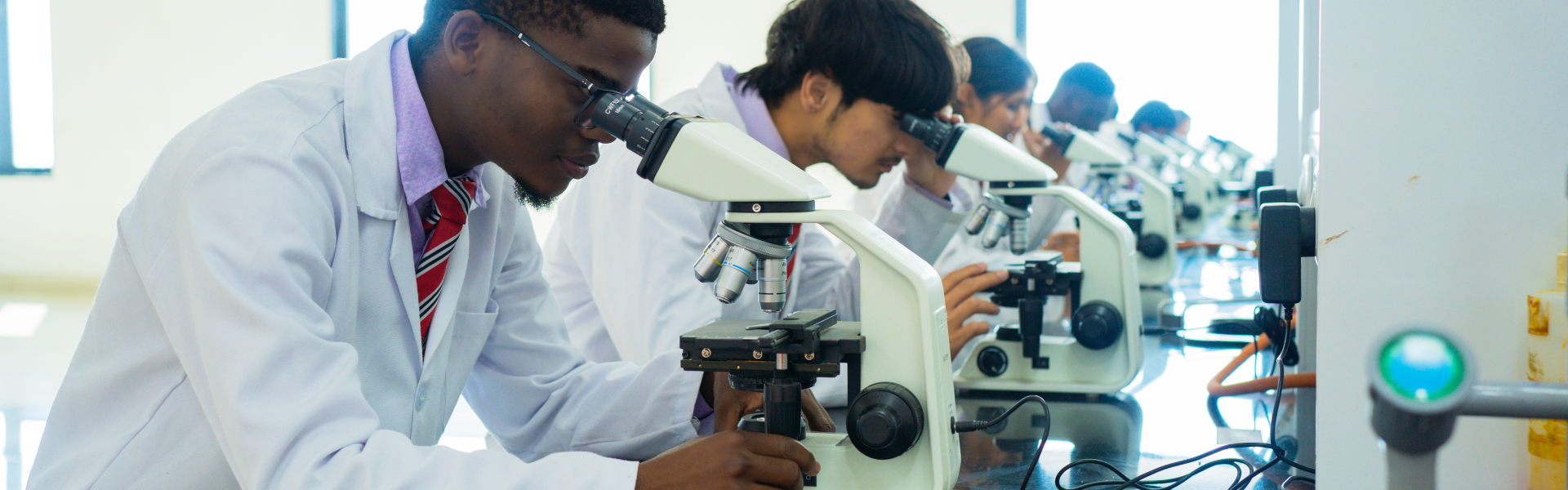
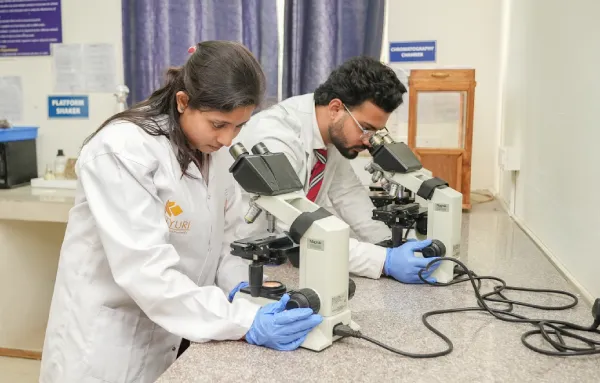
The M.Sc. Microbiology program is focused on hands-on experience and practical exposure to students through labs, internship and research project. It offers a wide range of career pathways to explore, such as:
Notes: Semester 1 and 2 are applicable only for regular entry students. Lateral entry students begin from Semester 3.
Graphic Era stands out with its NAAC A+ accreditation and NIRF 2025 ranking of 48 in the University category, offering state-of-the-art labs, industry collaborations, and a research-driven curriculum aligned with NEP 2020. The department's experienced faculty and focus on hands-on training ensure high employability in pharmaceuticals, healthcare, and environmental sectors, backed by strong placement records and global exposure opportunities.
It is a 2-year program (4 semesters) with 84 credits, emphasizing advanced topics like bacteriology, virology, immunology, and research projects for practical expertise.
Candidates must hold a Bachelor's degree in Microbiology, Biotechnology, Biochemistry, or related fields (e.g., B.Sc. PCB/CBZ) with at least 50% marks. Relevant work experience may be considered.
Visit https://geu.ac.in/admissions/fee-structure/ for current rates and financial aid options.
Students undertake lab-based projects, dissertations in the final Semester, and 24 week internships in industries or research institutes.