






GEU
facilities
Level
Postgraduate
facilities
Duration
2 Years
M.Tech in VLSI System Design

Admission Procedure

Admission to the M. Tech in VLSI Design and System program is based on academic merit and selection criteria as per university norms.

Provisional Admission

They must have passed a Bachelor’s Degree in the relevant field of Engineering and Technology from institutions approved by the All India Council for Technical Education, Central or State Governments, or their equivalents, with at least 50% marks (at least 45% in case of candidates belonging to reserved category).

About The Program

The Department of Electronics and Communication Engineering (ECE) at Graphic Era (Deemed to be University) , Dehradun offers a future-oriented M.Tech program in VLSI System Design that builds advanced expertise in semiconductor technologies, integrated circuit design, and system-level innovation. The program is designed to meet the growing demand for highly skilled professionals in the global chip design and electronics industry.

Aligned with national initiatives such as the India Semiconductor Mission, the program aims to develop specialists capable of contributing to India’s expanding semiconductor and electronics ecosystem through advanced design, verification, and system integration skills.

The M.Tech VLSI System Design curriculum provides in-depth knowledge of CMOS VLSI design, digital and analog IC design, system-on-chip (SoC) design, semiconductor device modeling, low-power VLSI, FPGA-based system design, and hardware–software co-design. It also integrates emerging areas such as AI hardware accelerators, embedded intelligence, nanoelectronics, and advanced verification methodologies. Strong emphasis is placed on research, design optimization, and real-world problem-solving.

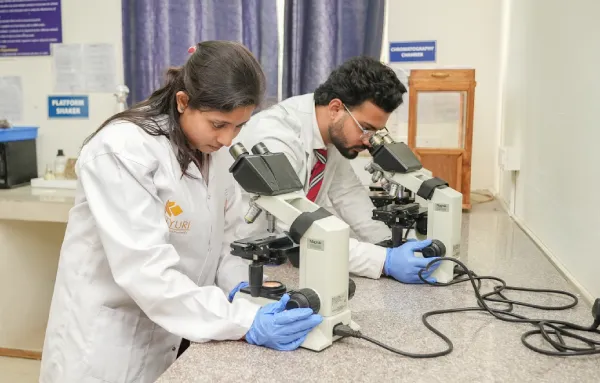
In line with industry and research requirements, the program focuses on advanced semiconductor design, fabrication-aware methodologies, and system-level integration. Students gain extensive hands-on experience using industry-standard EDA tools such as Cadence, Synopsys, Xilinx/Vivado, MATLAB, and Mentor Graphics, preparing them for roles in chip design, verification, and electronic system development.

The program is delivered by highly qualified and research-oriented faculty, including members recognized among the World’s Top 2% Scientists, with expertise in VLSI design, nanoelectronics, embedded systems, communication engineering, and signal processing. Academic learning is complemented by advanced laboratories, sponsored research projects, industry collaborations, internships, and thesis-based research work.

Graduates of the program are well-equipped for careers in semiconductor industries, VLSI design and verification companies, embedded system design, consumer electronics, defence and aerospace, and emerging deep-tech sectors. The program also provides a strong foundation for pursuing doctoral research and advanced R&D roles in premier institutions in India and abroad.


Eligibility

They must have passed a Bachelor’s Degree in the relevant field of Engineering and Technology from institutions approved by the All India Council for Technical Education, Central or State Governments, or their equivalents, with at least 50% marks (at least 45% in case of candidates belonging to reserved category).

Selection Criteria may include

  • GATE score (preferred but not mandatory)
  • Performance in the qualifying degree (B. Tech/B.E.)
  • University-level entrance examination and/or interview, if applicable
  • Overall academic merit and relevant professional or research experience, if any Final admission is granted based on merit as determined by the university in accordance with prevailing admission guidelines.

Provisional admission (Yes/ No)

Yes, Provisional admission may be granted to candidates who are awaiting the results of their qualifying exam, if they submit their final grade reports prior to the start of the academic year. This guarantees that worthy candidates will not be denied the chance because of delayed results.

Key Highlights

  • Advanced and Specialized VLSI Curriculum
    Designed to develop high-end expertise in digital, analog, and mixed-signal VLSI design, system-on-chip (SoC) architecture, semiconductor devices, and advanced electronic system design.
  • Strong Focus on Complete Chip and System Design Flow
    Including specification development, RTL design, synthesis, verification, physical design, timing closure, low-power design, and system-level integration.
  • State-of-the-Art VLSI Design and EDA Laboratories
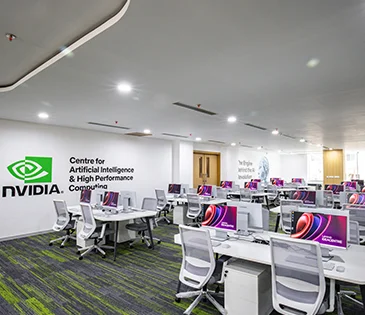
    With dedicated Cadence Virtuoso & Digital Flow Labs, FPGA & HDL Labs, Device Modeling Labs, and System Design Labs, providing hands-on exposure to industry-standard tools and workflows.
  • Industry-Oriented and Research-Driven Learning Approach
    Through design-centric courses, case studies, live industry projects, internships, and collaborative research with semiconductor and electronics industries.
  • Emphasis on Advanced Semiconductor and Emerging Technologies
    Including low-power VLSI, advanced CMOS technologies, FinFET/FD-SOI concepts, hardware acceleration for AI/ML, neuromorphic systems, and IoT hardware platforms.
  • Strong Research and Innovation Ecosystem
    Encouraging high-quality journal and conference publications, patent filing, IP generation, and development of application-oriented VLSI and system-level prototypes.
  • Experienced Faculty and Industry Mentors
    With deep expertise in VLSI design, semiconductor devices, nanoelectronics, embedded systems, and electronic system integration, actively engaged in funded research and consultancy.
  • Hands-on Exposure to System-Level Design and Verification
    Including modelling, simulation, hardware prototyping, performance evaluation, and validation of complex electronic and VLSI-based systems.
  • Interdisciplinary Approach to VLSI and System Design
    Integrating electronics, computer architecture, signal processing, and applied physics to address real-world engineering and research challenges.
  • Entrepreneurship and Innovation Support in the Semiconductor Domain
    Through innovation and incubation centers, IP awareness programs, startup mentorship, and guidance for fabless design startups and deep-tech ventures.
  • Professional Skill Development and Academic Enrichment
    Through workshops, advanced certification programs, expert lectures, technical symposia, and participation in national and international conferences.

Teaching Pedagogies

  • Outcome-Based Education (OBE)

    A structured and research-oriented teaching–learning framework with clearly defined Course Outcomes (COs) aligned with Program Outcomes (POs), Program Educational Objectives (PEOs), graduate attributes, and advanced industry and research requirements in VLSI design and system-level integration.

  • Project-Based and Research-Based Learning (PBRL)

    Integration of advanced design-oriented mini-projects, system-level case studies, and a comprehensive M.Tech dissertation focusing on VLSI architecture, ASIC/SoC design, low-power systems, high-speed circuits, verification, and system integration to enhance analytical, design, and research capabilities.

  • Laboratory-Centric and Tool-Based Instruction

    Extensive hands-on exposure through advanced laboratories in VLSI Design, Analog and Mixed-Signal Circuits, Physical Design, Verification, FPGA Prototyping, and System-Level Modeling using industry-standard EDA tools and workflows.

  • ICT-Enabled and Simulation-Based Learning

    Effective use of modern digital teaching tools and advanced EDA and simulation platforms such as Cadence, Synopsys, Mentor Graphics, MATLAB/Simulink, ModelSim, and Learning Management Systems (LMS), along with NPTEL/SWAYAM and virtual VLSI labs for in-depth design analysis and verification.

  • Industry and Research Engagement

    Regular expert lectures by industry professionals and researchers, industrial visits, sponsored workshops, advanced training programs, internships, and collaborative research initiatives to expose students to contemporary semiconductor technologies, fabrication processes, and emerging research trends.

  • Research, Innovation, and IPR Culture

    Strong emphasis on research publication, patent filing, participation in IEEE conferences, VLSI design challenges, funded research projects, IPR awareness programs, and innovation-driven activities to foster independent research aptitude and innovation.

  • Collaborative, Seminar-Based, and Self-Directed Learning

    Promotion of peer learning and professional development through technical seminars, research paper reviews, design reviews, group discussions, collaborative problem-solving, and self-directed learning to enhance critical thinking, communication skills, and lifelong learning abilities.

Specialization

  • B.Techin Electronics and Communication Engineering(ESR)
  • B.Techin Electronics and Communication Engineering(IoT)
  • B.Techin Electronics (VLSI Design & Technology)
  • B.Tech in Electronics and Communications Engineering for Working Professionals
  • M.Techin VLSI System Design
  • PhD in Electronics and Communication Engineering

Program Educational Objectives (PEOs)

PEO1

To facilitates students, for their employability in the diversified sectors of core industry, public sector or multinational corporations.

PEO2

Ability to pursue higher education or research in technologies related to VLSI at institutes of repute and high standard.

PEO3

To develop managerial skills and attitude of lifelong learning with effective inter-person communication resulting in leading diverse teams, with ethical and social behaviour.

Program Outcomes (POs)

PO1

Apply the knowledge of science, mathematics, and engineering principles for developing problem solving attitude.

PO2

Identify, formulate, and solve engineering problems in the broad areas like System Design using VLSI.

PO3

Use different modern engineering software tools in the domain of VLSI and Systems Design.

PO4

Design and conduct experiments, analyze and interpret data, imbibe programming skills for development of simulation experiments.

PO5

Function as a member of a multidisciplinary team with sense of ethics, integrity, and social responsibility.

PO6

Realize the need for self-education and ability for independent and life-long learning.

Program Specific Outcomes(PSOs)

PSO1

Attain competency in areas of IC designing, testing, and developing prototype of various VLSI circuits.

PSO2

Integrating various VLSI sub-systems to design industrial circuits.

PSO3

Students gain skills in developing various complicated circuits and excel in industrial sector.

Career Prospects

VLSI System Design lies at the heart of the global semiconductor and electronics industry, driving innovations in computing, communication, automation, and intelligent systems. With rapid advancements in System-on-Chip (SoC) design, artificial intelligence hardware, Internet of Things (IoT), 5G/6G communication, and low-power electronics, the demand for skilled VLSI professionals continues to grow exponentially.

Graduates with an M.Tech in VLSI System Design can work in semiconductor companies, fabless design houses, EDA tool industries, research laboratories, and technology-driven startups. They contribute to areas such as ASIC and FPGA design, chip verification, physical design, embedded hardware development, and semiconductor research.

The global push toward Make in India, chip manufacturing ecosystems, and advanced electronics, combined with increasing demand for high-performance and energy-efficient devices, ensures strong and sustained career prospects. Opportunities also exist in academia, research organizations, and entrepreneurship, where professionals can innovate and lead next-generation chip and system design solutions.

Electronics / Communication Engineer

VLSI Design Engineer

Semiconductor Device Engineer

Embedded Systems Engineer

Hardware Design Engineer

RF / Microwave Engineer

Signal Processing Engineer

Telecommunication Engineer

IoT Engineer

Automation and Control Engineer

Robotics Engineer

Defence and Aerospace Electronics Engineer

Systems Engineer

Research Engineer / Scientist

Graphic Era (Deemed to be University)

Placements

Graphic Era Deemed to be University has a strong connection to various industries, and its track record for successfully placing students in reputable positions is outstanding, with graduates being placed in internships and permanent roles. The university has formed valuable relationships with globally recognized companies such as Amazon, Microsoft, Google, Walmart, Adobe, and many more, providing students with ample opportunities to kick-start their careers.

Graduates from Graphic Era Deemed to be University can be confident in their ability to succeed in the workforce due to the exceptional training and real-world experience they gain from their internships and placements with these top-tier companies.

Notes: Semester 1 and 2 are applicable only for regular entry students. Lateral entry students begin from Semester 3.

Course Curriculum

Semester 1

  • Professional Communication
  • Semiconductor Materials and Devices
  • CMOS Analog Circuit Design
  • Advanced Digital Integrated Circuit
  • VLSI Technology

Program Elective-I

  • Advanced Nanotechnology
  • Optimization Techniques in VLSI Design
  • Theory and Application of Embedded Systems
  • Digital Signal Processing for VLSI
  • CMOS Analog Circuit Design Lab
  • Digital VLSI Circuit Design Lab

Semester 2

  • Advanced ASIC and FPGA Design
  • Digital System Design using Verilog HDL
  • Advanced VLSI Circuit Testing
  • Low Power VLSI Design

Program Elective-II

  • Micro-Sensors and MEMS
  • RF Microelectronics Devices
  • VLSI Circuits for Biomedical Application
  • Microwave & MM-wave Integrated Circuits and Applications
  • Verilog HDL Lab
  • VLSI Physical Design Lab
  • Mini Project with Seminar

Semester 3

Program Elective-III

  • Organic Electronics Devices and Circuits
  • Memory Design and Testing
  • System on Chip Design and Testing
  • Internet of Things
  • VLSI Physical Design Automation
  • Research Methodology and IPR
  • Modelling and Simulation Lab
  • Dissertation Phase-I

Skill Enhancement Course - Through Swayam

  • C-Based VLSI Design
  • Introduction to Algorithms and Analysis
  • Introduction to Machine Learning

Semester 4

  • Dissertation Phase-II

Contact Us

GEU
GEU

566/6, Bell Road, Society Area,
Clement Town, Dehradun,
Uttarakhand