Merit prepared on basis of the qualifying exam
Seats to be allocated based on projected scores(12th), calculated basis the candidate’s 10th percentage – only meritorious students
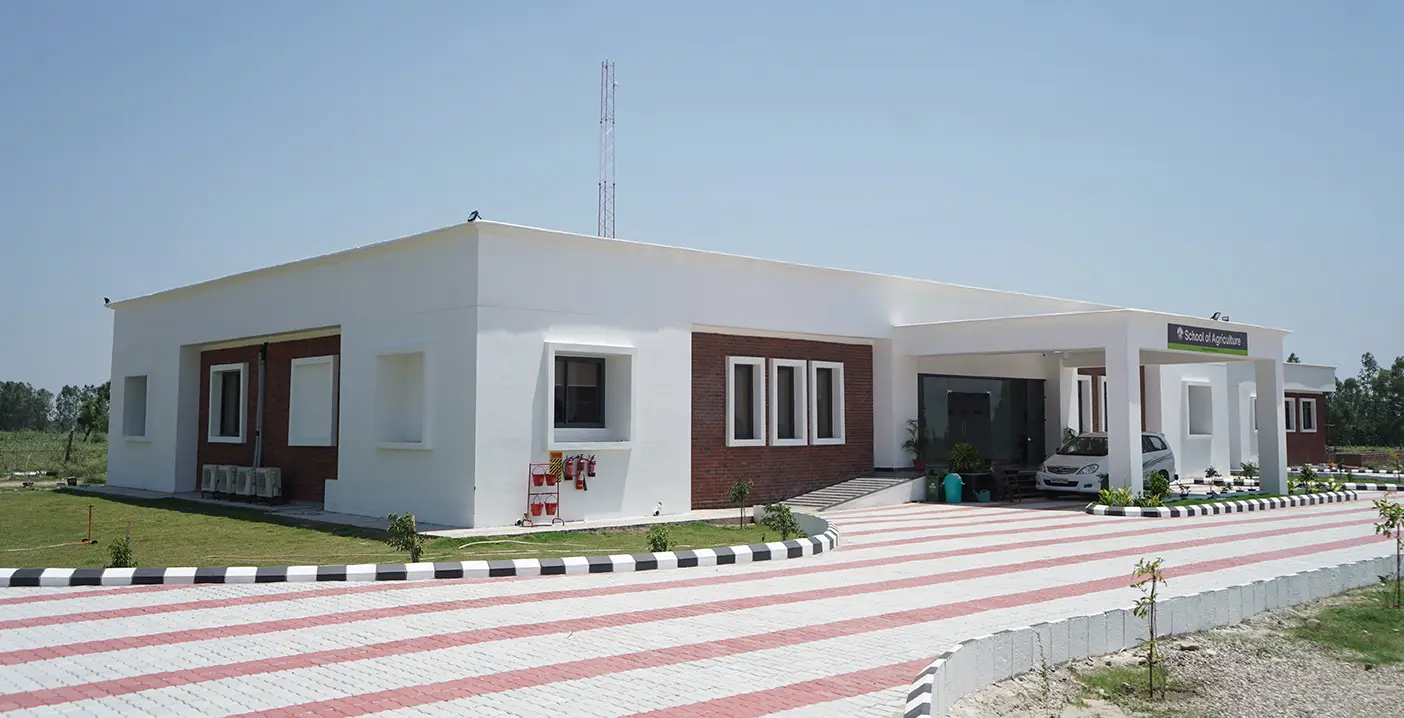
Welcome to the School of Agriculture at Graphic Era, a centre dedicated to excellence in agricultural education, research and innovation. The School of Agriculture is committed to nurturing future-ready agricultural professionals through quality education, practical exposure, and advanced research opportunities. The School encourages a multidisciplinary approach by providing students opportunities to collaborate and learn from various departments across the University.
With a strong emphasis on sustainable agriculture, modern farming technologies, agribusiness practices, and global agricultural advancements, the School of Agriculture prepares students to become skilled agricultural professionals, researchers, entrepreneurs, and leaders capable of addressing the evolving challenges of food security, natural resource management, and agro-industrial development in diverse environmental, technological, and economic settings.
10+2 in PCB /M or Agriculture
A structured teaching–learning framework with clearly defined Course Outcomes (COs) aligned with Program Outcomes (POs), Program Specific Outcomes (PSOs), graduate attributes, and current industry requirements in VLSI design, semiconductor technology, and chip development.
Integration of hands-on mini-projects and comprehensive capstone projects focusing on digital and analog VLSI design, RTL coding, ASIC/SoC design flow, FPGA-based implementations, and physical design to strengthen design thinking, innovation, and real-world problem-solving skills.
Extensive practical exposure through advanced laboratories in VLSI Design, Digital IC Design, Analog and Mixed-Signal Circuits, FPGA and ASIC Design, CMOS Technology, Semiconductor Devices, and EDA Tools, enabling experiential and skill-oriented learning.
Effective use of modern digital teaching tools and industry-standard EDA platforms such as Cadence, Synopsys, Xilinx/Vivado, ModelSim, MATLAB, Multisim, Learning Management Systems (LMS), NPTEL/SWAYAM resources, and virtual VLSI labs for design, simulation, and verification.
Regular guest lectures by semiconductor industry experts, industrial visits, workshops, certification programs, internships, and collaborative training initiatives to provide exposure to contemporary VLSI technologies, fabrication processes, and industry-standard design practices.
Active encouragement for student participation in IEEE/ISTE student chapters, VLSI design contests, hackathons, innovation challenges, IPR awareness programs, and funded research projects to foster research aptitude, innovation, and entrepreneurial thinking.
Promotion of teamwork and peer learning through group design projects, technical seminars, paper presentations, design reviews, discussions, and collaborative problem-solving sessions to enhance communication skills, professional ethics, and teamwork abilities.
To produce graduates with strong foundational and applied knowledge in agricultural sciences including agronomy, genetics and plant breeding, soil science, horticulture, plant pathology, entomology, agricultural economics, agricultural engineering, and extension education to address real-world agricultural challenges.
To develop analytical aptitude, critical thinking, and problem-solving skills among students for improving crop productivity, sustainability, and resilience through scientific approaches and modern agricultural technologies.
To prepare graduates for higher education, research, and competitive examinations in agriculture and allied sciences at national and international levels.
To inculcate entrepreneurial abilities, managerial competencies, and leadership qualities among students for agribusiness development, self-employment, start-ups, and professional careers in public and private sectors.
To sensitize students towards sustainable agriculture, environmental conservation, professional ethics, rural development, and socio-economic issues related to farming communities and society.
Apply fundamental and advanced knowledge of agronomy, genetics & plant breeding, soil science, horticulture, plant protection, agricultural engineering, agricultural economics, and extension education to agricultural systems.
Identify, formulate, and analyze complex agricultural problems using scientific principles, experimental data, and appropriate tools.
Design sustainable crop production systems, integrated farming systems, and climate-resilient agricultural practices for enhanced productivity and resource use efficiency.
Use research-based knowledge and research methods including design of experiments, analysis and interpretation of data, and synthesis of the information to provide valid conclusions.
Use modern agricultural technologies, ICT tools, bioinformatics resources, precision farming tools, and statistical software for data analysis and decision-making.
The student will be able to apply the knowledge of biotechnology and allied disciplines in industry, research and higher studies.
The student will be able to apply technological solutions in the area of modern biotechnological applications.
The students will be able to apply knowledge of biotechnology and allied disciplines to become an entrepreneur.
B.Sc. (Honours) Agriculture Graduate can pursue a variety of career paths, including agricultural research, agricultural extension, agribusiness management, farming and entrepreneurship. They can also opt for higher education, such as a master’s degree or a Ph.D., in the field of agriculture or related areas. Some of the prominent career opportunities are as below:
Notes: Semester 1 and 2 are applicable only for regular entry students. Lateral entry students begin from Semester 3.