
Merit prepared on basis of the qualifying exam
Bachelor’s degree in geology/geophysics/petroleum geosciences or any relevant area of allied Sciences with a minimum of 55% marks. Admission is granted on university-approved merit criteria.
The M.Sc. Applied Geology program offered by the Department of Petroleum Engineering and Earth Sciences, equips students with advanced knowledge in petroleum geology, mineral exploration, mining, geo-tech engineering, reservoir characterization, seismotectonics, environmental geology, and geohazard management.
Spanning four semesters with comprehensive coursework, field training, and dissertation research, the curriculum integrates cutting-edge topics like petrophysics, sequence stratigraphy, Himalayan tectonics, and Python for geosciences, preparing graduates for careers in ONGC, Oil India Ltd., GSI, mining corporations, and international energy firms. Emphasizing hands-on projects, industry-standard software, and Indian geological contexts, the program delivers industry-ready geoscientists capable of addressing real-world challenges in hydrocarbon exploration, resource assessment, and sustainable development.
Bachelor’s degree in geology/geophysics/petroleum geosciences or any relevant area of allied Sciences with a minimum of 55% marks. Admission is granted on university-approved merit criteria.
The M.Sc. in Applied Geology program employs a blend of traditional and modern teaching methodologies to provide students with a comprehensive and practical learning experience. The pedagogical approach includes
As part of academic enrichment, students engage with specialized modules and focus areas that deepen understanding and industry relevance. Students have the liberty to align their career path with their interests and chosen domain of specialization, preparing them for diverse roles in geology, geospatial science, environmental sectors, and resource industries: Remote Sensing & GIS, Mineralogy & Petrophysics, Mining Geology, Palaeontology & Evolutionary Geology, Petroleum geology and Petrophysics.
These focus areas build depth and prepare students for specialized roles in exploration, environmental assessment, resource consultancy, and advanced academic pursuits
Equip graduates with a strong foundation in geological principles, field methods, and analytical skills, enabling successful careers in geoscience, natural resources, and environmental sectors.
Develop competence in geological mapping, sampling, petrography, and data interpretation to address multidisciplinary geoscience challenges.
Prepare graduates to pursue advanced studies and research in geology, earth system sciences, and allied disciplines.
Promote professional values, ethical responsibility, and adherence to safety standards relevant to geoscience practice.
Build teamwork, communication, and problem-solving abilities for effective professional engagement in industry, academia, and government organizations.
Foster adaptability and lifelong learning to keep pace with technological innovations, geospatial tools, and emerging trends in geological sciences.
Demonstrate advanced knowledge of applied geology, including mineral, energy, water, and environmental resources, with strong theoretical and practical foundations.
Apply geological principles, field methods, and laboratory techniques to investigate complex subsurface and surface geological problems.
Analyse and interpret geological, geophysical, geochemical, and geospatial datasets using quantitative methods, geostatistics, and modern digital tools.
Utilize GIS, remote sensing, modelling software, and emerging AI/ML approaches for resource evaluation, hazard assessment, and environmental analysis.
Communicate scientific findings effectively through professional technical reports, maps, presentations, and research publications.
Demonstrate professional ethics, environmental responsibility, safety awareness, and preparedness for industry practice, research, or doctoral-level study.
Apply advanced geological, geophysical, and geochemical techniques for resource exploration, hydrogeology, and environmental studies, integrating petrophysical and geostatistical analyses.
Conduct independent field and laboratory investigations, using AI/ML tools, 3D modelling, and advanced GIS/RS applications for complex subsurface and surface geological interpretations.
Design and execute independent research or industry-oriented projects, generating professional-grade reports, models, and interpretations aligned with exploration, environmental consultancy, and applied geoscience practice.
The M.Sc. in Applied Geology equips graduates with practical skills and knowledge essential for advancing geological exploration, sustainable mining, and environmental stewardship—domains critical to resource security, infrastructure resilience, and planetary health in a resource-constrained world.

Graphic Era Deemed to be University has a strong connection to various industries, and its track record for successfully placing students in reputable positions is outstanding, with graduates being placed in internships and permanent roles. The university has formed valuable relationships with globally recognized companies such as Amazon, Microsoft, Google, Walmart, Adobe, and many more, providing students with ample opportunities to kick-start their careers.
Graduates from Graphic Era Deemed to be University can be confident in their ability to succeed in the workforce due to the exceptional training and real-world experience they gain from their internships and placements with these top-tier companies.
Notes: Semester 1 and 2 are applicable only for regular entry students. Lateral entry students begin from Semester 3.
Students gain analytical skills, geological field and laboratory techniques, data interpretation, scientific communication, and problem solving relevant to Earth science applications.
Yes. Students can engage in independent and faculty led research projects, present findings at academic forums, and contribute to publications, enhancing academic and professional readiness.
Absolutely. The program covers critical topics such as hydrology, geochemistry, and environmental geology that underpin environmental and sustainability careers.
Yes. Extensive field mapping, geological surveys, and field-based projects are an integral part of the curriculum to provide hands-on experience.
Yes. Students can choose specializations such as Remote Sensing & GIS, Mineralogy, Mining Geology, Palaeontology, Geostatistics, Petroleum Geology, or Environmental Geology.
Yes. Students learn to use GIS, Remote Sensing software, geostatistical tools, and other analytical applications for geological investigation.
Yes. Graduates are well-prepared for M.Sc., M.Tech., or Ph.D. programs in Geology, Applied Geosciences, Environmental Sciences, and related research fields.
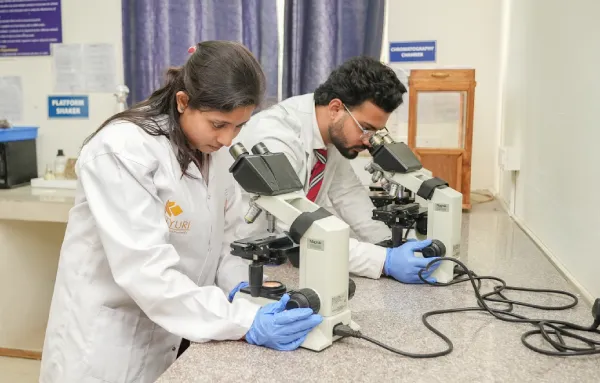
Through a combination of practical laboratory work, field projects, software training, and exposure to industry-oriented topics, students develop skills directly applicable to professional geoscience roles.
Bachelor’s degree in geology or any relevant area of allied Earth Sciences with a minimum of 55% marks. Admission is granted on university-approved merit criteria.