


GEU
facilities
Level
Ph.D.
facilities
Duration
As per UGC Guidelines
Ph.D.  in Program in Geology

Admission Procedure

Merit prepared on basis of the qualifying exam

Provisional Admission

Master degree (1-year after a 4-year UG OR 2-year after a 3-year UG) or equivalent in Earth Science streams, Petroleum Engineering streams or relevant field with 55 % marks or equivalent, 5% relaxation for SC/ST/OBC (NCL) PwD/EWS 4-year Bachelor’s Degree (Direct Admission) 4-year/8-semester Bachelor’s degree with 75 % marks. 5% relaxation for reserved categories.

About The Program

The Department of Petroleum Engineering and Earth Sciences offers Ph.D. program in Petroleum Engineering and Ph.D. program in Geology aims to develop high quality research programmes in areas of drilling fluids, drilling, petrophysics, petroleum geology, unconventional hydrocarbon resources, and data-driven decision-making using computational modeling, machine learning, and geoscientific analysis, energy, seismic studies, stress inversion, remote sensing & InSAR, landslides, engineering geology, paleontology, micropaleontology, biostratigraphy, paleoclimate, paleoceanography, climate change, marine and terrestrial environmental studies, hydrology, groundwater, natural hazards, with an emphasis on interdisciplinary approach.

The Ph.D. programme consists of a combination of course work and independent research. All Ph.D. students are expected to complete a specified of number of credits through course work based on educational qualification.

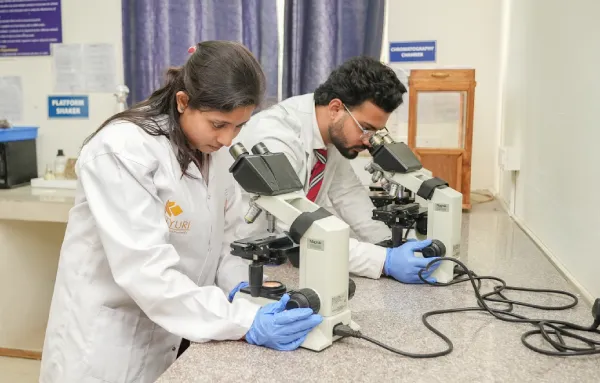
All Ph.D. students are expected to carry out independent research and present research findings in conferences and publications. The Ph.D. program is supported by advanced research infrastructure, strong academic environment, and centre for Artificial Intelligence & High-Performance Computing, in collaboration with NVIDIA, access to national and international journals, conferences proceedings, and collaborative research platforms, fostering global academic engagement. Strong institutional support is provided for conducting research, publishing in high-impact journals, and presenting scholarly outcomes at national and international forums.


Eligibility

Master degree (1-year after a 4-year UG OR 2-year after a 3-year UG) or equivalent in Earth Science streams, Petroleum Engineering streams or relevant field with 55 % marks or equivalent, 5% relaxation for SC/ST/OBC (NCL) PwD/EWS 4-year Bachelor’s Degree (Direct Admission) 4-year/8-semester Bachelor’s degree with 75 % marks. 5% relaxation for reserved categories.

M. Phil. with 55% marks or equivalent (5% relaxation for reserved categories)

Note: All eligibility conditions follow UGC regulations in force.

Teaching Pedagogies

The Ph.D. Program in Petroleum Engineering, Geology adopts a research-driven and learner-centered but mentor-guided pedagogical framework emphasis on independence and originality. Teaching–learning activities are designed to reinforce foundational disciplinary knowledge while cultivating advanced research competencies, critical thinking, experimental design, modeling and simulation, and research communication. These activities emphasize inquiry-driven learning, methodological depth, scholarly discourse, and the development of independent researchers capable of producing original and impactful knowledge.

The teaching learning pedagogies include interactive lectures, advanced laboratory based learning, focused seminars, journal club discussions, problem-based learning, experimental design based learning, high-performance computing resources based learning, field work based learning, blended and digital learning and industry interaction based learning.

Career Prospects

A Ph.D. in Geology, Petroleum Engineering, opens diverse career pathways across academia, industry, research institution, and public sectors. The common roles include university faculty as Assistant Professors, Associate Professors, or Professors, research scientists in research institution, research labs, and postdoctoral fellows, as well as advanced technical and leadership positions in oil and gas, energy, mineral exploration, resource management, infrastructure development, environmental consulting, companies. A Ph.D. holder also contribute to research and development in national laboratories, government agencies, regulatory affairs, intellectual property rights (IPR), and consulting firms, while expanding opportunities exist in emerging areas such as energy transition technologies, carbon capture and storage, geothermal energy, and sustainability. Their advanced research expertise, analytical capability, and scientific rigor enable them to address complex subsurface challenges and support innovation, policy, and strategic decision-making in the evolving global energy and earth science sector.

Notes: Semester 1 and 2 are applicable only for regular entry students. Lateral entry students begin from Semester 3.

Course Curriculum

Credit requirement is based on educational qualification

  • M. Tech / M. Phil or equivalent
  • M. Sc/M.A/M.Com/M.C.A/M.B.A or equivalent
  • B. Tech with 5 years professional experience
  • B. Tech or equivalent with valid GATE score

Semester 1

  • Research Methodology (Credits: 4)
  • Seminar (Credits: 2)

Elective course (Credits: 4 each)

  • Drilling Fluid Properties and Production Practices
  • Drilling Techniques
  • Geomorphology
  • Remote Sensing and GIS
  • Reservoir Engineering
  • Engineering Geology
  • Geochemistry
  • Python for Geoscience
  • Big Data for Geo Data Science
  • Sustainable Energy Resources
  • Health, Safety, Environment & Climate Change
  • Carbon Management and Sustainable Development
  • Applied Micropaleontology
  • Groundwater Hydrology

Contact Us

GEU
GEU

566/6, Bell Road, Society Area,
Clement Town, Dehradun,
Uttarakhand