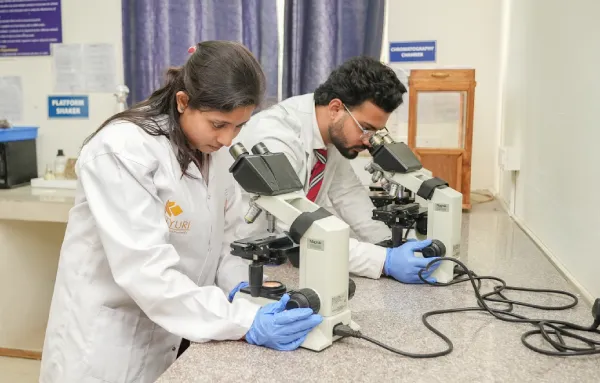

The School of Agriculture offers a blend of quality education, modern agricultural technologies, practical exposure, industry interaction, and research-oriented learning. Students gain hands-on experience through instructional farms, laboratories, polyhouses, hydroponics units, dairy units, mushroom production facilities, and field-based training.
The School focuses on experiential learning, smart agriculture technologies, research exposure, entrepreneurship development, precision farming, hydroponics, industry collaborations, and student-centric teaching methodologies aligned with ICAR standards.
Yes. The curriculum integrates practical learning, field exposure, agribusiness insights, ICT-enabled teaching, precision agriculture, research activities, internships, and interaction with agricultural scientists and industry experts.
Yes. Students undergo laboratory practical, field demonstrations, crop production activities, internship programs, farm training, research projects, industrial visits, and experiential learning modules.
Yes. Students are encouraged to participate in research projects, thesis work, scientific seminars, conferences, workshops, innovation activities, and field experiments.
Yes. The School integrates precision farming, GIS & remote sensing, hydroponics, protected cultivation, bioinformatics, weather-based advisory systems, ICT tools, and modern farm machinery into teaching and practical training.
The School offers:
Yes. Students are trained in agribusiness planning, startup development, value addition, agri-enterprise management, and commercial agriculture practices.
Yes. Regular field visits, industry interactions, internships, rural exposure, and practical demonstrations are integral components of all programs.
The School supports students through academic mentoring, industry interaction, skill development, placement assistance, research guidance, and entrepreneurship support.
Yes, the school of offers PhD programmes in Agriculture (selected disciplines)
Yes. The school has three farm sites with a specific area provided to the respective domain for practical training of students regarding various agricultural operations such as land preparation, plant protection measures, sowing methods, cultivation, harvesting, etc.
Yes. The School has hi-tech hydroponic polyhouses, naturally ventilated polyhouses, shade net houses, and greenhouse facilities.
Yes. The instructional dairy unit “Kamdhenu Dairy” supports practical learning related to livestock and dairy management.
These facilities help students identify crops, improved cultivars, seeds, and understand crop diversity through practical demonstration.
Yes. Dedicated instructional units are available for mushroom cultivation and vermicomposting training.
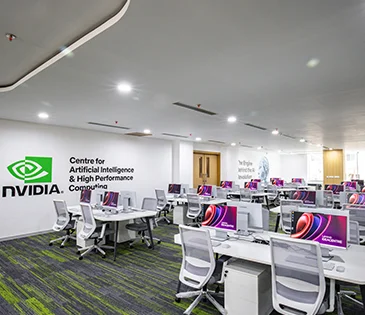
Yes. Smart classrooms, multimedia projectors, Wi-Fi-enabled teaching, online learning resources, and modern ICT tools are integrated into academics.
Yes. The School supports students through placement guidance, industry networking, internships, skill development, and career mentoring.
Yes. Students can appear for ICAR, ARS, NABARD, IBPS-AFO, FCI, UPSC, State PCS, and other agriculture-related examinations.
Yes. The programs prepare students for higher education, research collaborations, agribusiness careers, and international opportunities in agriculture and allied sectors.
Yes. Students are encouraged to build agri-startups, agribusiness ventures, protected cultivation enterprises, seed businesses, food processing units, and digital agriculture solutions.
The School integrates sustainability, climate-smart agriculture, precision farming, research, innovation, agribusiness management, and modern technologies into its academic ecosystem to prepare future-ready agricultural professionals.
The program duration is 4 years divided into 8 semesters.
Students must have passed 10+2 with PCB/PCM/Agriculture subjects.
The program covers agronomy, horticulture, soil science, genetics & plant breeding, agricultural economics, plant pathology, entomology, extension education, agricultural engineering, and agribusiness management.
Yes. Students receive extensive practical exposure through instructional farms, crop production activities, demonstrations, and experiential learning programs.
The School follows Outcome-Based Education (OBE), experiential learning, project-based learning, blended teaching, ICT-enabled learning, field-based practical, and continuous assessment.
Yes. Students learn hydroponics, precision farming, protected cultivation, integrated farming systems, climate-smart agriculture, and sustainable farming practices.
Graduates can pursue careers as:
Yes. Students can pursue M.Sc. in Agriculture, horticulture, allied fields, MBA in Agribusiness at international and national levels.
Students can appear for national and state level government exams like ADO/AO, Extension Officers, National Boards, ICAR, ARS, NABARD, IFFCO, IBPS-AFO, FCI, UPSC, State PCS and other agriculture-related examinations.
Yes. The curriculum strengthens concepts required for ICAR, UPSC, State PCS, NABARD, IBPS-AFO, ARS, and other agriculture-related examinations.
Yes. Students are encouraged to develop agribusiness ideas, startups, value-added products, and sustainable agricultural enterprises.
Yes. The curriculum follows ICAR VI committee align with NEP 2020