BOARD OF STUDIES (BoS) MEETING REPORT
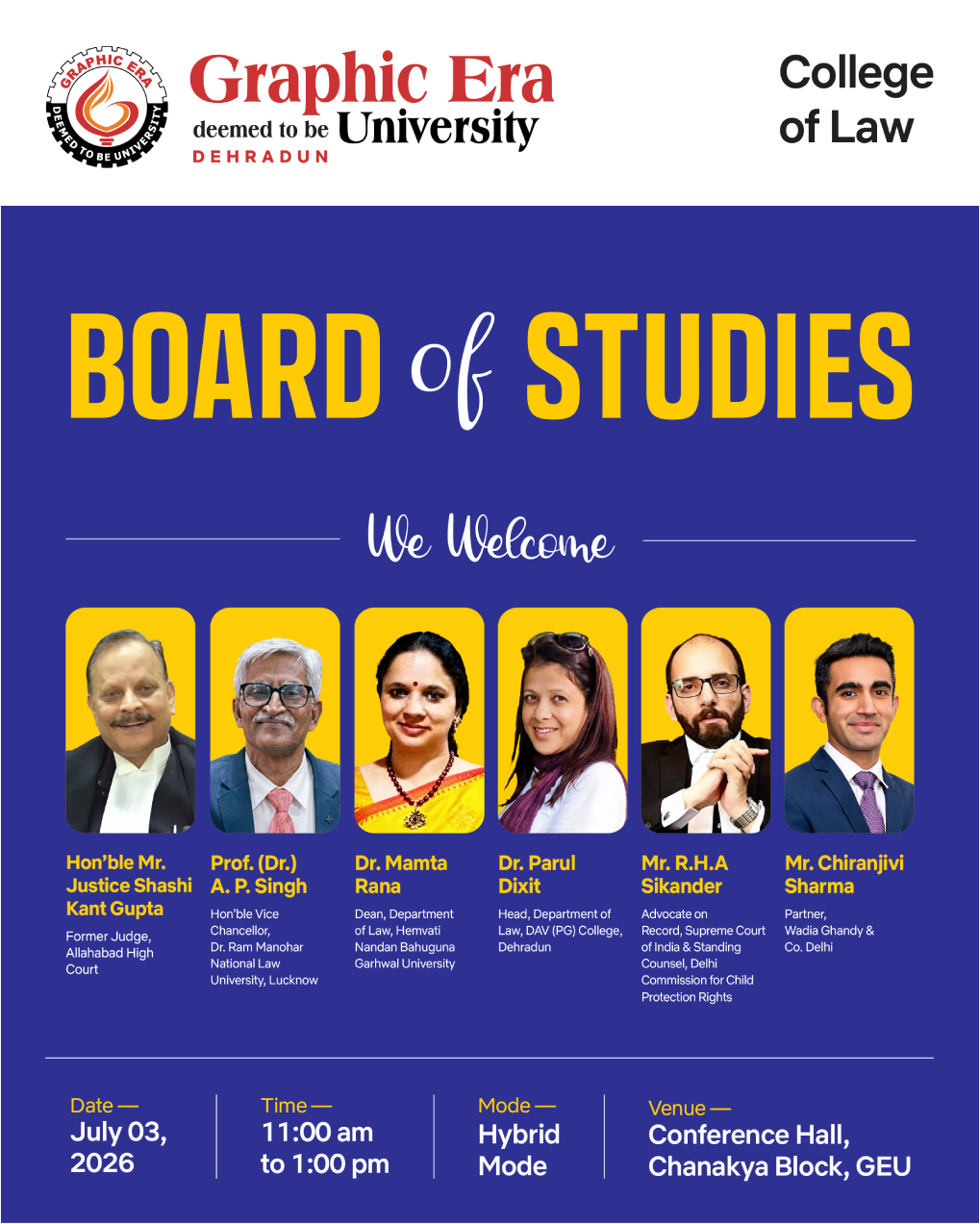
Date: 3/7/2026
Time: 11:00 am to 1 pm
Introduction
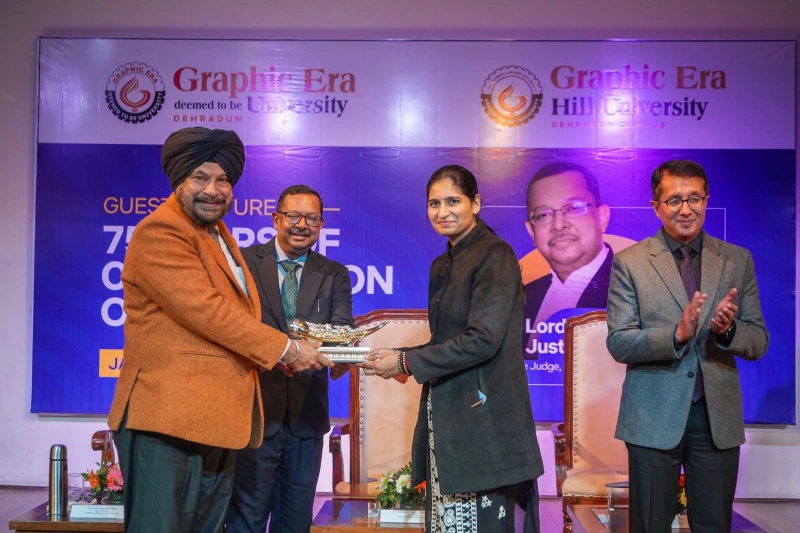
The Board of Studies (BoS) Meeting of the College of Law, Graphic Era (Deemed to be University), Dehradun, was convened to review and strengthen the academic framework of the undergraduate, postgraduate, and research programmes offered by the College. The meeting was was graced by the esteemed presence of Hon'ble Mr. Justice Shashikant Gupta, Former Judge, Allahabad High Court; Prof. (Dr.) A. P. Singh, Vice Chancellor, Dr. Ram Manohar Lohiya National Law University, Lucknow; Prof. (Dr.) Mamta Rana, Dean, Faculty of Law, Hemvati Nandan Bahuguna Garhwal University; Dr. Parul Dixit, Head, Department of Law, DAV (PG) College, Dehradun; Mr. R. H. A. Sikander, Advocate-on-Record, Supreme Court of India; and Mr. Chiranjiv Sharma, Partner, Wadia Ghandy & Co. and chaired by Dr. Ashutosh Hajela, Professor & Head, College of Law, Graphic Era (Deemed to be University), Dehradun.
The meeting was also attended by Dr. Shailja Thakur and Dr. Samta Kathuria, Faculty Members of the College of Law, along with the Research Scholars Ms. Ankita Kandari, Mr. Arun Singh, Mr. Aakash Sajwan, Ms. Joohi Deshmukh, Mr. Mridul Pandey, and Ms. Shubhangi Arya. Their active participation in the proceedings contributed meaningfully to the deliberations, reflecting the College's collaborative approach towards academic excellence, curriculum development, and quality enhancement in legal education.
Valuable Remarks by the Distinguished Members
The distinguished members of the Board appreciated the academic initiatives undertaken by the College of Law and offered several constructive suggestions to further strengthen the curriculum and improve students' professional competencies.
Hon'ble Mr. Justice Shashikant Gupta, Former Judge, Allahabad High Court, emphasized that legal education should focus not only on doctrinal knowledge but also on developing students' practical understanding of the justice delivery system. He recommended strengthening clinical legal education through regular court visits, trial advocacy exercises, moot courts, legal aid activities, and internships so that students graduate with both academic knowledge and practical courtroom experience. He also stressed the importance of professional ethics, constitutional values, and advocacy skills as integral components of legal education.
Prof. (Dr.) A. P. Singh, Vice Chancellor, Dr. Ram Manohar Lohiya National Law University, Lucknow, highlighted the transformative role of technology in the legal profession. He recommended adopting an interdisciplinary and outcome-based approach in accordance with the National Education Policy (NEP) 2020, enabling students to acquire technological competence alongside legal expertise.
Prof. (Dr.) Mamta Rana, Dean, Faculty of Law, Hemvati Nandan Bahuguna Garhwal University, underscored the importance of integrating contemporary legal developments into the curriculum. She encouraged greater emphasis on research methodology, interdisciplinary learning, and emerging areas of law.
Dr. Parul Dixit, Head, Department of Law, DAV (PG) College, Dehradun, emphasized the need to bridge the gap between classroom teaching and professional practice.
Mr. R. H. A. Sikander, Advocate-on-Record, Supreme Court of India, stressed that litigation demands strong practical skills in drafting, research, and courtroom advocacy. He suggested that students should be exposed to procedural law through simulated court proceedings, case analysis, and regular interaction with practicing advocates and judges. He also recommended mandatory internship components across different stages of the law programme to strengthen professional readiness.
Mr. Chiranjiv Sharma, Partner, Wadia Ghandy & Co., highlighted the evolving expectations of the legal industry in the era of digital transformation. He recommended introducing specialised courses on Corporate Compliance, and Contract Drafting, while strengthening internships with leading law firms and corporate legal departments to enhance employability and industry preparedness.
The Board unanimously observed that legal education is undergoing rapid transformation owing to technological advancements and changing professional requirements. It was therefore recommended that the curriculum place greater emphasis on Artificial Intelligence and Law, Legal Technology, Data Protection, and Digital Governance, while simultaneously reinforcing clinical legal education through legal aid clinics, internships, moot courts, trial advocacy, mediation, negotiation, drafting exercises, and experiential learning. The members agreed that a balanced integration of theoretical instruction with practical training would better equip students to meet the evolving demands of the legal profession.














 Download Brochure