Teaching Pedagogies
The design pedagogy is aimed at empowering future designers with building-in enhanced human intelligence (HI) for creative problem-solving with AI assisted holistic curriculum that cultivates intelligence, capacity, skills, tools, method, technique, and crucial additional factors in a developmental sequence, fostering well-rounded creative minds.
Design education embraces the synergy of Al and HI, forging a 'hyper-transdisciplinary' approach. This empowers learners to tackle complex challenges through deep integration of knowledge, Al-augmented creativity, and ethically guided innovation. Cultivating both Al literacy and enhanced human intelligence will be central to shaping impactful design solutions for tomorrow's world.
Building-in Areas of Expertise in Innovation
Design Strategy: Defines the overarching vision and framework for design decisions to achieve specific goals.
- User research
- Design direction
- Culture & context
- Design impact
- Socio-business design
- Strategic design
Design Tools & Technologies: Equips students with the practical skills to translate concepts into tangible outputs using relevant software and methods.
- Design thinking
- CAD softwares
- Human intelligence & Artificial intelligence
- Ergonomics
- Prog. languages
- XR Lab (AR+VR+MR)
- Emerging technologies
Design Innovation : Fosters creative problem-solving and the development of novel and impactful design solutions.
- Design process
- HCI - Human Factors
- Inclusive Design
- Systems thinking
- Managing uncertainty
- Value realization & creation
Experience Design: Focuses on understanding and shaping meaningful and user-centric interactions across touchpoints.
- Multi-sensory design
- Human interface
- Nature & sustainability
- Design futures
- Product lifestyle
- Holistic User Experience
Business Design Management: Integrates design thinking with business principles for strategic decision-making and value creation.
- Business tools for Design
- Leadership & change maker
- Design management
- Professional communication
- Promotion & awareness
- Business strategy
- Project management
Infrastructure
- Drawing Studios
- Illustration and Graphic Design Studios
- Photography Studio
- Sound Mixing and Recording Studio
- Cinematography Studio
- CAD Studio
- Visual Merchandising Studio
- Prototyping Workshops (such as Wood, Metal, Plastic, Paint shop, Assembly workshop)
- Ergonomics Lab
- Fabrication Lab
- Mechatronics lab
- CNC Lab and Laser Cutting Shop Floor
- 3D Printing Facility
- Material Testing lab
- IoT Lab
- AR/VR Lab & Usability Lab
- Creative Display Studio
Key highlights - Infrastructure
The infrastructure at the world-class B.Des. (Interior and Spatial Experience Design) program is based on the concept of 'living labs' that merge physical craftsmanship with digital intelligence. The following list outlines the essential infrastructure categories aligned with industry standards:
Experience & Interaction Labs: These spaces move beyond static visuals to allow for real-time spatial testing.
- Simulation Suite : Equipped with motion-capture sensors and spatial audio systems, it allows students to walk through 1:1 scale digital twins of their designs to test volume, lighting, and movement.
- Smart Space & IoT Lab : A functional interior setup where students can program 'responsive environments', adjusting smart lighting, automated partitions, and climate sensors based on user behavior data.
- Human Factors & Ergonomics Lab : Equipped with eye-tracking glasses and wearable biometric sensors to measure how users physically and emotionally react to different spatial layouts and color palettes.
Fabrication & Making Centers : The bridge between a conceptual 'idea' and a tangible 'product.'
- Advanced Digital Fabrication Lab : Equipped with high-precision laser cutters, multi-axis CNC routers, and large-format 3D printers for creating custom furniture, intricate joinery, and structural components.
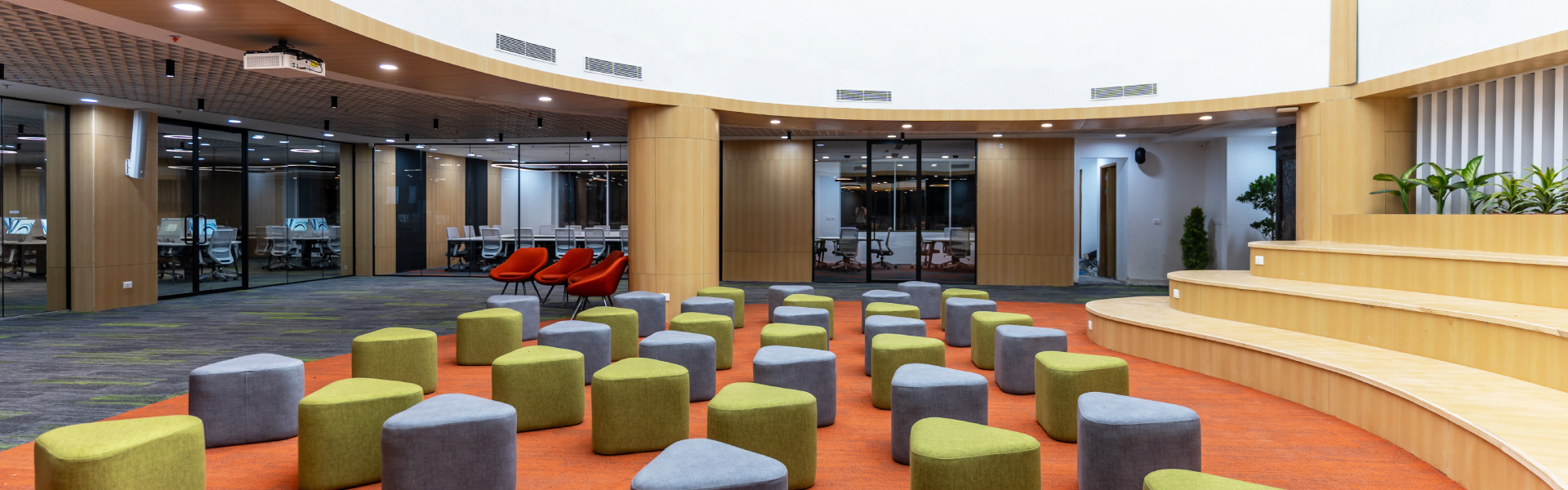
- The Workshop : A traditional making space for woodworking, metal-smithing, and clay modeling, where students learn the 'tactile weight' of materials and manual construction techniques. In the open-plan area students can construct full-scale 'spatial fragments' (like a retail kiosk or a hospital room) to test construction feasibility.
Material & Resource Libraries : A hub for research into the 'skin' of the built environment.
- Circular Material Library and Sample Hub : A physical and digital archive focusing on 'regenerative' materials, mycelium-based bricks, recycled ocean plastics, and carbon-negative finishes, with detailed data on their life cycle.
Collaborative Design Studios : The core academic engine of the program.
- Agile Design Studios : Replacing fixed desks with 'mobile workstations' and writable walls. This allows the space to be reconfigured instantly for a solo drafting session, a team charette, or a formal jury.
- High-End Visualization Cluster : Workstations optimized for heavy environmental simulations (lighting, airflow, and complex geometry) and high-fidelity rendering.
- Hybrid Crit Studio : A presentation area with large-scale interactive touchscreens and global connectivity for remote jury members or international industry collaborators to mark up student work in real-time.
Ancillary & Support Spaces : Infrastructure that fosters a professional culture.
- Archive & Documentation Studio : A dedicated space for high-quality photography and videography of student models and full-scale prototypes for portfolio building.
- Student 'Maker' Commons : An informal, 24/7 accessible space for social interaction and spontaneous 'tinkering,' designed with biophilic principles to support mental well-being.
- Industry Liaison Office : A professional meeting room for hosting live clients, project partners, and site supervisors for collaborative 'Live Lab' sessions.
The following key highlights characterize the unique pedagogical and professional environment of the program.
Experience-Centric Design Philosophy : The curriculum prioritizes the 'human-spatial interface', moving design inquiry from surface aesthetics to the psychological and physiological impact of built environments. This includes the study of atmosphere, sensory perception, and human behavior within a space.
Evidence-Based Design (EBD) Methodology : Students engage in 'research-led' studio projects where design decisions are validated through environmental simulations and user-data analytics. This scientific approach facilitates the creation of high-performance spaces in healthcare, workplace, and retail sectors.
Material Innovation & Circularity : A core academic pillar focuses on 'Life Cycle Thinking'. The program explores the integration of regenerative materials, carbon-neutral finishes, and adaptive reuse strategies to address the global demand for sustainable spatial interventions.
Phygital & Smart Environment Integration : The pedagogy incorporates the design of 'Responsive Spaces', where physical interiors are augmented by digital overlays and IoT (Internet of Things) frameworks. Students learn to design environments that adapt in real-time to occupant needs and environmental shifts.
Transdisciplinary Industry 'Live Labs' : Academic credit is awarded for 'Live Lab' collaborations, where students work alongside architects, urban planners, and technology consultants. This structure provides a professional context for solving complex, real-world spatial problems before graduation.
Advanced Digital Fabrication & Prototyping : The program provides access to high-precision manufacturing tools, enabling the transition from 'concept' to 'prototype'. This includes the mastery of complex geometries through parametric design and 1:1 scale construction of spatial components.
Global Design Standards & Benchmarking : The curriculum aligns with international professional frameworks, preparing graduates for global practice. Emphasis is placed on universal design principles, inclusive accessibility, and global building codes.
Specialization
Stream: B.Des. (Interior Spatial Experience Design)
Interior and Spatial Experience Design focuses on creating meaningful, functional, and restorative physical environments, systems, and habitats. This specialization determines how people interact with the built world, shaping their entire journey within a space to be intuitive, healthy, and culturally resonant.
The program elevates traditional interior design to spatial experience design, teaching students to curate the full discourse of engagement a person has with a physical environment—from sensory triggers to smart responsiveness. It integrates environmental foresight and deep human-centered research to manage the complexity of smart, biophilic, and sustainable systems. The curriculum focuses on ethics, inclusive accessibility, and the enhancement of human well-being, ensuring that the spaces of the future augment user comfort and decision-making while maintaining a regenerative relationship with the planet.
Highlight Areas
Responsive Environments & Ambient Intelligence, Human-Space Interaction (HSI) & Spatial Psychology, End-to-End Spatial Service Blueprinting, Environmental Ethics, Universal Inclusion, and Circularity, Strategic Foresight & Trend Integration in Habitats, Biophilic Urbanism, Socio-Spatial Design and many more.










 Download Brochure




 Download
Brochure
Download
Brochure