





GEU
facilities
Level
Certificate
facilities
Duration
2 Years
facilities
Fee Structure
Click Here
Diploma In Hotel Management

Admission Procedure

Merit prepared on basis of the qualifying exam

Provisional Admission

Candidates must have completed 10+2 or an equivalent examination from a recognized Board.

About The Program

The Diploma in Hotel Management is a comprehensive two-year programme designed to prepare students for operational and supervisory roles in the hospitality industry.

The programme is structured into four semesters, comprising one year of academic study followed by one year of industrial exposure. During the academic phase, students gain strong theoretical knowledge along with practical training in core hotel operations through classroom instruction, laboratory work, and skill-based learning.

The industrial exposure year provides hands-on, real-world experience in reputed hotels and hospitality establishments, enabling students to apply classroom learning in professional environments. The diploma offers specialization in Food Production & Bakery, Food & Beverage Service, and Room Division operation (Front Office & Housekeeping), equipping students with focused skills, industry-relevant competencies, professional grooming, and service orientation required for successful careers in hotels, resorts, cruise lines, airlines, and the broader hospitality service industry.

Eligibility Criteria for the admissions in the Program

  • Candidates must have completed 10+2 or an equivalent examination from a recognized Board.
  • Students from any stream (Science/Commerce/Humanities) are eligible to apply.
  • A minimum of 50% aggregate marks in the qualifying examination is required (as per University norms)

Teaching Pedagogies

  • Lecture Method Concept-based classroom teaching for theory subjects such as Front Office, F&B Service, Housekeeping, and Food Production.
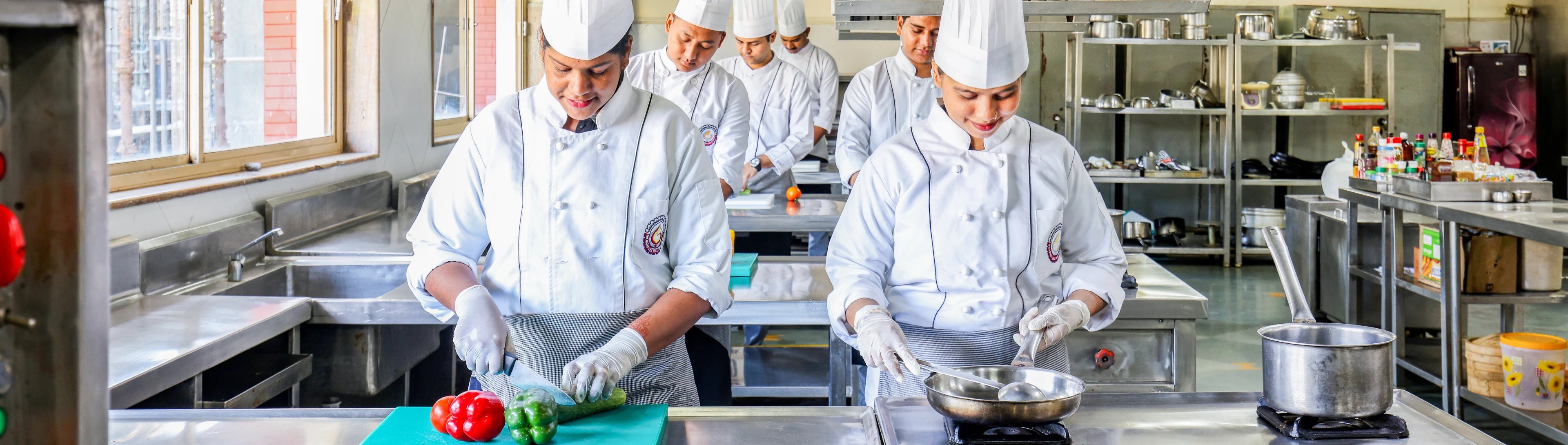
  • Practical Demonstrations Live demonstrations in training kitchens, training restaurants, bakery labs, and housekeeping labs.
  • Hands-on Training / Skill-Based Learning Students perform tasks independently under faculty supervision to develop operational skills.
  • Industry Exposure Visits Educational visits to hotels, resorts, catering units, airlines, and hospitality operations for one year.
  • Industrial Training / Internship Mandatory on-the-job training in hotels or hospitality organizations.
  • Audio-Visual Aids & ICT Tools Use of PPTs, videos, virtual hotel tours, and hotel software demonstrations.
  • Guest Lectures & Industry Experts Sessions Sessions by hotel managers, chefs, HR professionals, industry & academic expert and alumni.
  • Group Discussions & Presentations Enhances communication skills, teamwork, and confidence.
  • Mock Interviews & Grooming Sessions Preparation for placements through interview practice and professional grooming.
  • Blended Learning Combination of classroom teaching, online resources, and practical labs.
  • Assessment through Continuous Evaluation Practical exams, viva, assignments, and performance-based assessments.
  • Event-Based Learning Students manage live events, catering functions, and campus hospitality operations.

Specializations

  • Food Production & Bakery Operation
  • Food & Beverage Service Operation
  • Room Division Operation

Program Educational Objectives (PEOs)

PEO1

To meet the demand for trained and professional people in the hospitality industry of our country.

PEO2

To provide opportunities to the students within the institution, for developing necessary operating skills, values, and attitudes to occupy key operational positions in the hospitality sector.

PEO3

Function effectively as an individual, and as a member or leader in diverse teams, and in multidisciplinary settings.

PEO4

Apply ethical principles and commit to professional ethics, responsibilities, and norms of the hospitality practice.

PEO5

Identify, formulate, research literature, and analyze complex hospitality problems Reaching substantiated conclusions using principles of management.

Program Outcomes (POs)

PO1

Effective & Efficient execution

Executes activities effectively and efficiently to the standards expected in the operation required in the hospitality sector.

PO2

Managerial Skills

Manages tasks, functions, duties, and activities in the operation of the hotels, restaurants, travel, and government and non-government agencies in accordance with the competency standards.

PO3

Analytical Problem Solving

Analyses situation, identifies problems, formulates solutions, and implements corrective and/or mitigating measures and action management into food service and accommodation operations.

PO4

Critical Thinking

Exhibit the ability to develop, examine, question, and explore perspectives or alternatives to problems in hospitality operations.

PO5

Effective Communication

Demonstrate the ability to use professional written and oral communication skills and techniques to successfully communicate.

PO6

Diversifying Skills

Display awareness, understanding, and skills necessary to live and work in a diverse world.

PO7

Ethical Professionalism

Practice professional ethics, provide leader.

Program Specific Outcomes (PSOs)

PSO1

Utilize interpersonal skills to lead/manage first-level employees in a hospitality setting.

PSO2

Comprehend and articulate written and oral communication as appropriate for hospitality environments.

PSO3

Demonstrate ability to apply policies for managing diverse, multicultural hospitality.

PSO4

Exhibit awareness of professional and ethical responsibility in all aspects of conduct.

PSO5

Demonstrate an ability to manage the professional preparation, presentation and service of quality food and beverages.

Career Pathways

  • Hotels
  • Resorts
  • Airlines
  • Cruise lines
  • Retail
  • The hospitality service industry

Notes: Semester 1 and 2 are applicable only for regular entry students. Lateral entry students begin from Semester 3.

Frequently Asked Questions

DHM (Diploma in Hotel Management) is a professional course designed to train students for careers in the hospitality and tourism industry, covering hotel operations, customer service, and management basics.

The duration of the DHM program is usually 2 years, which includes academic study and industrial training / internship.

Students must have passed 10+2 (any stream) from a recognized board. Some institutes may allow admission after 10th standard as well.

Core subjects include:
  • Food Production
  • Food & Beverage Service
  • Front Office Operations
  • Housekeeping
  • Hospitality Marketing
  • Communication Skills
  • Hotel Accounting
  • Industrial Training

Yes, industrial training (internship) is a compulsory part of the course and helps students gain practical exposure in hotels and resorts.

Graduates can work in:
  • Hotels & Resorts
  • Airlines & Cruise Lines
  • Restaurants & Cafรฉs
  • Event Management Companies
  • Tourism Offices
  • Hospitals and Corporate Catering

Common roles include:
  • Front Office Executive
  • Food & Beverage Service Associate
  • Commis Chef
  • Housekeeping Supervisor
  • Guest Relations Executive

The starting salary ranges between โ‚น12,000 โ€“ โ‚น20,000 per month, depending on the organization and location.

Yes. Students can go for:
  • BHM (Bachelor in Hotel Management)
  • B.Sc. in Hospitality or Catering
  • MBA in Hospitality or Tourism

Most institutes provide placement support and interview opportunities with reputed hotel brands.

Yes. Hospitality skills are globally relevant, and students can apply for jobs abroad after gaining experience.

  • Good communication
  • Pleasant personality and grooming
  • Customer-service mindset
  • Teamwork and adaptability
  • Time management

The medium of instruction is English, but practical explanations may be given in Hindi or bilingual mode for better understanding.

Most institutes offer direct admission based on eligibility. Some may conduct a personal interview or basic aptitude test.

Generally, the age limit is 17โ€“25 years, but it may vary depending on institute policies.

Students must follow professional grooming standards such as:
  • Formal uniform as prescribed by the institute
  • Clean shave / neatly trimmed beard (for boys)
  • Tied hair and light makeup (for girls)
  • Clean shoes and proper hygiene

Yes, practical lab sessions in kitchen, service, housekeeping, and front office are compulsory and carry internal marks.

Evaluation is based on:
  • Internal assessments
  • Practical exams
  • End-term written exams
  • Internship performance report

The student may appear for a re-exam / back paper as per institute and university norms.

Some institutes and government bodies provide merit-based or need-based scholarships.

Yes, some institutes offer flexible timings or weekend batches for working professionals.

Many institutes provide hostel facilities or help students find nearby accommodation.

Recognition depends on the institute. Students should check whether the institute is approved by UGC / AICTE / State Board / University.

Yes, students should be medically fit as hospitality work involves long hours an d standing duties.

  • 10th / 12th Marksheet
  • Transfer Certificate
  • Character Certificate
  • Passport-size photographs
  • ID proof (Aadhaar, etc.)

Contact Us

GEU
GEU

566/6, Bell Road, Society Area,
Clement Town, Dehradun,
Uttarakhand