Candidates must have passed Class XII or equivalent examination with Physics, Chemistry, and Mathematics (PCM) as compulsory subjects and must meet the minimum aggregate percentage prescribed by the university.
Admission is based on merit, university-level entrance test (GECET), and applicable national-level examination scores, followed by counseling conducted by the university.
Yes. The department offers specializations in Space Technology and Drone Technology, in addition to the core aerospace engineering curriculum.
No prior Aerospace or Drone-related experience is required. The curriculum is structured to build foundational knowledge from the first year onward.
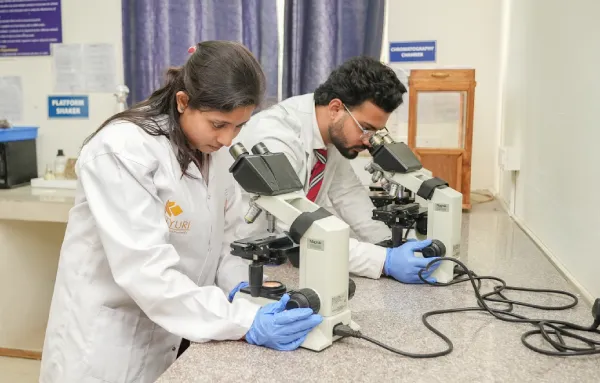
Students undergo extensive laboratory training, participate in design projects, receive UAV/Drone assembly and flight-testing training, and engage in hands-on experience through industry-certified programs.
Yes. The department regularly conducts guest lectures, workshops, internships and seminars with experts from ISRO, DRDO, NASA, BrahMos Aerospace, HAL, NAL, Airbus, and leading drone-technology companies.
Graduates receive excellent placement support, with opportunities in aerospace companies, drone industries, defence organizations, research institutions, and global aviation firms.
Yes. Students are provided internship opportunities through established industry collaborations with reputed national and international aerospace and drone organizations.
Students are trained in industry-standard tools such as MATLAB, Python, ANSYS, CFD software, CATIA, SolidWorks, XFLR5, OpenVSP, and specialized drone simulation tools.
Yes, undergraduate students are encouraged to participate in research projects, paper publications, innovation challenges, hackathons, and IPR-focused activities under faculty mentorship.
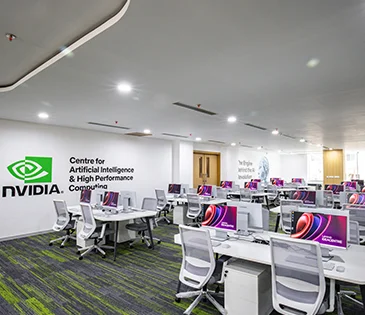
The department houses dedicated aerodynamics lab, structural lab, propulsion lab, high performance computing lab, aeromodelling lab, simulation facilities and many more.
Yes. Students are encouraged to participate in competitions related to aircraft design, UAV innovation, model rocketry, space technology, and robotics, supported by faculty mentorship.
Yes. The university offers merit-based and need-based scholarships according to university guidelines, subject to meeting eligibility criteria.
Graduates can work as aerospace engineers, space systems engineers, drone engineers, flight test engineers, propulsion specialists, avionics engineers, researchers, and technical officers in aviation and defence sectors or can go for higher education like M.Tech/MS or direct PhD.