
GEU

Frequently Asked Questions

The department offers M.Sc. Chemistry at the postgraduate level and Ph.D. Chemistry at the doctoral level, with strong emphasis on advanced learning and research.

Research areas include water chemistry, organic synthesis, inorganic and organometallic chemistry, nanomaterials, environmental and green chemistry, natural products, catalysis, chemosensors, biofuels, polymers, and analytical chemistry.

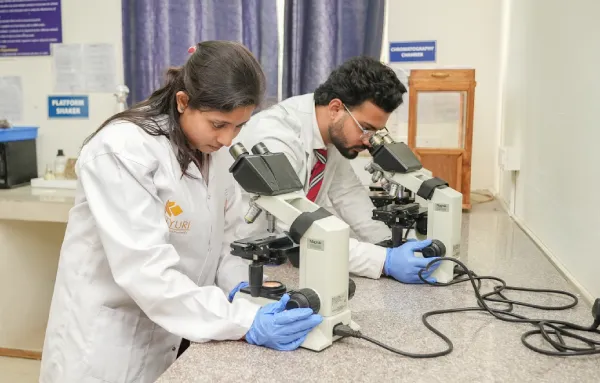
The department has well-equipped laboratories with facilities such as UV–Visible spectroscopy, zeta potential analyzer, chromatographic and electrochemical techniques, furnace, distillation assembly along with access to advanced characterization instruments.

Yes, both M.Sc. and Ph.D. students are actively encouraged to undertake research projects, publish papers in peer-reviewed journals, and present their work at national and international conferences.

Yes, the department offers academic mentoring and guidance for CSIR-NET, GATE, JAM, and Ph.D. entrance examinations, integrated with the curriculum.

Yes, the department promotes interdisciplinary research and collaboration with other departments such as life sciences, environmental sciences, and engineering within the university and with external institutions.

Graduates pursue careers in academia, research organizations, chemical and pharmaceutical industries, quality control, analytical laboratories, or opt for higher studies and doctoral research.

Yes, the department maintains interactions with industries, research laboratories, andacademic institutions through expert lectures, collaborative research, and training initiatives.

Yes, all academic and research activities are conducted in accordance with UGC regulations and NAAC-recommended outcome-based education practices.

The department focuses on academic excellence, research aptitude, ethical practices, communication skills, and professional competence, preparing students for diverse scientific careers.

The minimum duration is 3 years, and the maximum duration is generally 6 years, as per UGC regulations.

Candidates must have a Master’s degree in Chemistry or allied subjects with the required minimum marks and or qualify for UGC-NET/CSIR-NET/GATE or equivalent examinations, as per institutional norms.

Specializations include Organic, Inorganic, Physical, Analytical, Materials, and Interdisciplinary Chemistry.

Yes, coursework is mandatory during the initial phase of the programme, followed by a comprehensive examination.

Assessment includes coursework evaluation, research progress reviews, thesis submission, and viva-voce examination.

Yes, eligible candidates may receive fellowships such as UGC-JRF, CSIR-JRF, INSPIRE, or institutional fellowships, subject to availability.

Graduates can pursue careers in academia, research organizations, R&D industries, government laboratories, and scientific consultancy.

Yes, scholars are encouraged to publish their research in peer-reviewed national and international journals.

Yes, the programme is conducted in accordance with the latest UGC guidelines.

Yes, subject to institutional policies and UGC norms, working professionals may apply under permitted categories.

The M.Sc. Chemistry programme is of two years duration, consisting of four semesters, in accordance with UGC guidelines.

Candidates must have a B.Sc. degree with Chemistry as a core/major subject from a recognized university, with the prescribed minimum marks as per UGC norms.

Admission is based on merit followed by counseling, as per university regulations.

The programme covers Organic Chemistry.

Yes, the curriculum includes extensive laboratory courses, seminars, and a research project/dissertation in the final semester.

Students have access to well-equipped laboratories, advanced analytical instruments, library resources, and computational facilities.

Yes, students receive hands-on training in spectroscopic, electrochemical, chromatographic, and thermal analysis techniques.

Graduates can pursue careers in research and development, chemical and pharmaceutical industries, teaching, quality control, environmental analysis, or opt for doctoral studies and competitive examinations.

Yes, the programme is designed in compliance with UGC regulations and follows outcome-based education (OBE) principles recommended by NAAC.

Yes, the curriculum provides a strong foundation for Ph.D. programs, CSIR-NET, GATE, and other national and international competitive examinations.

Contact Us

GEU
GEU

566/6, Bell Road, Society Area,
Clement Town, Dehradun,
Uttarakhand