
GEU

Frequently Asked Questions

The department stands out due to its highly qualified faculty (81.25% Ph.D. holders), state-of-the-art laboratories, strong industry collaborations, excellent research output, and consistent placement performance.

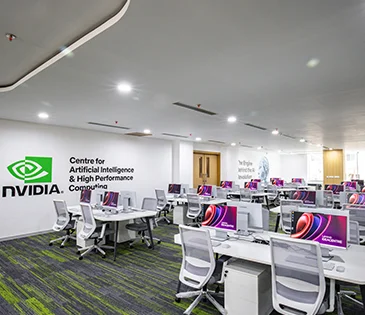
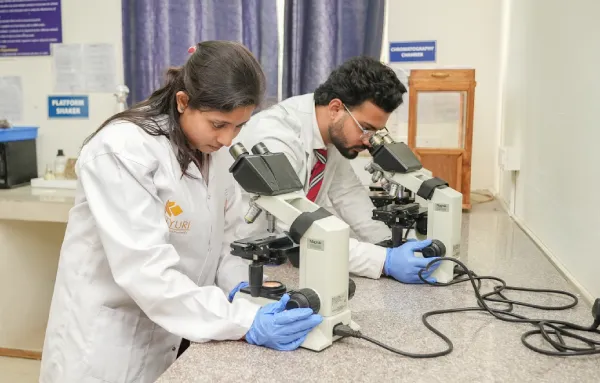
The department is equipped with advanced laboratories and industry-standard tools such as MATLAB (campus-wide license), Cadence, CST Studio, VT-CAD, OrCAD, Xilinx, and other modern EDA and simulation platforms.

Yes, the department has active MoUs and collaborations with reputed organizations including DRDO–DEAL, IIT Roorkee, Samsung PRISM, Altium Education, NIELIT (Govt. of India), DesignTech Systems, and Entuple Technologies.

The department has a strong placement record, with placements up to ₹20 LPA. Graduates are placed in domains such as VLSI, telecommunications, embedded systems, AI, IoT, and software engineering.

Yes, students actively participate in research projects, innovation challenges, funded research initiatives, and IEEE conferences, guided by experienced faculty members.

The department regularly organizes national and IEEE international conferences, including the IEEE DICCT series, along with workshops, FDPs, and expert talks supported by government agencies like SERB and DRDO.

Major research areas include VLSI and Semiconductor Devices, Wireless Communication and Microwave Engineering, IoT and Embedded Systems, and Electronic & Polymer Sensors.

Yes, students participate in industrial visits every semester, receive structured internship guidance, and gain hands-on industrial exposure through industry-aligned laboratory work.

Yes, graduates pursue higher education, research, entrepreneurship, and global careers, with alumni working in organizations across India, USA, and Japan.

The department encourages participation in technical clubs, cultural activities, leadership programs, IEEE activities, and innovation challenges for overall personality and professional development.

Yes, alumni actively engage through mentorship, guest lectures, career guidance, and testimonials, supporting current students in career planning and professional growth.

The department provides career counseling, professional development programs, internships, research guidance, and strong alumni mentorship to ensure lifelong learning and employability.

Yes. ECE offers opportunities in electronics, telecommunications, IT, automation, AI, robotics, and semiconductor industries, making it one of the most versatile engineering branches.

Absolutely. Many IT and software companies recruit ECE graduates due to their strong analytical, programming, and problem-solving skills.

Circuit design, programming (C/C++/Python), communication systems, problem-solving, teamwork, and proficiency with simulation tools.

Electrical Engineering focuses on power systems and electrical machines, whereas ECE emphasizes electronic components, communication systems, microprocessors, and embedded technology.

Yes, University encourage internships to enhance industry readiness.

Yes, coding is part of embedded systems, signal processing, and communication system simulations, but the branch is not purely software-oriented.

Candidates with a valid UGC-NET (Category 1, 2 or 3) or GATE score are exempted from the written test. However, they must attend the online interview.

  • Mode :  Online
  • Type : MCQ
  • Sections : 50% Research Methodology + 50% Subject-Specific (as per GATE/UGC-NET syllabus)
  • Qualifying marks : 50%
  • Interview : Same day (online), where candidates discuss their research interests.

Yes. Final-semester candidates can apply, but admission will be provisional until submission of final results.

Yes. The University offers: Rs. 36,000/month (for UGC-NET Category 1) Up to Rs. 32,000/month (for UGC-NET Category 2 & 3 or GEU Entrance Top Rankers) Meritorious Scholars’ Research Grant up to Rs. 2,00,000 per year Merit-cum-means tuition fee waivers

Scholars have access to:

  • Advanced laboratories & research centres
  • Technology Business Incubator support
  • Publication & patent guidance
  • International workshops and conferences
  • Experienced supervisors and interdisciplinary research culture

Yes. Part-Time applicants must submit a No Objection Certificate (NOC) from their employer.

Yes. Fee structure varies for Full-Time and Part-Time candidates.

All information—exam link, schedule, and interview details—will be sent to the registered mobile number and email.

Contact Us

GEU
GEU

566/6, Bell Road, Society Area,
Clement Town, Dehradun,
Uttarakhand