
GEU

Frequently Asked Questions

Students gain analytical skills, geological field and laboratory techniques, data interpretation, scientific communication, and problem solving relevant to Earth science applications.

Yes. Students can engage in independent and faculty led research projects, present findings at academic forums, and contribute to publications, enhancing academic and professional readiness.

Absolutely. The program covers critical topics such as hydrology, geochemistry, and environmental geology that underpin environmental and sustainability careers.

Candidates must have completed Class 12 with Physics, Chemistry, and Mathematics or Biology and meet the minimum percentage requirement as defined by the university.

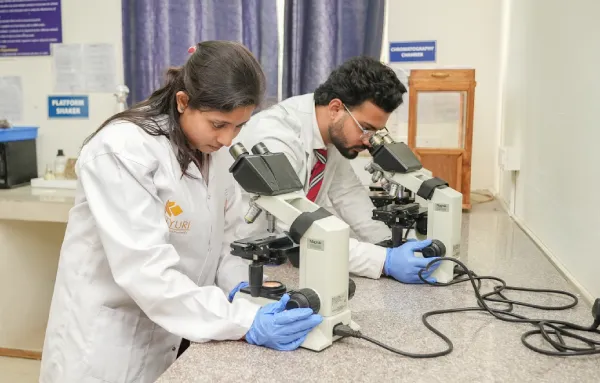
Yes. Extensive field mapping, geological surveys, and field-based projects are an integral part of the curriculum to provide hands-on experience.

Yes. Students can choose specializations such as Remote Sensing & GIS, Mineralogy, Mining Geology, Palaeontology, Geostatistics, Petroleum Geology, or Environmental Geology.

Yes. Students learn to use GIS, Remote Sensing software, geostatistical tools, and other analytical applications for geological investigation.

Graduates pursue careers in core engineering industries, R&D, higher education, startups, and public sector organizations

Yes. Graduates are well-prepared for M.Sc., M.Tech., or Ph.D. programs in Geology, Applied Geosciences, Environmental Sciences, and related research fields.

Through a combination of practical laboratory work, field projects, software training, and exposure to industry-oriented topics, students develop skills directly applicable to professional geoscience roles.

Contact Us

GEU
GEU

566/6, Bell Road, Society Area,
Clement Town, Dehradun,
Uttarakhand