
GEU
facilities
Level
Undergraduate
facilities
Duration
2 Years
facilities
Fee Structure
Click Here
M.B.A Business Analytics Program

Admission Procedure

Bachelor's degree in any discipline from a recognised university

Provisional Admission

Admission will be granted by the university on the basis of entrance test scores, and personal interview.as per merit decided by the university.

About The Program

Welcome to the Department of Management Studies at Graphic Era (Deemed to be) University, where we are celebrating 25 years of excellence in research and education! The Department of Management Studies was established in 2003. Ranked 52 among the top management colleges in India by NIRF 2025 and awarded a Diamond rating by QS I-Gauge, the Department of Management Studies, at Graphic Era (Deemed to be University), is a renowned department that provides a transformative educational experience to its students and prepares them for successful careers.

The department encourages a multi-disciplinary perspective by providing opportunities to learn from other departments of the University. With a focus on global business practices and international exposure, the Department of Management Studies (DOMS), Graphic Era (Deemed to be University) prepares students to become technology driven top managers, future business leaders, and entrepreneurs who can navigate and succeed in diverse cultural, technological, and economic environments.

Recognising the growing importance of data-driven decision making, Artificial Intelligence, and digital transformation across industries, the MBA Business Analytics curriculum also integrates contemporary learning in analytics, AI, emerging technologies, and modern business tools that are increasingly valued by employers worldwide. This helps students develop the ability to understand both business strategy and the technological shifts shaping the future of organisations.

Graphic Era is shaping the future of learning through its world-class Centres of Excellence, designed to equip students with industry-ready skills and hands-on expertise in business analytics:

  • AWS Skill Builder University Campus and the nation's First Future Ready GenAI Campus, enabling next-generation learning in Cloud Computing, Cloud-native solutions, Generative AI, and scalable digital solutions
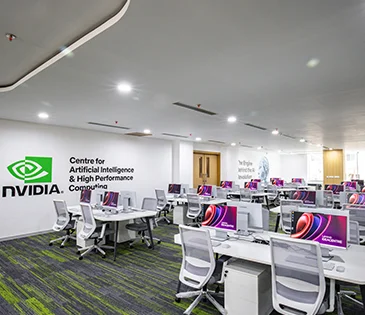
  • Centre for Artificial Intelligence & High-Performance Computing, established in collaboration with NVIDIA, fostering innovation in AI, Deep Learning, and advanced computing technologies
  • iOS Development Center, powered by Apple and Infosys, empowering students to design and develop cutting-edge applications for the Apple ecosystem

Eligibility

  • Bachelor's degree in any discipline from a recognised university
  • Minimum 50% aggregate marks (45% for SC/ST candidates)
  • Valid CAT/MAT/XAT/CMAT/GMAT/GEU Entrance Test score
  • Admission will be granted by the university on the basis of entrance test scores, and personal interview.as per merit decided by the university.

Teaching Pedagogies

The Department of management studies adopts innovative, student-centric teaching pedagogies designed to enhance conceptual understanding, practical proficiency, and industry readiness. Our approach integrates modern educational practices with emerging technologies to create an engaging, outcome-driven learning environment. Key pedagogical practices include:

  • Outcome-Based Education (OBE): All courses are structured around clearly defined learning outcomes to ensure measurable academic and professional growth.
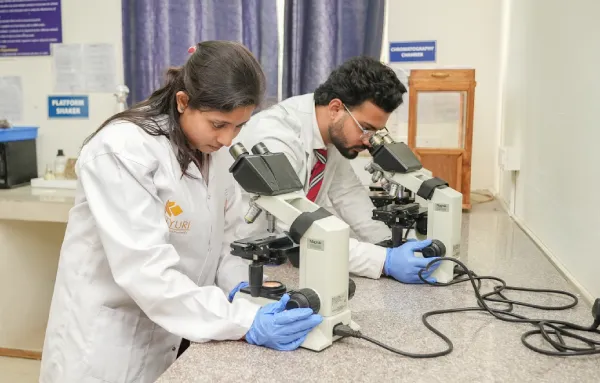
  • Experiential & Hands-On Learning: Strong emphasis is placed on practical learning through workshops, simulations, live projects, case analysis, analytics labs, and tool-based learning experiences.
  • Project-Based & Problem-Based Learning: Students work on industry-relevant problems, case studies, mini-projects, business simulations, and capstone projects to develop analytical thinking and solution-oriented skills.
  • Flipped Classroom & Blended Learning: Classroom time is enhanced through pre-class digital content, interactive discussions, collaborative exercises and applied learning activities.
  • Industry-Academia Engagement: Regular expert lectures, corporate interactions, masterclasses, internships, certifications, and industry collaborations provide valuable real-world exposure.
  • Use of Modern ICT Tools: Smart classrooms, LMS platforms, physical and virtual labs, AI development labs, data visualisation platforms, business simulation tools, and industry-standard coding environments support interactive and technology-driven learning.
  • Research-Oriented Teaching: Students are encouraged to explore emerging trends, publish research papers, participate in hackathons, and engage in innovation-driven initiatives.
  • Continuous Assessment & Feedback: Frequent quizzes, assignments, presentations, reviews, peer evaluations, and faculty mentoring help monitor progress and encourage continuous improvement.
  • Skill Development & Holistic Learning: Equal emphasis is placed on communication skills, teamwork, leadership, professional ethics, adaptability, and lifelong learning to prepare students for dynamic global careers.
#row2#

Program Educational Objectives (PEOs)

PEO1

To produce graduates having knowledge, ability and skill to apply basic principles of management to plan, execute, monitor and evaluate business operations.

PEO2

To develop analytical aptitude and techno-managerial skills among students for effective coordination and communication for managing business organisations.

PEO3

To inculcate leadership qualities, interpersonal skills and professional traits among the students to work individually and in team.

PEO4

To sensitise the students towards issues like personal & professional ethics, environment conservation, culture and socio-political settings of immediate surroundings.

Program Outcomes (POs)

PO1

Apply knowledge of management theories and practices to solve business problems.

PO2

Foster Analytical, critical thinking and techno-managerial abilities for data-based decision making.

PO3

Ability to develop Value based Leadership ability.

PO4

Ability to understand, analyse and communicate global, economic, legal, and ethical aspects.

PO5

Ability to lead themselves and others in the achievement of organisational goals, contributing effectively to a team environment.

PO6

Ability to develop entrepreneurial skills using innovative practices.

Career Pathways

With the growing demand for highly skilled management professionals across industries, MBA graduates can explore a wide range of leadership, functional, analytical, and consulting roles in corporates, MNCs, startups, banks, fintech, consulting firms, government organisations, and emerging digital enterprises.

Graduates may pursue the following opportunities:

Analytics, AI and Technology-Enabled Roles
  • Business Analyst
  • Data Analyst
  • Marketing Analyst
  • Financial Analyst
  • Product Analyst
  • Data Insights Specialist
  • BI Consultant
  • AI Project Coordinator
Senior Leadership (with experience)
  • Chief Executive Officer (CEO)
  • Chief Financial Officer (CFO)
  • Chief Operating Officer (COO)
  • Chief Human Resources Officer (CHRO)
Management, Strategy and Consulting
  • Management Trainee
  • Business Consultant
  • Strategy Associate
  • Operations Manager
  • Project Manager
  • Entrepreneur / Startup Founder
Marketing and Growth Roles
  • Marketing Manager
  • Brand Manager
  • Digital Marketing Specialist
  • SEO & SEM Analyst
  • Social Media Manager
  • Content Strategist
  • Sales Manager
Finance and Banking Roles
  • Finance Officer
  • Finance Consultant
  • Investment / Research Analyst
  • Banking Operations Manager
  • Risk and Compliance Executive
  • Fintech Associate
Human Resource Roles
  • HR Business Partner
  • Talent Acquisition Specialist
  • Learning & Development Manager
  • HR Analyst
  • Organisational Development Consultant
Sector-Specific Opportunities
  • Hospital Administrator
  • Healthcare Operations Manager
  • Supply Chain Manager
  • Aviation Business Analyst
  • Airport Operations Manager
  • Cargo Operations Head
  • Retail Operations Manager

Course Curriculum

Trimester 1

  • Management Concepts and Organisational Behaviour
  • Business Environment
  • Managerial Economics
  • Financial Statement Analysis and Reporting
  • Marketing Management
  • Professional Communication
  • Statistics for Business
  • Introduction to Python and Excel
  • MOOC

Trimester 2

  • Human Resource Management
  • Supply Chain Management
  • Financial Management
  • International Business
  • Retail and E-commerce Management
  • Business Analytics with Python
  • Career and Life Skills-I
  • Power Apps / Certification / MOOCs

Trimester 3

  • Operations Management
  • Corporate Legal Environment
  • Business Research & Intelligence
  • Career and Life Skills-II
  • Advanced Excel / MOOCs / Certification
  • Discipline Elective
  • Specialisation Elective-I
  • Specialisation Elective-II
  • Specialisation Elective-III

Trimester 4

  • Strategic Management
  • Artificial Intelligence for Managers
  • Specialisation Elective-IV
  • Specialisation Elective-V
  • Specialisation Elective-VI
  • Specialisation Elective-VII
  • Career and Life Skills-III
  • Summer Internship Project
  • MOOCs / Certification

Trimester 5

  • Project Management
  • Entrepreneurship & Innovation
  • Specialisation Elective-VIII
  • Specialisation Elective-IX
  • Specialisation Elective-X
  • Specialisation Elective-XI

Trimester 6

  • 1. Business Analytics Capstone Project/Venture Creation/Family Business Management-Dissertation

Business Analytics Elective Courses

  • Applied Programming for Business Analytics
  • Machine Learning for Strategic Decision Making
  • Deep Learning for Business
  • Natural Language Processing for Business
  • Generative AI and Large Language Models for Business Applications
  • Predictive Analytics for Competitive Advantage
  • Product Management for Tech-Driven Businesses
  • Prompt Engineering & AI Interaction Design
  • Big Data Analytics
  • Business Intelligence & Data-Driven Decisions
  • Data Warehousing and ETL
  • Financial Analytics & Valuation Using Data
  • Web and Digital Marketing Analytics
  • AI Strategy and Digital Transformation
  • Data Governance, Ethics, and Regulatory Framework of AI
  • Exploratory Data Analysis
  • Cloud Computing & Scalable Infrastructure
  • Operations Analytics & Supply Chain Optimisation

Frequently Asked Questions

The programme is of 2 years (6 trimesters) duration, designed in accordance with applicable UGC/AICTE norms. The trimester system enables focused learning, continuous assessment, and wider course coverage.

Candidates must have completed graduation from a recognised university/institution. Admission is based on merit, qualifying entrance test scores as applicable, and personal interview conducted by the University.

After completing an M.B.A., graduates can explore a wide range of career opportunities across industries. Popular roles include Business Analyst, Consultant, Marketing Manager, Finance Executive, HR Manager, Operations Manager, Strategy Associate, and Entrepreneurial ventures. Banking, fintech, and insurance offer strong financial and analytical career opportunities. Graduates may also build careers in marketing, branding, retail management, aviation, hospital administration, healthcare, sports management, and other specialised sectors. With growing industry demand for digital and data-led decision making, graduates may also pursue emerging opportunities in analytics, digital products, fintech, digital marketing, and technology-enabled management roles.

The MBA curriculum covers key areas of management such as Applied Programming, Machine Learning, Deep Learning, Natural Language Processing, Generative AI, LLM, Business Analytics along with Strategy, Economics, Finance, Marketing, Human Resource Management, Operations, Entrepreneurship, and Business Environment. Specialisations offer students the opportunity to learn niche sectors such as aviation, hospital administration, retail and sports management, and other latest industry-relevant disciplines. In addition, the MBA programme offers contemporary exposure to research projects, internships, certifications, and capstone learning experiences aligned with current industry needs.

Graphic Era offers a strong industry-oriented curriculum, academic environment, experienced faculty, modern infrastructure, innovation ecosystem, and growing focus on emerging areas such as Analytics, AI, and Digital Transformation. Students benefit from practical exposure through projects, internships, certifications, and career development support.

Contact Us

GEU
GEU

566/6, Bell Road, Society Area,
Clement Town, Dehradun,
Uttarakhand