GEU
facilities
Level
Postgraduate
facilities
Duration
2 Years
M.Sc. Agriculture (Genetics and Plant Breeding)

Admission Procedure

Merit prepared on basis of the qualifying exam

Provisional Admission

2 years Duration, in accordance with UGC/AICTE norms.

About The Program

The M.Sc. Agriculture Genetics and Plant Breeding programme prepares students to become seed scientists, plant breeders, researchers, germplasm conservers, biotechnologist, consultants, entrepreneurs and leaders capable of addressing emerging challenges related to crop improvement, food security, nutritional security, seed sectors, genetic resource conservation, climate resilience and sustainable agricultural development in diverse environmental and socio-economic conditions.

The programme provides students with opportunities to learn and conduct field-based and laboratory-based research related to plant breeding techniques, hybridization, molecular breeding, seed technology, crop improvement, genetic analysis, and biotechnology applications in agriculture. It also focuses on advanced farmer-oriented technologies and modern breeding approaches that enhance crop productivity, quality, adaptability and sustainable agricultural production systems.

Eligibility Criteria for Admission in the Program

B.Sc. Agriculture or B.Sc. (Honours) Agriculture/ Forestry

Teaching Pedagogies

The M.Sc. Agriculture (Genetics and Plant Breeding) program at the School of Agriculture, Graphic Era adopts advanced, research-oriented, and student-centric teaching pedagogies aimed at developing scientific expertise, analytical abilities, and innovation in genetics, biotechnology, and crop improvement. The program integrates modern breeding technologies, laboratory-based learning, and interdisciplinary approaches to create a comprehensive and outcome-driven academic environment. Key pedagogical practices include:

  • Outcome-Based Education (OBE): The curriculum is designed around clearly defined learning outcomes to ensure advanced conceptual understanding, research competency, and professional growth in genetics and plant breeding.
  • Research-Oriented Teaching and Learning : Strong emphasis is placed on research methodology, experimental design, biometrical analysis, molecular techniques, scientific writing, and thesis-based learning to develop independent research and innovation capabilities among students.
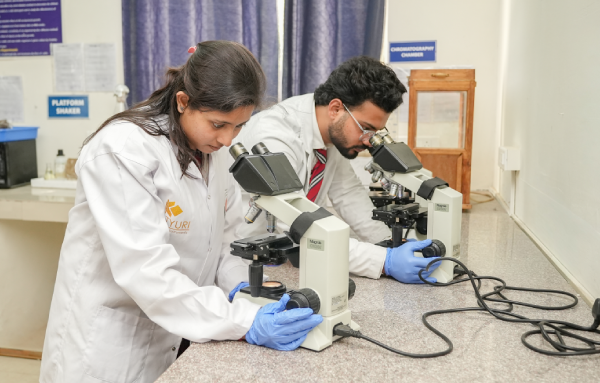
  • Field & Laboratory-Based Practical Training : Students receive extensive practical exposure through hybridization techniques, germplasm evaluation, seed production, cytogenetics, molecular marker analysis, tissue culture, and field breeding trials for crop improvement programs.
  • Experiential & Hands-On Learning : The program emphasizes experiential learning through plant breeding experiments, molecular biology practices, biotechnology applications, phenotyping studies, and crop improvement demonstrations.
  • Problem-Solving & Analytical Learning : Teaching methodologies focus on addressing real-world agricultural challenges related to crop productivity, genetic variability, disease resistance, abiotic stress tolerance, and climate-resilient crop breeding through case studies and research-based problem-solving activities.
  • Use of Modern Technologies and ICT Tools : Advanced ICT-enabled teaching, smart classrooms, bioinformatics tools, molecular breeding techniques, statistical software, genomics applications, and biotechnology laboratories are integrated into teaching and research activities.
  • Seminars, Journal Discussions & Scientific Presentations : Students actively participate in seminars, technical presentations, journal reviews, workshops, and scientific discussions to strengthen critical thinking, scientific communication, and professional confidence.
  • Industry, Research & Institutional Interaction : Regular interaction with plant breeders, geneticists, biotechnology experts, seed industry professionals, and researchers from national and international organizations provides exposure to emerging trends and innovations in crop improvement.
  • Continuous Assessment & Academic Mentoring : Student performance is continuously evaluated through assignments, practical records, laboratory work, seminars, research reviews, viva voce examinations, presentations, and faculty mentoring to ensure continuous academic and professional development.
  • Skill Development & Professional Competence : Equal emphasis is placed on leadership, teamwork, communication skills, ethical research practices, entrepreneurship, and lifelong learning to prepare students for careers in research, academia, seed industries, biotechnology sectors, and agricultural development organizations.

Program Educational Objectives (PEOs)

PEO1

To produce postgraduates with advanced knowledge and technical expertise in genetics, plant breeding, biotechnology, seed science, molecular breeding, and crop improvement for developing high-yielding, climate-resilient, and quality crop varieties.

PEO2

To develop research aptitude, analytical thinking, and problem-solving abilities among students through scientific experimentation, biometrical analysis, molecular techniques, and modern breeding approaches for addressing emerging agricultural challenges.

PEO3

To prepare graduates for higher education, advanced research, teaching, and professional careers in agricultural universities, research institutions, seed industries, biotechnology sectors, and allied organizations at national and international levels in accordance with ICAR standards.

PEO4

To inculcate leadership qualities, scientific communication skills, professional ethics, and interdisciplinary competencies among students for effective teamwork, technology dissemination, and sustainable agricultural development.

PEO5

To promote innovation, entrepreneurship, and application of modern genetic and breeding technologies for sustainable crop improvement, seed production, biodiversity conservation, and enhancement of food and nutritional security.


Program Outcomes (POs)

PO1

Apply advanced knowledge of genetics, plant breeding, cytogenetics, molecular biology, biotechnology, biometrical genetics, and seed science for crop improvement and sustainable agricultural development.

PO2

Design, conduct, analyze, and interpret laboratory and field experiments using scientific methodologies, statistical tools, molecular techniques, and bioinformatics approaches in genetics and plant breeding research.

PO3

Develop innovative and climate-resilient crop improvement strategies for enhancing productivity, quality, disease resistance, stress tolerance, and genetic diversity through conventional and modern breeding approaches.

PO4

Demonstrate effective scientific communication, leadership, teamwork, extension abilities, and professional ethics for successful interaction with researchers, farmers, industries, and policy stakeholders.

PO5

Engage in lifelong learning, advanced research, seed industry development, biotechnology applications, and agripreneurship through the adoption of emerging technologies and sustainable breeding practices.

Program Specific Outcomes (PSOs)

PSO1

To provide basic knowledge of principles and processes involved in growth, evolution and classification of various microorganisms, plants and animals.

PSO2

To develop the postgraduates with essential skills  in handling and processing living cells (microbes, plants and animals)

PSO3

To inculcate ability to solve problems related to society, health, environment, agriculture and food.

PSO4

To develop scientific temper, communication skill and ethical practices and biosafety guidelines in the pursuit of sciences

Career Pathways

Postgraduates in Agriculture Genetics and Plant Breeding program from the School of Agriculture at Graphic Era University can pursue diverse career opportunities in research, academics, seed industries, biotechnology sectors, government organizations, and entrepreneurship.

  • Crop Improvement Specialist
  • Scientist & Research Associate
  • Seed Production and Quality Assurance Officer
  • Molecular Breeding and Biotechnology Specialist
  • Agricultural Biotechnologist
  • Research and Development (R&D) Professional
  • Agricultural Officer
  • Agri-startup Founder
  • Genetic Resource and Germplasm Conservation Expert
  • Academic Professional in universities and higher educational institutions
  • Bioinformatics Professional in genomics, molecular breeding, and precision agriculture sectors
  • Advanced Research Opportunities in genetics, plant breeding, biotechnology, and allied agricultural sciences

Course Curriculum

Semester 1

  • Principles of Genetics
  • Principles of Plant Breeding
  • Crop Breeding-1
  • Experimental Design
  • Basic Biochemistry
  • Basic Concepts in Laboratory Techniques
  • Agriculture Research, Research Ethics and Rural Development Programmes

Semester 2

  • Fundamentals of Quantitative Genetics
  • Principles of Cytogenetics
  • Molecular Breeding and Bioinformatics
  • Crop Breeding -II (Rabi Crops)
  • Varietal Development and Maintenance Breeding
  • Intellectual Property and its management in Agriculture
  • Master’s Thesis Research

Semester 3

  • Fundamentals of Quantitative Genetics
  • Principles of Cytogenetics
  • Breeding for Quality and Special Traits
  • Breeding for Stress Resistance and Climate Change
  • Library and Information Services
  • Technical Writing and Communications Skills
  • Master’s Thesis Research

Semester 4

  • Master’s Thesis Research
  • Master’s Seminar

Contact Us

GEU
GEU

566/6, Bell Road, Society Area,
Clement Town, Dehradun,
Uttarakhand